
Reading time: 17 min
Key Takeaways
- Shade flowers can fill dark borders with color if you match them to light.
- Shade-loving perennials like astilbe, bleeding heart, and torenia are the backbone of low-light gardens.
- Full shade, partial shade, and dappled shade need different plant choices.
- Seasonable bloom planning with spring, summer, and fall flowers keeps color going all year.
Does your garden have a dark, empty corner where nothing seems to bloom? The problem might not be your gardening skills — it’s your plant selection. Most people assume shade means no flowers, but dozens of shade flowers, shade-loving perennials, and annuals thrive in low light. In my experience, once you understand your exact light level and choose accordingly, a north-facing bed can carry color from spring to fall. Let me show you what actually works.
What Does “Shade” Actually Mean in a Garden?
Before you buy a single plant, look at how much sun reaches the soil. According to White Flower Farm, part shade is casually defined as 3-4 hours of sun per day; full shade receives no direct sun at all (n.d.). That distinction changes everything. A spot that gets only morning light behaves very differently from a bed that bakes in harsh afternoon sun.
Partial Shade vs. Full Shade vs. Dappled Shade
| Light Level | Definition | Example Location | Best Plant Types |
|---|---|---|---|
| Full shade | No direct sun; bright indirect light all day | North side of house, under dense trees | Hosta, bleeding heart, tiarella, astilbe |
| Partial shade | 3-4 hours of direct sun, ideally in the morning | East-facing foundation, under high-branched trees | Primrose, astilbe, brunnera, hydrangea |
| Dappled shade | Filtered sunlight through leaves or lattice all day | Beneath open maples, pergola, woodland edge | Toad lily, pulmonaria, ferns, wild ginger |
| Deep shade | Very little light; almost no direct sun | Under stairs, evergreen canopy, narrow alleys | Few flowers; use ferns, ivy, dry-shade sedges |
How to Measure Light in Your Yard
Don’t guess. On a clear day, check the spot every two hours from 9 a.m. to 5 p.m. and write down sun or shade. Do it again in July, when the sun’s angle is highest. What most people get wrong is measuring at eye level — the plant lives at soil level, so crouch down and look up. The plant will tell you if you got it wrong: leggy growth and burned leaves are clues.
Now that you know your shade type, let’s meet the stars — 27 shade flowers that bloom without full sun.
27 Best Shade Flowers That Bloom Without Full Sun
Here is the answer to the question I hear most: what flowers bloom all summer in shade? These are the strongest performers for low-light gardens.
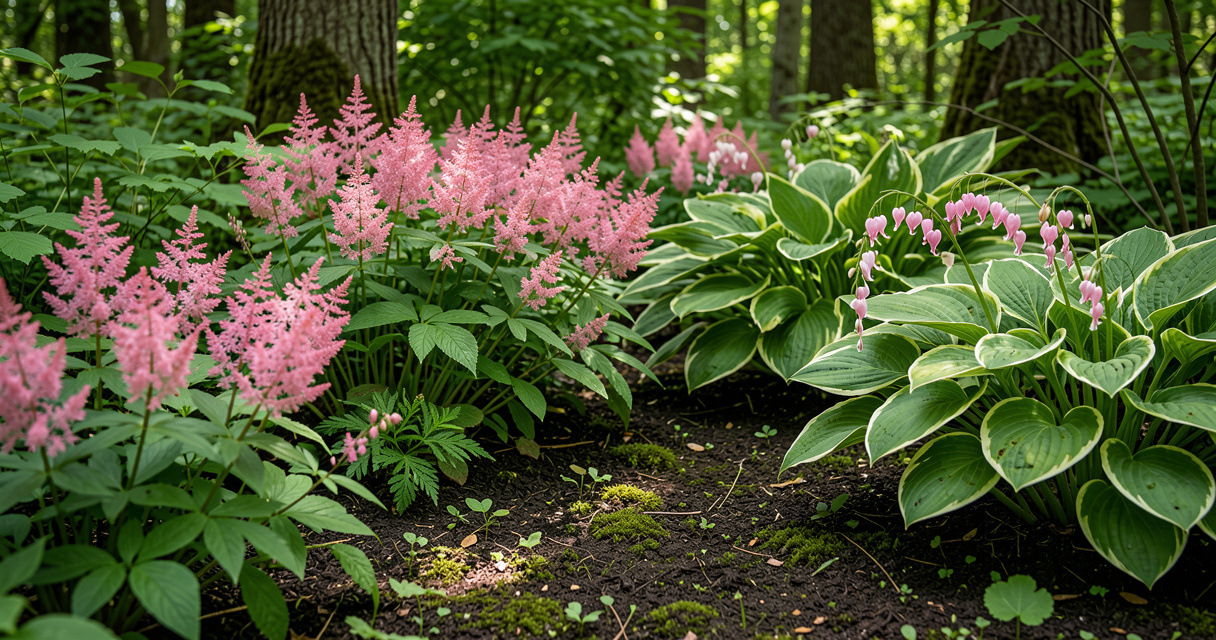
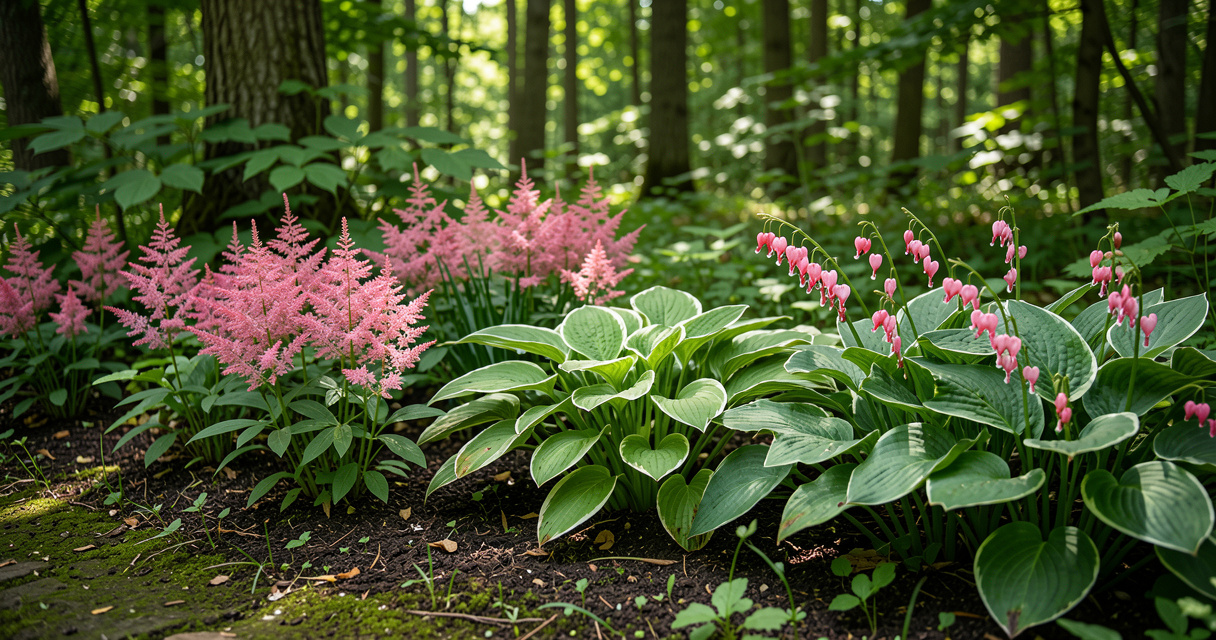
- Astilbe: feathery plumes in pink, red, and white
- Hosta: bold foliage with lavender or white flower spikes
- Bleeding heart: heart-shaped flowers on arching stems in spring
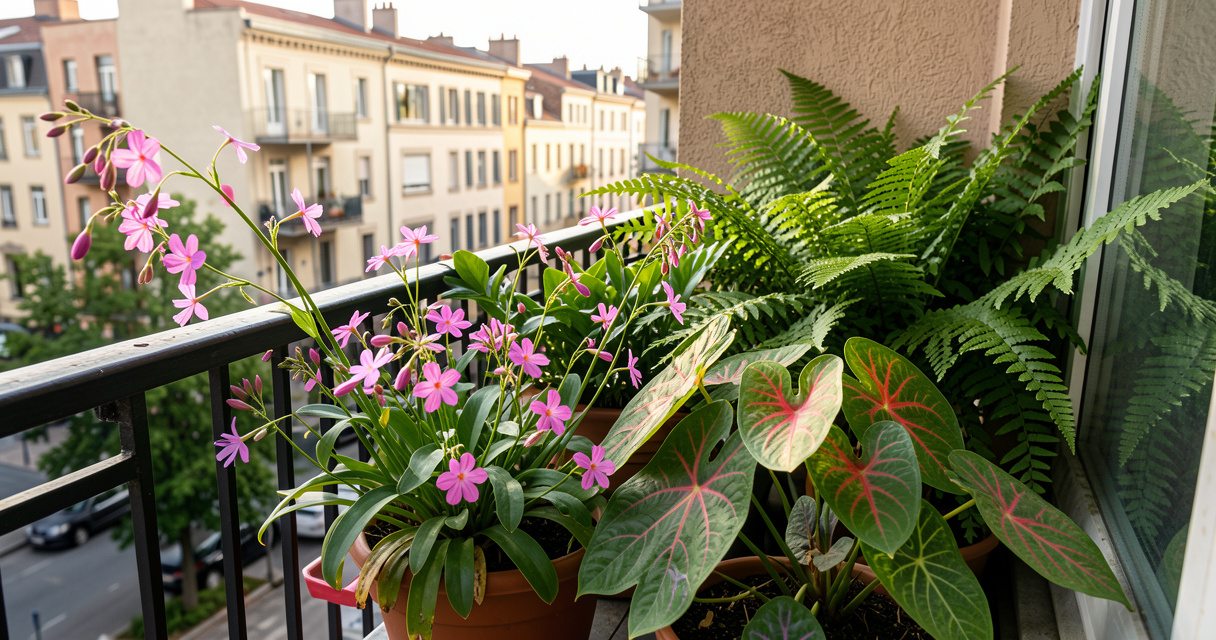
- Wishbone flower: low-maintenance annual with snapdragon-like blooms all summer
- Primrose: early spring color in partial to full shade
- Caladium: colorful foliage for shaded beds and containers
- Toad lily: orchid-like late-summer flowers
- Jacob’s ladder: blue bell-shaped flowers and ladder-like foliage
The question I hear most often is, what flowers can grow in shade? The list is longer than you think. I’ve organized the 27 best by plant type, with USDA zones, bloom time, and height. This is the directory I wish I’d had when I started.
Perennial Shade Flowers
Perennials are the backbone of any shade garden. These return year after year and form the structure of a woodland garden: astilbe, hosta, bleeding heart, tiarella, pulmonaria, toad lily, Japanese anemone, brunnera, primrose, hardy geranium, heuchera, and Jacob’s ladder. Some perennials go dormant after blooming — bleeding heart often vanishes by midsummer — so plant ferns and hostas nearby to fill that space.
Annual Shade Flowers
Annuals are the quickest way to add color. In full shade, impatiens and begonias bloom continuously until frost. Torenia, also known as wishbone flower, is a great low-maintenance annual. According to Garden Design, wishbone flower is an annual for zones 10-11 that grows 8-16 in tall and trails up to 36 in, thriving in partial sun to shade (n.d.). Fuchsia, lobelia, browallia, New Guinea impatiens, and coleus round out the list.
Bulbs and Tubers for Shade
Bulbs and tubers give you early color and bold foliage. Caladium, tuberous begonia, and hardy cyclamen all tolerate shade. Plant spring bulbs like scilla and glory-of-the-snow in drifts for a naturalized look; winter aconite and lily of the valley will also naturalize in a moist, humus-rich corner.
Here is the complete at-a-glance list, including hardiness zones and bloom time.
| Plant | Type | USDA Zones | Bloom Time | Height | Light Needs |
|---|---|---|---|---|---|
| Astilbe | Perennial | 4-8 | June-Aug | 12-36 in | Full to partial shade |
| Hosta | Perennial | 3-9 | July-Aug | 8-36 in | Full shade to partial |
| Bleeding heart | Perennial | 3-9 | April-May | 24-30 in | Full to partial shade |
| Tiarella | Perennial | 3-8 | April-June | 6-12 in | Full to partial shade |
| Pulmonaria | Perennial | 3-8 | March-May | 8-18 in | Dappled to full shade |
| Toad lily | Perennial | 4-8 | Aug-Oct | 24-36 in | Partial to full shade |
| Japanese anemone | Perennial | 4-8 | Aug-Oct | 36-48 in | Partial shade |
| Brunnera | Perennial | 3-8 | April-May | 12-18 in | Partial to full shade |
| Primrose | Perennial | 3-8 | March-May | 6-12 in | Partial shade |
| Geranium macrorrhizum | Perennial | 4-8 | May-June | 12-18 in | Partial shade |
| Heuchera | Perennial | 4-9 | May-July | 8-18 in | Partial shade |
| Jacob’s ladder | Perennial | 3-8 | April-June | 12-30 in | Partial to full shade |
| Impatiens | Annual | 10-11 | June-frost | 12-24 in | Full shade to partial |
| Begonia | Annual | 9-11 | June-frost | 6-12 in | Partial to full shade |
| Torenia | Annual | 10-11 | June-frost | 8-16 in, trails 36 in | Partial sun to shade |
| Fuchsia | Annual | 10-11 | June-frost | 12-24 in | Partial shade |
| Browallia | Annual | 10-11 | June-frost | 12-18 in | Partial to full shade |
| Lobelia | Annual | 10-11 | June-frost | 6-10 in | Partial shade |
| Coleus | Annual | 10-11 | Foliage; small flowers | 12-36 in | Shade to partial |
| New Guinea impatiens | Annual | 10-12 | June-frost | 12-18 in | Partial shade |
| Caladium | Tuber | 9-11 | Foliage | 12-24 in | Full shade to partial |
| Tuberous begonia | Tuber | 9-11 | June-frost | 10-18 in | Partial shade |
| Hardy cyclamen | Tuber | 5-9 | Sep-Nov | 4-6 in | Dappled to full shade |
| Scilla | Bulb | 2-8 | March-April | 4-6 in | Full to partial shade |
| Glory-of-the-snow | Bulb | 2-8 | March-April | 4-6 in | Partial shade |
| Lily of the valley | Bulb | 2-7 | May | 8-12 in | Dappled to full shade |
| Winter aconite | Bulb | 3-7 | Jan-March | 3-6 in | Full to partial shade |
Let me give you a real example. A friend from a community garden in Haarlem had a north-facing foundation bed that seemed hopeless. We planted astilbe, hosta, and bleeding heart in layered drifts. By midsummer, the astilbe plumes and hosta flowers were so full that people asked what they had done. The answer wasn’t magic — it was matching the plants to the light.
Once you see the options, the next question is whether to build with perennials or refresh with annuals.
Annual vs. Perennial Shade Flowers: Which Should You Choose?
If you’ve ever stood in a garden center wondering whether to buy the long-lived perennial or the colorful annual, you’re not alone. Both have a place. In my experience, the strongest shade gardens combine the two: perennials provide structure, annuals fill gaps, and together they guarantee color from June to frost.
Long-Term Value of Perennials
Shade-loving perennials cost more at first but pay you back for years. You can divide astilbe and hosta, share with neighbors, and watch the border mature. Their bloom windows may be shorter, but foliage like heuchera and hosta carries the spot all season. Don’t overthink it: if you’re building a permanent bed, start with perennials.
Instant Color with Annuals
Annuals are the quick fix. In full shade, impatiens and begonias are foolproof. If you want long-blooming shade flowers for containers, torenia and New Guinea impatiens will flower until frost. The trade-off is simple: you’ll replant next year, but you get instant color now.
| Type | Lifespan | Bloom Season | Maintenance | Best For |
|---|---|---|---|---|
| Perennials | Return every year | Weeks to months, depending on species | Low once established; divide every 3-4 years | Permanent borders, structure, wildlife |
| Annuals | One growing season | Continuous until frost | Moderate; water, feed, deadhead | Containers, instant color, small spaces |
No single answer works for every spot. Use perennials for backbone and annuals for polish, and you’ll get the best of both.
Full Shade vs. Partial Shade: The Best Plants for Each Light Level
What most people get wrong is thinking “full shade” means “no light at all.” Full shade still has bright indirect light. A spot under a tree with a clear sky above is different from a covered alley, and the plants below expect that difference.
Full Shade All-Stars
In truly full shade, the reliable flowering perennials are hosta, bleeding heart, tiarella, and astilbe. They don’t need direct sun to photosynthesize well; they need moisture and good soil. If the soil is dry and rooty, tackle that first — no full shade perennial will thrive with zero water.
Partial Shade Favorites
Partial shade opens more doors. Primrose, brunnera, and Japanese anemone are all happier with a few hours of morning sun. Can hydrangeas grow in full shade? They can survive, but they bloom best with some morning light. The same is true for many “shade” plants — a little sun makes flowers richer.
| Plant | Light Tolerance | Soil Needs | Landscape Use |
|---|---|---|---|
| Hosta | Full shade to partial | Moist, well-drained | Borders, containers |
| Bleeding heart | Full shade to partial | Rich, moist | Woodland, cottage |
| Astilbe | Full shade to partial | Moisture-retentive | Damp shade, borders |
| Tiarella | Full to partial | Humus-rich | Groundcover, edge |
| Primrose | Partial shade | Moist, cool | Edges, containers |
| Wishbone flower | Partial sun to shade | Well-drained | Baskets, containers |
| Hydrangea | Partial shade (morning sun best) | Moist, acidic | Foundation, hedge |
Matching light matters, but the real secret is timing bloom waves across the seasons.
Spring, Summer, and Fall Shade Flowers: A Season-by-Season Bloom Calendar
A shade garden that only blooms in May gets dull by August. The secret to season-long color is planting for bloom succession: spring ephemerals, summer perennials, and late bloomers.
Early Spring Bloomers
Spring is when shade gardens shine. Bleeding heart, pulmonaria, and primrose open as the soil warms. According to The Spruce, tiarella blooms for about six weeks in spring and thrives in full or partial shade, USDA zones 3-8 (n.d.). Plant these around the base of deciduous trees before the canopy fills in.
Summer Color
Summer in shade is all about moisture and texture. Astilbe plumes and hosta flower spikes last for weeks, especially if the soil stays moist. Add annuals like torenia and begonia for uninterrupted color, and you’ll have long-blooming shade flowers all the way to September.
Late Season Flowers
Autumn doesn’t have to end the show. According to The Spruce, toad lilies grow 2-3 ft tall and bloom from late summer to early fall in partial sun to full shade, USDA zones 4-8 (n.d.). Japanese anemones and hardy cyclamen follow, turning a shaded border into a late-season highlight.
| Season | Plant | Bloom Time | USDA Zones |
|---|---|---|---|
| Spring | Bleeding heart, pulmonaria, primrose, tiarella | March-May | 3-8 |
| Summer | Astilbe, hosta, torenia, begonia | June-Aug | 3-10 depending on plant |
| Fall | Toad lily, Japanese anemone, hardy cyclamen | Aug-Oct | 4-9 depending on plant |
- Map your light level before buying anything.
- Pick 3-4 plants for each season.
- Include foliage anchors like hosta and ferns.
- Add annuals in gaps for instant color.
- Record bloom times in a garden journal.
With your plant list ready, let’s talk about how to actually plant and keep them thriving.
Planting and Care Essentials for Shade Flowers
Shade garden soil is often surprisingly dry because tree roots and roof overhangs block rain. In my experience, most failures come down to planting without improving the soil first.
Preparing the Soil
The best soil for a shade garden is rich, crumbly, and well-drained but moisture-retentive. That sounds contradictory, but compost solves it. Spread 2-3 inches of compost over the bed, dig it in lightly, and let soil organisms do the work. I studied plant biology at Wageningen; soil structure is everything.
Watering and Mulching
New plantings need deep, regular watering for their first two seasons. Then mulch with shredded leaves or bark — a 2-3 inch layer keeps roots moist and suppresses weeds. In dry shade, mulch is not optional; it’s the difference between thriving and surviving.
Deadheading and Fertilizing
Deadheading is simple: snap off spent flowers to push more buds. Use a balanced fertilizer lightly in spring, not a high-nitrogen feed, or you’ll get lush leaves and few blooms. The plant will tell you if it needs water — drooping leaves before noon are the first clue.
- Test the soil before planting.
- Amend with compost.
- Dig the hole twice as wide as the root ball.
- Water deeply after planting.
- Mulch 2-3 inches.
If tree roots compete with your flowers, don’t fight them. Plant in a raised bed or container instead of digging into compacted root zones.
Good soil and water set the stage. Next, let’s make it beautiful.
Designing a Stunning Shade Garden: Foliage, Texture, and Containers
A shade garden shouldn’t be flat rows of perennials. The Dutch love a relaxed, naturalized look — layers of foliage, contrast in texture, and a few bold containers to lift the eye. Front yards under trees and under-deck beds both respond beautifully to this layered approach.
Layering Foliage and Flowers
Layer ground covers like tiarella and wild ginger, mid-height perennials like astilbe and hosta, and upright accents like toad lily and ferns. The flowers become the highlight, but the leaves do the heavy lifting. In a front yard under trees, this layering turns a dusty root zone into a woodland garden.
Shade Container and Hanging Basket Ideas
Renters and small-space gardeners: containers are your best friend. A balcony gardener I know transformed a full-shade front door with one pot of wishbone flower, caladium, and a fern. Garden Design has long shown how window boxes soften bare walls; the same trick works on a shady patio. Here’s what I’d do with a few pots and a north-facing corner.
| Container Type | Plant Combination | Light | Season |
|---|---|---|---|
| Window box | Impatiens, begonia, trailing lobelia | Full to partial shade | Summer |
| Hanging basket | Fuchsia, torenia, ivy | Partial shade | Summer |
| Front-door urn | Caladium, ferns, coleus | Full shade | Summer |
| Shallow tub | Primrose, hardy cyclamen, moss | Partial shade | Spring/Fall |
Now that the garden looks good, let’s solve the problems that shade gardens love to hide.
Common Shade Garden Problems and How to Fix Them
Tackling Dry Shade
Dry shade is the toughest condition. Under shallow-rooted trees, the canopy hides rain and roots steal moisture. Rare Roots names Carex pensylvanica and saxifrage among the dry-shade survivors; I’d add wild geranium and hardy fern. The key is to improve soil once and then choose resilient plants. A Reddit user once asked why their maple tree bed was empty; we suggested a shallow raised bed, sedge, and wild geranium. Within a season, the bed was green and calm.
Dealing with Tree Root Competition
Never build a raised soil volcano around a mature tree. Instead, plant in containers near the trunk or use a raised bed that sits on the soil surface. Avoid planting under shallow-rooted trees within the drip line if the soil is too compacted; use containers. This is the dry shade plants problem that makes or breaks a low-light garden.
| Problem | Cause | Solution | Recommended Plants |
|---|---|---|---|
| Nothing thrives under a tree | Dry soil, root competition, compacted soil | Add compost, water deeply, mulch, or use containers | Carex pensylvanica, wild geranium, ferns |
| Brown edges on leaves | Too much sun or heat | Move to more shade or mulch to keep the soil cool | Astilbe, hosta, toad lily |
| Leggy growth | Not enough bright indirect light | Move plant to a brighter spot or thin surrounding branches | Torenia, impatiens, begonia |
| Poor flowering | Nitrogen overload or wrong light level | Use balanced fertilizer and check light | Bleeding heart, astilbe, primrose |
Warning: If your tree has dense, shallow roots, don’t dig through them. Repeatedly cutting roots weakens the tree and turns your garden bed into a graveyard.
Troubleshooting is part of the process. Let’s answer a few questions I hear from new shade gardeners.
Frequently Asked Questions
What shade flowers bloom all summer?
Wishbone flower, torenia, astilbe, and certain hostas provide long-lasting color. Annuals like impatiens and begonias also bloom continuously until frost in partial to full shade.
Do any flowers grow in full shade?
Yes, many perennials tolerate full shade, including hosta, bleeding heart, astilbe, and tiarella. “Full shade” means no direct sun, but these plants still need bright indirect light.
What is the difference between partial shade and full shade?
Partial shade means 3-4 hours of direct sun per day; full shade means no direct sun at all. Some plants tolerate both, while others prefer one or the other.
Can shade flowers grow in containers?
Absolutely. Wishbone flower, caladium, and ferns thrive in pots and hanging baskets. Use a high-quality potting mix and ensure drainage, since containers dry out faster than garden beds.
Why are my shade flowers not blooming?
Too much or too little light, poor soil fertility, or overwatering are common causes. Check whether the plant matches the spot, amend soil with compost, and avoid nitrogen-heavy fertilizers that push foliage over flowers.
What are the best perennial shade flowers for beginners?
Hosta, bleeding heart, astilbe, and brunnera are forgiving and reliably grow in shade. They need moist, well-drained soil and minimal maintenance once established.
Plant One Forgotten Corner First
You don’t need to redesign your whole yard at once. Pick one forgotten shady corner, match the light level, and plant a small mix of spring, summer, and fall bloomers. Add a container if there’s no bare soil. In my experience, one successful corner becomes the inspiration for the next.
The best shade-loving flowers are not limited to foliage. Astilbe, bleeding heart, torenia, and toad lily add real color across seasons. Match the plant to your exact light level — full shade, partial shade, and dappled shade call for different varieties. Plan for bloom succession with spring ephemerals, summer perennials, and late-blooming toad lilies. Fix soil moisture and tree-root competition, and dry shade becomes a thriving garden.
So, what will you plant first in that forgotten shady corner?

I’ve spent over fifteen years in botanical gardens and nurseries across the Netherlands and Belgium. Now I garden in Haarlem and write what I wish someone had told me sooner. No fluff — just what actually works.