

Temps de lecture : 4 min
Key takeaways
- Twisted trees are long-term decisions — match the species to your soil, space and patience before you fall for the shape.
- Willow grows fastest and suits wet ground; hazel is the most forgiving; beech is the slowest but the most sculptural.
- What most people get wrong is planting for the mature silhouette and forgetting how much room the roots and canopy will claim.
Start with the site, not the shape
When someone asks me which twisted tree to plant, my first question is never about the tree. It is about the ground. In my experience, the same twisted willow that looks magnificent on a damp Dutch polder will sulk and die on a dry sandy plot in ten years. The plant will tell you — but only if you read the soil first.
At Wageningen we used to say that a tree is a thirty-year conversation with its site. So before you look at a single catalogue, dig a spade’s depth and squeeze the earth in your hand. If it holds together like a rope, you have clay. If it crumbles and feels gritty, you have sand. That single test narrows your choice more than any photograph ever will.
The three contenders at a glance
Here is the honest comparison I give to clients, based on twelve years of watching these trees in botanical gardens and specialist nurseries across the Netherlands and Belgium.
- Twisted willow (Salix species, often Salix matsudana ‘Tortuosa’): the fastest grower of the three, with contorted golden-green stems that catch the winter light. Thirsty — it wants moisture and does not forgive drought.
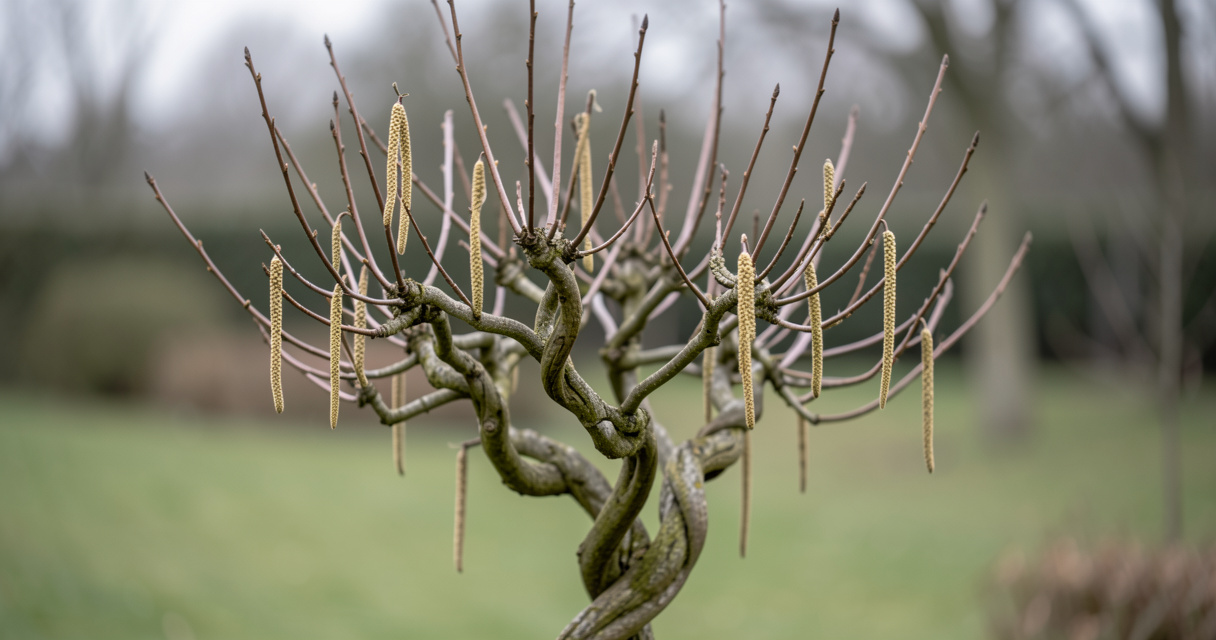
- Corkscrew hazel (Corylus avellana ‘Contorta’): a smaller, sage character with twisted branches and catkins in late winter. Tolerant of most soils, happy in light shade, and it will not overwhelm a modest garden.
- Weeping beech (Fagus sylvatica ‘Pendula’): the most sculptural of all, a slow, deliberate tree that becomes a living piece of architecture over decades. It demands space, patience and decent soil.
Don’t overthink the labels. Focus on how each one behaves in your particular corner of the world.
Willow: the fast, thirsty romantic
The twisted willow is the tree most people picture when they hear “contorted.” My grandmother taught me that willows are the gypsies of the garden — they wander, they drink, and they are never quite where you expect them. The corkscrew stems are spectacular against a grey November sky, and I still stop to look at them every winter.
But here is the reality: a willow can put on two metres in a single season. That energy is beautiful, and it is also a responsibility. The roots travel. Do not plant one near a drain, a patio or a boundary you care about. In my experience, the best place for a twisted willow is a damp lower corner where the ground stays cool, ideally with a pond or a ditch nearby. If you have sandy, dry soil, look elsewhere — this is not the tree for you, and pretending otherwise only delays the disappointment.
Hazel: the forgiving middle ground
The corkscrew hazel is what I recommend to most first-time gardeners, and I say that without hesitation. It is smaller — usually reaching two to three metres — and it responds to the situation rather than dictating it. The twisted branches are dense and graphic in winter, then the long catkins appear in February and give you something to watch while the rest of the garden sleeps.
What most people get wrong is pruning it too hard in the first years. Hazel twists are best left to find their own shape; remove only dead or crossing wood in late winter. It tolerates clay, sand and light shade, which makes it the most adaptable of my three. If you have a small garden and want that twisted silhouette without a lifetime commitment, this is what I’d do.
Beech: the slow sculpture
The weeping beech is the opposite of the willow in temperament. It is patient, and it asks you to be patient too. A young beech looks unremarkable for the first decade, then something clicks and the weeping form begins to pour downward like water, creating a green cascade that becomes the emotional centre of a garden.
This is not a tree for a small plot, and I am honest about that. Give it space, good soil and freedom from root disturbance, and it will reward you for a century. The Dutch horticultural tradition has planted beeches along estates for generations, and there is a reason they are still there. Fagus does not like wet, compacted ground; it wants a deep, well-drained loam. If your site has those conditions, the beech is the most rewarding long-term choice of the three.
How to decide
Let me show you what actually works in practice. Ask yourself three questions, in this order: how wet is the ground, how much room do I really have, and how patient am I?
If the answer is wet ground and plenty of space, plant the twisted willow. If the ground is ordinary and the space is modest, choose the corkscrew hazel. If you have decent soil, real room and a willingness to wait, the weeping beech will outlive the conversation. The learning curve is gentle with all three, but the consequences of a poor match are not. Take one season to observe your site before you buy. The plant will tell you — you only have to listen.

I’ve spent over fifteen years in botanical gardens and nurseries across the Netherlands and Belgium. Now I garden in Haarlem and write what I wish someone had told me sooner. No fluff — just what actually works.