

Reading time: 18 min
Key takeaways
- Main window: Most repeat-blooming roses are pruned in late winter or early spring, after the last hard frost, as the buds begin to swell.
- Climate sets the date: The same job happens in May in USDA Zone 3 and in January in Zone 10. Local frost dates and plant cues beat any fixed calendar.
- Type changes everything: Once-blooming old garden roses are pruned right after flowering, not in spring, and climbing roses need almost no structural pruning for their first three years.
- Fall is damage control: After a killing frost, remove only dead, diseased, or overlong canes and never take more than one third to one half of the bush.
Is your rose bush still holding green canes in November, and you cannot decide whether to cut it back now or wait for spring? That hesitation is healthy. It means you have actually looked at the plant instead of the calendar.
Rose pruning timing is not one fixed date. It shifts with your climate, your rose type, and the dormancy signals the plant sends you in late winter. Cut too early and you push soft growth into a freeze. Cut too late and you trade away the first flush of bloom. In twelve years advising botanical gardens and specialist nurseries across the Netherlands and Belgium, I have seen far more roses harmed by badly timed pruning than by pruning that was simply a little rough.
This guide gives you a single decision tree for when to prune rose bushes — zone, type, and season in one place — so you can stop cross-referencing three articles and start making cuts you trust.
When to Prune Rose Bushes: The Short Answer
Prune rose bushes in late winter or early spring, just as new growth begins — typically from January to May depending on your climate. Wait until after the last hard frost. Prune once-blooming roses right after they flower, and in fall remove only long or damaged canes after a killing frost.
Quick answer: late winter or early spring, after the last hard frost, when buds swell or new shoots appear. Zones 3–4: May. Zones 5–7: March–April. Zone 8: February–March. Zones 9–10: January–February.
What most people get wrong is treating that window as a fixed appointment. It is not. In my own Haarlem garden, the main cut usually falls somewhere between late February and mid-March. A colleague in northern Scotland prunes six weeks later than I do. A reader writing to me from southern Portugal prunes in January and is finished before my hellebores have opened.
The trigger is never the date on the wall. It is dormancy ending.
The new-growth signal
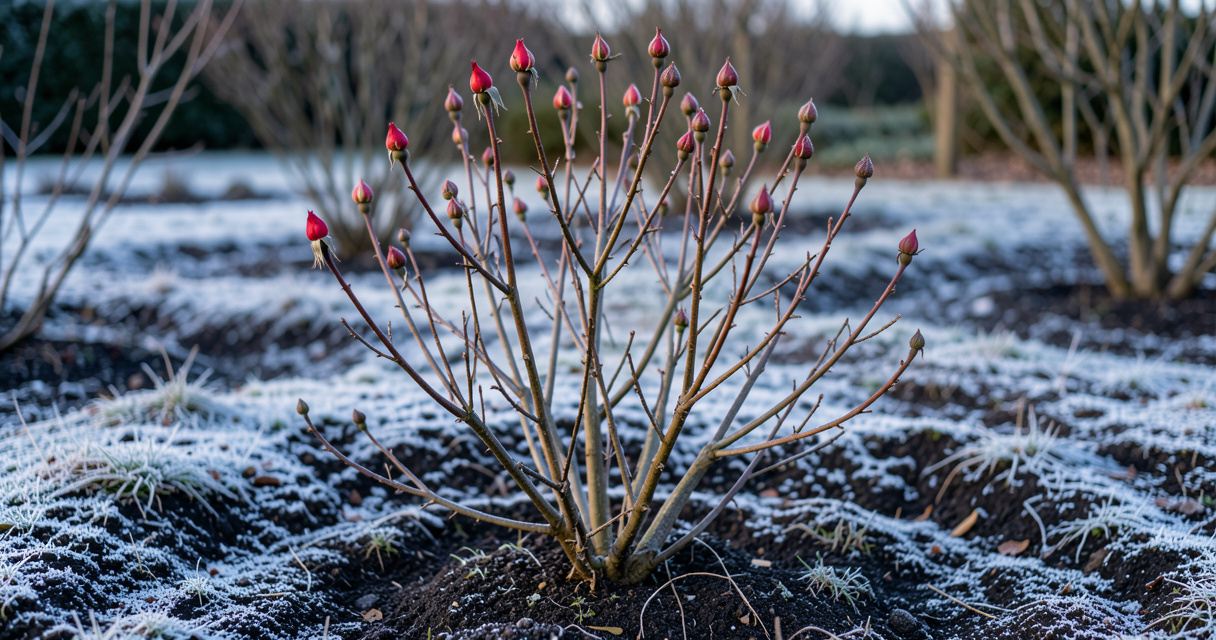
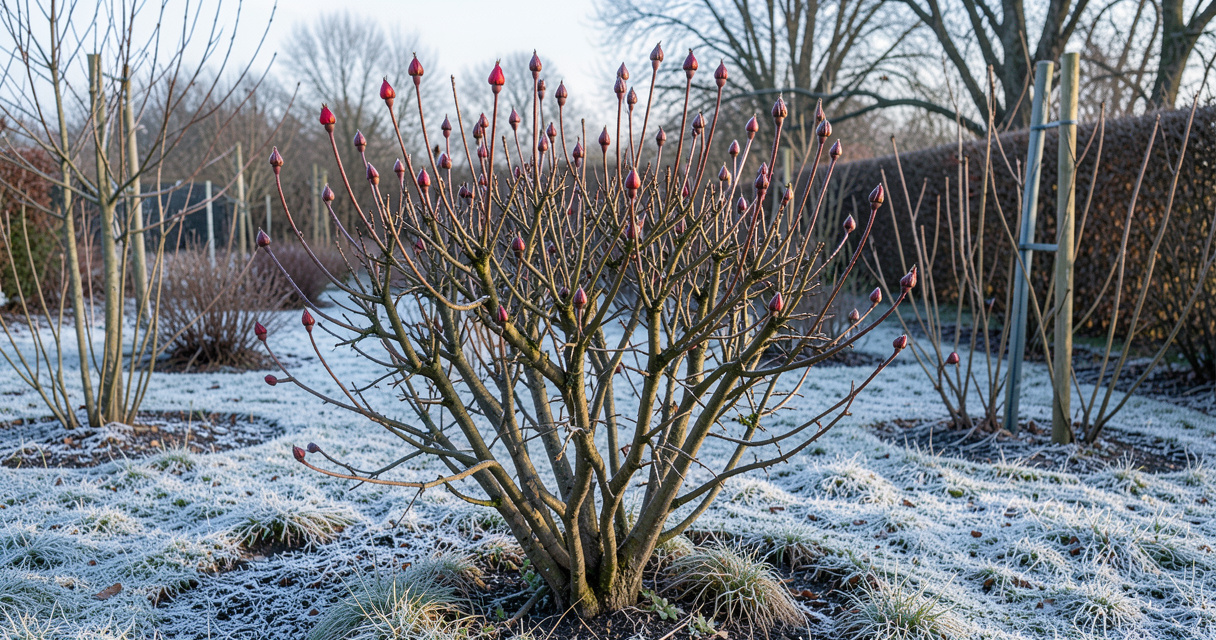
Go outside and look at the canes properly. The first sign is a change in the buds: they swell, plump up, and shift from dull brown to a live red or green. That is the plant breaking dormancy, and it is the moment your pruners should come out of the shed.
Wait until three or four buds on a cane have broken and you can see the first hint of leaf. At that point the rose has committed to the season. Cutting a week earlier is usually fine. Cutting a month earlier, while the bush is still fully dormant and a hard frost is still likely, is where trouble starts.
My grandmother taught me the second cue, and I have never found a better one: the forsythia. When the forsythia opens its first yellow flowers, the soil is warming and the roses are ready. It is not folklore for its own sake — forsythia and roses respond to the same accumulating warmth. The plant will tell you, if you let it.
Why late winter beats early fall
Prune a rose in early October in a cold climate and you do the opposite of what you intended. The cut removes apical dominance, the plant responds with soft new shoots, and the first hard frost turns those shoots to mush. You have spent the plant’s stored energy on growth that cannot survive.
Late winter pruning works with the plant rather than against it. You remove old wood in the last weeks before the plant can replace it, so the energy goes into the buds you kept instead of the canes you took away. The wound calluses as growth starts. There is no wasted flush.
That general window only becomes useful once you anchor it to your own climate — which is exactly what the zone calendar does next.
Rose Pruning Timing by Climate Zone and Region
Rose pruning by zone is the fastest way to turn a vague “late winter” into a date you can write in a diary. It is not a perfect system — microclimates exist, and a sheltered city courtyard runs two weeks ahead of open countryside twenty kilometres away — but it gets you into the right month.
According to Garden Design’s zone guidance, gardeners in USDA Zones 3–4 prune in May, Zones 5–7 in March or April, Zone 8 in February or March, Zone 9 in January or February, and Zone 10 in January. That is a spread of nearly five months between the coldest and warmest gardens. No single article can give you one date, and any source that tries is guessing.
USDA zone calendar
Use this table as your starting point, then adjust with the plant cues in the next section.
| USDA zone | Recommended pruning window | Local plant or weather cue |
|---|---|---|
| Zone 3 | May | Soil workable, forsythia long finished, buds visibly swelling |
| Zone 4 | May | Last hard frost past, new shoots 1–2 cm |
| Zone 5 | Late March to April | Forsythia in full bloom, buds plump and red |
| Zone 6 | March to early April | Forsythia opening, daffodils fading |
| Zone 7 | Late February to March | Forsythia just breaking, buds clearly swollen |
| Zone 8 | February to March | New shoots emerging, light frost still possible |
| Zone 9 | January to February | Roses semi-dormant, first leaf buds visible |
| Zone 10 | January | Coolest weeks of the year, growth slow but present |
Read the left column as a rough address and the right column as the real decision. If your Zone 6 garden sits on a cold slope with late frosts, the forsythia cue will hold you back a week or two — and that is the correct outcome.
Forsythia and local cues
The forsythia rule is the most portable piece of rose advice I know. It works because forsythia blooms on the same accumulated heat that wakes a rose, so it self-calibrates to your garden rather than to a map. If you have no forsythia, watch for the first green tips on your roses’ buds, or the moment your lawn starts growing properly.
The second cue that matters more than any calendar is the last killing frost. A hard frost below about −4 °C (25 °F) after you have pruned can blacken the fresh cuts and set the plant back weeks. Be honest about your average last frost date, and then add a week of caution. Pruning a week late costs you almost nothing. Pruning three weeks early can cost you the first bloom cycle.
Cold-climate exceptions
If you garden in Zones 3 or 4, your situation is genuinely different. The growing season is short, the wood dieback over winter is real, and a rose that was pruned hard in autumn will often be dead to the snow line by March. In these gardens, the annual pruning has to happen late — May is not an exaggeration — and winter protection matters more than tidiness.
In my experience, cold-climate gardeners benefit from leaving extra cane length through winter and cutting back to the final height in spring once they can see what survived. You are not delaying pruning. You are pruning in two stages so the plant carries its own insurance through the cold.
Once you know your window, the next question is whether your particular rose even follows the standard rule — and for several rose types, it does not.
Match Pruning Time to Your Rose Type
Timing follows bloom habit first and plant size second. A rose that flowers once, on wood grown the previous year, cannot be pruned in spring without removing the flowers you were waiting for. A rose that repeats through summer flowers on new growth, so spring pruning costs it nothing.
| Rose type | When to prune | Target cut height | Special note |
|---|---|---|---|
| Once-blooming old garden roses | Immediately after flowering (summer) | Shape only; remove roughly one third of oldest canes | Spring pruning removes the entire bloom display |
| Repeat-blooming shrubs | Late winter to early spring, as buds break | One third to one half of current height | Deadhead through summer for repeat flowers |
| Hybrid teas | Early spring, after last hard frost | 30–45 cm above soil, 5–7 strong canes | Lower cuts give fewer but larger blooms and longer stems |
| Floribundas | Early spring | 45–60 cm | Keep more canes than hybrid teas; you want cluster bloom |
| Knock Out roses | Late winter to early spring | Cut back to about 30 cm (12 in) | Tolerates hard renewal; flowers on new wood |
| Petite Knock Out roses | Late winter to early spring | 10–15 cm (4–6 in) | Dwarf habit; do not leave long leggy canes |
| Climbing roses, years 1–3 | No structural pruning | Remove only dead, damaged, diseased wood | Let the framework establish and tie in canes |
| Climbing roses, mature | Late winter, after flowering for once-bloomers | Tie in horizontals; shorten laterals to 2–3 buds | Horizontal canes flower most heavily along their length |
Once-blooming vs. repeat-blooming roses
This is the single distinction that decides your pruning date. Once-blooming roses — most of the albas, gallicas, damasks, and many species roses — set their flower buds in late summer on canes that will overwinter. Prune them in March and you cut off the season’s flowers before they exist.
Repeat-blooming roses flower on fresh growth produced in the same season. They can lose cane in late winter and still give you a full summer. If you are not sure which you have, wait for the first flowering and note whether the bush produces a second, smaller flush in late summer. That observation is worth more than any label on a nursery pot.
Hybrid teas and modern shrubs
Hybrid tea rose pruning follows the classic model: early spring, after the last hard frost, down to roughly 30–45 cm with five to seven strong canes left standing. Cut lower and you get fewer, larger flowers on longer stems — the exhibition look. Cut higher and you get more flowers of moderate size, earlier.
Modern shrub roses are more forgiving. They flower on new wood, they branch readily, and they recover from a hard cut. With these I am less precise and more interested in the shape of the bush than in the height of any single cane. Don’t overthink it — remove the oldest third of canes at the base and shorten what remains.
Knock Out and Petite Knock Out
If you are wondering how to prune Knock Out roses in spring, the answer is simpler than most gardeners expect. According to Knock Out Roses and the New York Botanical Garden, Knock Out roses should be cut back to 12 inches (about 30 cm) in late winter to early spring. They are bred to tolerate a hard cut and to regenerate from low wood.
Petite Knock Out roses, the dwarf form, are cut back harder in proportion: Knock Out Roses recommends 4–6 inches (10–15 cm) in late winter or early spring. Leave them taller and you get floppy growth and a sparse centre. The whole appeal of the dwarf series is a tight, dense, rounded plant, and that only happens if you are willing to be decisive.
Climbing roses
Climbing rose pruning is where enthusiasm does the most damage. For the first three years, do not prune climbing roses for shape at all. Remove dead, damaged, or diseased wood when you see it, and otherwise let the plant build a permanent framework. Every hard cut in those years delays the wall or pergola you are trying to cover.
Once the framework is established, the annual job is mainly tying in and shortening. Bend the long canes toward horizontal — flowering is strongest along the length of a horizontal cane — and cut the short side shoots back to two or three buds. For once-blooming climbers, do this immediately after flowering. For repeat bloomers, do it in late winter.
Type fixes the season. What type does not fix is the weather, and that is where autumn pruning needs a much stricter set of rules.
Fall and Winter Pruning: What You Can and Cannot Cut
Pruning roses in fall is not the annual pruning event. It is damage control. That distinction matters, because the popular instruction to “cut roses back in autumn” has ruined a great many plants in cold gardens.
After the first killing frost
Wait for the first killing frost before you touch anything in autumn. A killing frost is the one that ends the growing season — foliage blackened, soft tips gone, soil cold. Everything before that is still growing season, and pruning during it stimulates exactly the growth you do not want.
After that frost, three jobs are legitimate. First, remove dead, diseased, and damaged canes right down to clean wood. Second, shorten canes that are long enough to whip in winter wind, because a rocking cane loosens the crown in frozen ground. Third, clear fallen leaves from around the base, since blackspot and rust overwinter in them.
So, can you prune roses in November? In a cold climate, yes — but only within those three categories. November is a fine month for cleanup and a bad month for structural pruning.
Why early fall pruning backfires
A rose pruned in early October is being told, in the only language it has, that something has eaten it. The response is predictable: it pushes new shoots from the buds below each cut. Those shoots are soft, thin-walled, and full of water. The first hard frost destroys them, and the plant has spent stored carbohydrates producing them.
I once advised a client in the Betuwe who had pruned her hybrid teas to knee height in the first week of October, a habit inherited from her father. By December, every cut had produced 20 cm of pale, tender growth, and the frost took all of it back to the old wood. The following spring the bushes flowered three weeks later than her neighbour’s — not from the pruning itself, but from the energy the plant had wasted on growth that never had a chance.
Waiting until after a killing frost, and cutting far less, protects the plant. It is not laziness. It is timing.
Winter damage prevention
Winter damage rarely comes from cold alone. It comes from freeze-thaw cycles, wind rocking the crown, and wet soil around the base. Your autumn work should target those three things and nothing else.
Warning: do not prune heavily in early autumn. In cold climates, wait for dormancy or a killing frost before making any cut beyond dead or damaged wood.
Fall cleanup checklist
- Remove dead, damaged, and diseased canes down to clean wood
- Shorten whippy canes that could rock the crown in winter wind
- Strip and bin fallen leaves showing blackspot or rust
- Clean and oil your bypass pruners before storage
- Apply a 2–3 inch layer of mulch around the base, keeping it clear of the stems
The mulch matters more than it looks. According to iHomeRank, a 2–3 inch layer around the base after pruning cleanup moderates soil temperature and reduces the freeze-thaw cycling that heaves roots out of the ground.
Once the season turns and the buds break, the cuts themselves have to be made properly — which is the next step.
Step-by-Step: How to Make the Cut at the Right Time
Timing gets you to the plant. Technique decides whether the plant responds well. A rose is unusually good at sealing a clean cut and unusually bad at sealing a torn one, so the quality of the cut matters more than the position of it.
Tools and safety
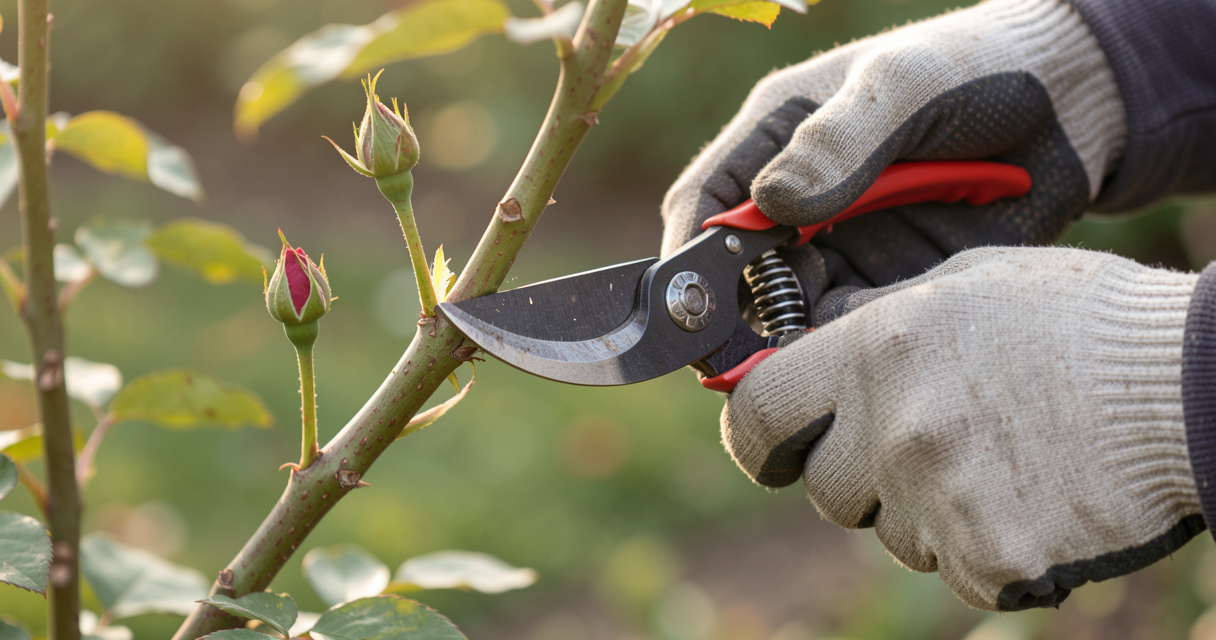
Use bypass pruners, not anvil pruners. Anvil pruners crush the cane between a blade and a flat plate, and a crushed cane dies back below the cut. Bypass pruners slice, the way scissors do. For canes over about 1.5 cm, use loppers rather than forcing a small pruner.
Clean your blades with alcohol between bushes, especially if you have had blackspot or dieback in the garden. Rose diseases travel on blades far more often than gardeners admit.
Before you start
- Leather gloves and long sleeves — rose thorns and rose canes are a bad combination at speed
- Sharp bypass pruners, plus loppers for thick old canes
- Clean blades with alcohol before the first cut
- A bucket for diseased material, kept separate from the compost
- Twine for tying in climbers as you work
The 45-degree cut
Cut at a 45-degree angle, about 5 mm above an outward-facing bud, with the slope running away from the bud. The angle lets water run off the cut surface instead of sitting in it, and the outward-facing bud directs the new shoot away from the centre of the bush, keeping the middle open to light and air.
If you cut too far above the bud, you leave a stub that dies back. If you cut too close, you damage the bud itself. Those 5 mm are the whole skill.
While you are in there, remove suckers — the vigorous shoots coming from below the graft union, usually with different foliage. Pull them away rather than cutting, if you can, so you take the bud with them. And remove any leaf carrying blackspot rather than leaving it on the ground.
Cleanup and aftercare
Clear every cutting from the soil surface. Diseased material goes in the municipal waste, not the compost heap. Then mulch. A 2–3 inch layer around the base — pulled back slightly from direct contact with the stems — conserves moisture through summer and buffers root-zone temperature through winter.
Deadheading roses is the summer counterpart to spring pruning, and the timing is different. When a flower fades, follow the stem down to the first strong five-leaflet leaf and cut just above it. That is where the next flowering shoot will come from. On repeat bloomers, deadheading every week or two through the first flush keeps the cycle going instead of letting the plant set hips and rest.
Do not use deadheading as an excuse for structural pruning in summer. Remove the flower, leave the framework.
Common Timing Mistakes and Warning Signs
Almost every pruning failure I have been called out to look at falls into one of three categories: too early, too hard, or the wrong plant at the wrong moment.
Pruning too early
What happens if you prune roses too early? You wake the plant before the weather is ready to support it. Tender new growth appears, a late frost arrives, and the plant loses the flush it just paid for. On once-blooming roses, early pruning also removes the flower buds themselves, so the cost is the entire year’s display.
Pruning too hard
Can pruning kill a rose bush? Rarely in one session, but repeated over-pruning will. Strip a repeat bloomer down to two canes every spring and you will see fewer flowers each year, then a general decline. The plant has finite stored reserves, and every hard cut spends them.
Warning: never remove more than one third to one half of the bush in a single pruning session unless you are correcting severe damage. Better Homes & Gardens sets the same limit, and it is a good one.
Pruning the wrong rose type
Pruning a once-blooming old garden rose in March is not a small error. You have removed the year’s flowers along with the wood that carried them. The same mistake on a climbing rose in its second year costs you a season of framework.
Watch for the warning signs that something has gone wrong: canes shrivelling from the tip, dieback spreading below a cut, or a flush of pale, soft growth in autumn. All three mean the timing or the depth was wrong, and all three are correctable next season.
Those errors come up so often that they deserve quick, direct answers — which is what the questions below are for.
Frequently Asked Questions About Rose Bush Pruning Timing
Quick-answer checklist: November — cleanup only. Winter — nothing structural. Spring — the main cut, as buds break. Summer — deadheading only.
Can I prune rose bushes in November?
In cold climates, November pruning should be limited to damaged or overly long canes after a killing frost. Avoid major structural pruning until late winter or early spring, when new growth begins.
What happens if I prune roses too early?
Early pruning stimulates tender new growth that cold weather may damage, and it can remove flower buds on once-blooming roses before they have a chance to open. The plant spends stored energy on growth that will not survive.
Should I cut back roses before winter?
Only lightly. After the first killing frost, trim long stems that may snap in winter storms and remove dead or diseased wood. Do not cut more than one third to one half of the bush, and do not encourage fresh growth.
How do I know when to prune roses?
Watch for swollen buds or new shoots in late winter or early spring. The forsythia-bloom cue and your local frost dates refine that timing for your specific climate.
Do all roses get pruned at the same time?
No. Once-blooming roses are pruned right after flowering, repeat bloomers in late winter or early spring, and climbing roses need minimal pruning for their first three years.
Can I prune roses in summer?
Summer pruning is mainly deadheading spent blooms to encourage more flowers. Avoid heavy structural pruning during heat stress unless you are removing damaged or diseased canes.
How often should rose bushes be pruned?
Most roses need one major annual pruning in late winter or early spring, plus deadheading through the flowering season and removal of dead or diseased wood whenever you spot it.
Building a Rose Bush Pruning Schedule You Will Actually Follow
Strip away the detail and the rose bush pruning schedule is four entries long. Late winter or early spring is the main pruning window for most repeat-blooming roses. Your USDA zone, the forsythia bloom, and the swelling buds refine the exact week. Once-blooming roses, Knock Out roses, and climbing roses each carry an important exception. And fall pruning stays limited to damage control after a killing frost.
Here is what I would do with that. Write the four entries in a notebook in January. Walk the garden once a week from late winter, looking at buds rather than the calendar. When three or four buds on a cane have broken, prune — not before. Take no more than one third to one half of the bush. Cut 5 mm above an outward-facing bud at 45 degrees. Clear the debris, mulch 2–3 inches, clean your tools, and then leave the plant alone until the flowers fade.
The learning curve is real, and it is shorter than most gardeners fear. One full year of watching your own roses — noting when the buds swell, when the forsythia opens, when the last frost actually arrives — teaches you more than any zone table ever will. The plant will tell you. Your job is to be outside when it does.
So before you pick up the pruners this season, ask yourself one question: are your roses truly dormant, or are you about to wake them too soon?

I’ve spent over fifteen years in botanical gardens and nurseries across the Netherlands and Belgium. Now I garden in Haarlem and write what I wish someone had told me sooner. No fluff — just what actually works.