

Reading time: 5 min
Key Takeaways
- Layer plants with graduated light tolerance — from full-shade ferns to sun-loving perennials — to soften the edge between zones.
- Use structural elements like lattice or tall grasses to filter light gradually, creating a natural diffusion zone.
- Match foliage texture and color across light levels so the eye moves smoothly from dark to bright areas.
Why Sharp Contrasts Bother Me (and Maybe You Too)
In my experience, the biggest mistake people make when designing a garden is treating shade and sun as two separate worlds. You end up with a dark patch under a tree and a bright lawn just meters away — and the line between them feels more like a cut than a conversation. My grandmother’s garden in Leeuwarden had no such lines: hostas melted into wild grasses, and ferns brushed against sun-drenched echinaceas. The secret wasn’t a plan — it was a gentle transition, plant by plant.
Understanding Light Zones: More Than Just Sun vs. Shade
What most people get wrong is thinking of light as binary. In reality, every garden has a spectrum: deep shade (north side of a wall), dappled shade (under a deciduous tree), partial sun (morning light, afternoon shade), and full sun (six-plus hours). Your job is to place plants along this spectrum so the change feels like movement, not a jump. Don’t overthink it — let the plant tell you where it belongs.
The Transition Layer: Plants That Live on the Edge
Let me show you what actually works. Instead of planting a sun-loving Echinacea next to a shade-dwelling Hosta, use a buffer zone of plants that tolerate both. Here’s what I’d do:
- For light shade to partial sun: Heuchera (coral bells) — they come in every color from lime green to deep burgundy and handle about four hours of direct sun nicely.
- Between shade and light: Tiarella (foamflower) — delicate, low-growing, and perfectly happy in the dappled zone under a tree that catches morning light.
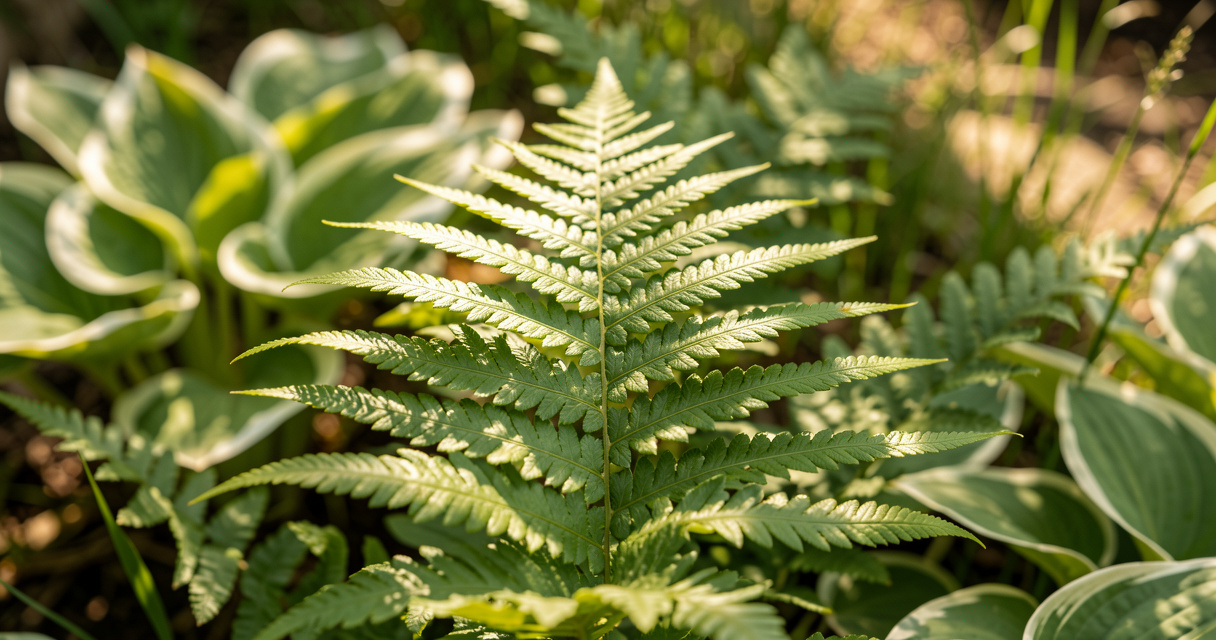
- For the edge of full shade: Dryopteris filix-mas (male fern) — a robust fern that takes some sun if the soil stays moist, but truly shines in deeper shade.
Study your garden at different times of day. In Haarlem, my city garden gets harsh afternoon sun in one corner; I planted Geranium ‘Rozanne’ there, which blooms from June to frost and does equally well in partial shade on the north side of my shed. The same plant, same color, unifies the space.
Structural Filters: Using Hardscape and Plants as Light Modifiers
Before I studied plant biology at Wageningen, I thought you needed a pergola or a large tree to filter light. Not true. A simple lattice panel placed where sunlight hits the shaded border creates a shifting pattern of dappled light that lasts all morning. Alternatively, plant tall, airy grasses like Calamagrostis ‘Karl Foerster’ at the boundary — their translucent stems soften the beam without blocking it entirely.
For the garden in Leeuwarden, my grandmother used a low hedge of Buxus (boxwood) along the sunward edge of her fern bed. It didn’t cast deep shade, just a gentle filter that made the transition feel deliberate. Here’s what I’d do today: use Ilex crenata (Japanese holly) instead — disease-resistant and slow-growing, it forms a neat, filtered edge without the constant pruning boxwood demands.
Texture and Color: The Visual Glue
From my twelve years of consulting for botanical gardens, I learned one thing: texture carries the eye more than color. A bed of fine-textured Luzula sylvatica (great wood-rush) in the shade leads naturally to the finer leaves of Stipa tenuissima (Mexican feather grass) in sun — the same gestural quality, different light tolerance. Keep your leaf shapes similar across the transition, and the shift becomes almost invisible.
Color can help too, but don’t force it. Use repeating flower tones — for example, purple Campanula in partial shade and purple Salvia in full sun — to create a subtle color echo. Don’t overthink it; just pick one hue and let it wander through different light zones.
Practical Pairings That Work (Based on Real Gardens)
Let me give you three combinations I’ve used in clients’ gardens from Friesland to Flanders. These are not theoretical — I’ve seen them thrive over multiple seasons.
- Deep shade to dappled sun: Polystichum setiferum (soft shield fern) — Galium odoratum (sweet woodruff) — Anemone nemorosa (wood anemone). The fern gives height, woodruff fills the middle, and anemones creep outward into lighter patches.
- Dappled to partial sun: Hosta ‘June’ — Heuchera ‘Caramel’ — Geranium ‘Johnson’s Blue’. The hosta anchors shade, heuchera bridges, and geranium takes the sun end.
- Partial sun to full sun: Penstemon digitalis ‘Husker Red’ — Echinacea purpurea — Perovskia atriplicifolia (Russian sage). Dark foliage of penstemon works in part shade; echinacea and perovskia love the open sun.
When Theory Meets Reality: A Case from My Own Garden
In my 80 square metre city garden in Haarlem, I have a corner that gets direct sun from noon to 4 PM and deep shade from a neighbour’s wall the rest of the day. What most people would do is plant shade lovers there — and watch them scorch. Instead, I used a staggered hedge of Fagus sylvatica (beech) and Prunus laurocerasus (cherry laurel) along the sunny side. The beech thins out the light, and the laurel creates a soft backdrop. Beneath them, Epimedium (barrenwort) spreads in the filtered light, its heart-shaped leaves fading into the brighter Alchemilla mollis (lady’s mantle) beyond. Here’s what I’d do again: the same mix, with a few extra Epimedium plants to fill gaps faster.
The transition isn’t perfect — nothing in gardening is — but the plant will tell you if it’s working. If a leaf bleaches, move it. If it flops, support it. Don’t overthink it.
What Doesn’t Work (And Why Being Honest Helps)
I’ve made every mistake. I once planted Phlox paniculata (garden phlox) in what I thought was “light shade” — it was actually full sun most of the afternoon, and the leaves burned by June. Another year, I tried to force Rhododendron into a sunny border because I loved the flowers. The plant struggled, leaves yellowed, and I learned: the plant will tell you. Don’t ignore it.
What I see in many gardens is an abrupt line between a mulched shade bed and a sunny lawn. The fix? Extend the shade bed with a gravel or stepping-stone path that visually connects the two, then let low-growing Thymus serpyllum (creeping thyme) weave through the stones — it takes sun and partial shade, softening the edge without needing more plants.
Your Next Steps: A Simple 3-Phase Plan
Here’s what I’d do if you’re starting from scratch this season (we’re in June 2026, so timing is good for planting perennials and dividing ferns):
- Map your light zones over one full day — sketch where shadows fall and how they move.
- Pick one transition (a 1–2 metre strip between deep shade and full sun) to work on first.
- Install plants in layers: a structural filter (lattice or hedge), then shade-tolerants, then bridge plants, then sun-lovers — in that order, no more than 30 centimetres apart so the canopy touches.
Don’t overthink it. Start small, watch what happens, and next year you’ll know exactly where to add more Heuchera or swap out a fern that turned crispy. In my experience, that’s the only way to create a garden with no visual breaks — by listening to what the plants tell you, one season at a time.

I’ve spent over fifteen years in botanical gardens and nurseries across the Netherlands and Belgium. Now I garden in Haarlem and write what I wish someone had told me sooner. No fluff — just what actually works.