

Temps de lecture : 4 min
Points clés à retenir
- Thickness matters: For most perennials and ferns, 4 cm is enough; go to 8 cm only for high-traffic or deeply shaded areas.
- Calculate first: A 40 L bag covers 1 m² at 4 cm; bags multiply quickly, so measure your bed in square meters before buying.
- Install smarter: Always lay a weed barrier underneath if you have heavy clay or perennial weeds — what most people get wrong is skipping this step.
Why Thickness Is the First Thing to Decide
In my experience, the most common mistake with slate mulch is applying it too thinly. You see people spreading a layer that’s barely a centimeter deep — all for show, no function. What most people get wrong is thinking that a thin layer of slate will look good and suppress weeds. Let me show you what actually works.
Slate mulch does two things: it suppresses weeds and retains soil moisture. But it only does them well when the layer is thick enough. The trick is finding the sweet spot between too little (waste of money) and too much (waste of money — plus it can suffocate your perennials).
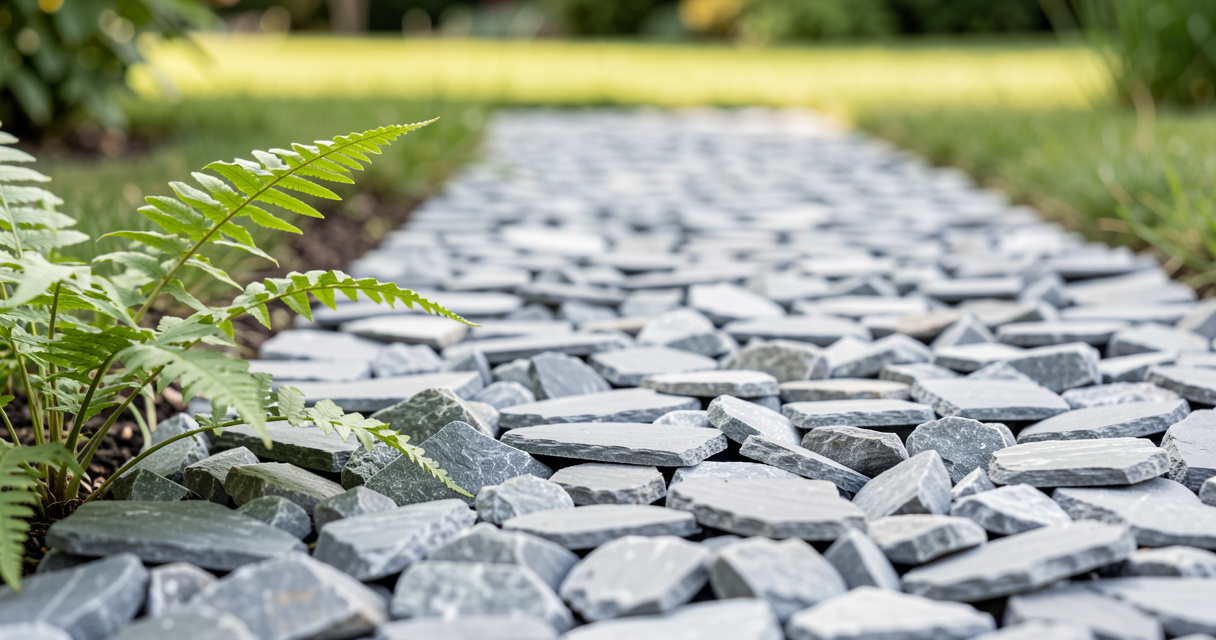
I have a small city garden in Haarlem — 80 square meters — and I have tested both 4 cm and 8 cm layers over three seasons. My grandmother taught me that plants tell you what they need. Here, the slate told me: 4 cm for my hostas and ferns is perfect. For the gravel path where I walk every day, 8 cm gives me a satisfying crunch and zero bare patches.
4 cm vs. 8 cm: What the Numbers Mean
The choice comes down to where and why you use the mulch. Let me show you the differences in everyday terms.
- 4 cm — Light duty: Best for flower beds, around perennials, shrubs, and ferns. Adequate weed suppression if you have good soil prep. The plant will tell you — if you see light-coloured slate showing through after one season, top it up. In a garden, my standard recommendation is 4 cm for everything except paths and heavy-play zones.
- 8 cm — Heavy duty: Ideal for pathways, driveways, children’s play areas, or anywhere people walk on the mulch regularly. Also perfect if you have a steep slope where runoff is likely — the extra thickness stabilises the slate. In my own path, 8 cm has stayed put for three summers with minimal addition.
How to Calculate Slate Mulch Quantity
Here’s what I’d do before you even look at a bag: grab a tape measure and figure out exactly how many square meters your bed or path covers. At 18–20 mm (3/4 inch) slate, a typical 40 L bag covers roughly:
- 1 m² at 4 cm depth
- 0.5 m² at 8 cm depth
Quick rule of thumb: For every 10 m² of bed at 4 cm, you need ten bags of 40 L. At 8 cm, double that — twenty bags.
Don’t overthink it. Most garden centers sell slate in 40 L or 25 kg bags. But — and this is the part that drives me crazy — never assume volume is the same as coverage. Different slate grades (smaller chips vs. larger slabs) will compact differently. I always buy one extra bag per 10 m² to top up after settling.
Prep the Ground Right — Don’t Skip This
What most people get wrong is laying slate directly onto soil and thinking the weeds will never come back. That works for one season max. After that, the slate sinks into the earth, worm castings bring weed seeds up, and you end up pulling dandelions through a layer of sharp stone.
Here’s what actually works — based on twelve years of field experience and the methods used at botanical gardens I’ve consulted for in the Netherlands:
- Weed it — Pull every visible weed and root first. Use a fork to loosen the top 5 cm of soil.
- Level it — Rake the soil flat so the slate sits evenly.
- Lay a barrier — Landscape fabric (permeable, not plastic) cuts annual weeds down by 90%. In my own garden, I use a woven polypropylene geotextile. It lasts.
- Add an edging strip — To stop slate from migrating into your lawn or bed, install a flexible metal or plastic edge. Trust me, you don’t want to be picking flat stones out of your grass all summer.
The Right Way to Spread and Compact Slate
Now that your bed is prepped, it’s time to apply the slate. My method is low-tech but effective:
- Empty your bags into a wheelbarrow and dump in small, even piles across the area — don’t pour one huge heap.
- Spread the slate with a hard rake or garden trowel. Aim for a consistent depth across the entire surface.
- For paths, use a tamper or a flat piece of plywood — walk over the wood to press the slate down. This stops it from shifting underfoot.
- Water the slate lightly after spreading. It settles the dust and helps the chips lock together.
Maintenance: What My City Garden Has Taught Me
Slate isn’t zero maintenance — anyone who tells you otherwise hasn’t lived with it for a season. In my 80 m² Haarlem garden, here’s what I do to keep it looking sharp:
- Top up once a year: In spring, add 1–2 cm of fresh slate to beds where the layer has compacted. The plant will tell you — if you see soil poking through, it’s time.
- Rake gently: In late autumn, I give the slate a light rake with a bamboo rake. It lifts fallen leaves without disturbing the layer.
- Watch for moss: In shaded corners, moss can grow on top of slate. A iron sulfate spray or a stiff broom takes care of it without hurting your plants.
My grandmother taught me that good gardening is a dialogue with the garden. You ask, you listen, you adjust. Slate mulch is no different. Start with the right thickness, calculate your bags honestly, and take time to prep the ground. Do that, and it will look crisp and purposeful for years.
This article draws on practical experience from Haarlem, Netherlands — winter 2025/26 was the first real test of my 8 cm path. It passed.

I’ve spent over fifteen years in botanical gardens and nurseries across the Netherlands and Belgium. Now I garden in Haarlem and write what I wish someone had told me sooner. No fluff — just what actually works.