
Reading time: 18 min
Key Takeaways
- Hardiness and shade tolerance are two different questions. A plant can survive your winter and still crisp up by August. Check the USDA zone first, then match the light.
- Dry shade is the hardest condition in gardening. Epimedium, hellebore, hardy geranium, Heuchera villosa and Solomon’s seal are the five that genuinely cope with root competition.
- Foliage, evergreen anchors and succession bloom carry a shade bed through all four seasons — flowers are a bonus, not a foundation.
- Fall planting plus two seasons of deep watering is what turns a nursery purchase into a permanent plant.
What do you plant in the corner of the yard that never gets sun? The spot where the soil is dry, the tree roots are relentless, and every experiment has ended in a bare patch of dust by August.
What most people get wrong is shopping for shade tolerance alone. They buy a beautiful Astilbe, plant it under a maple, and watch it die. The plant was shade tolerant — but it was not hardy in that spot, in that soil, under that root pressure. Shade hardy perennials need to pass three tests before they earn a place in a full shade bed: winter survival in your zone, tolerance of your light level, and tolerance of your soil moisture.
I have spent twelve years consulting for botanical gardens and specialist nurseries across the Netherlands and Belgium, and another few decades turning my own 80 square metre city garden in Haarlem into a living laboratory. My grandmother taught me that the woodland garden never lies: if a plant fails, the soil and the light will tell you exactly why. Let me show you what actually works, and why.
What Makes a Shade Perennial Hardy? Zones, Light Levels, and Soil
“Hardy” is thrown around loosely in garden writing. In horticulture, it has one precise meaning: the plant survives the coldest temperatures your garden will deliver. That is measured in USDA Hardiness Zones, and it is the first number you should check on any plant label.
Shade tolerance is a completely separate trait. It describes how much light a plant needs to photosynthesise without scorching or etiolating. A plant can be perfectly hardy in Zone 4 and still be unable to live in full shade — and a plant that loves full shade can be hopelessly tender in a cold climate. Both filters must pass before purchase.
According to the New York Botanical Garden’s LuEsther T. Mertz Library reference material, cold-climate shade perennials span a wide hardiness range — often from Zones 3-4 through 8-9. The list includes Hosta spp. (Zones 3-9), Helleborus orientalis (4-9), Epimedium x rubrum (4-9), Tiarella cordifolia (4-8) and Athyrium niponicum ‘Pictum’ (3-8). That zone span is the single most useful filter you can apply before you spend money.
Full Shade, Part Shade, and Dappled Light Explained
Shade is not a single condition. It is at least four, and the plants that work in one will fail in another.
| Light level | Direct sun per day | Shade hardy perennials that perform best |
|---|---|---|
| Full shade | 0 to 3 hours, usually none | Hosta, ferns, Epimedium, Solomon’s seal, Asarum |
| Part shade | 3 to 6 hours (morning preferred) | Helleborus, Brunnera, Pulmonaria, Tiarella, Astilbe |
| Dappled light | Filtered sun all day under a canopy | Heuchera, Japanese painted fern, hardy geranium |
| Dry shade | Low light plus low moisture | Epimedium, Helleborus, Heuchera villosa, hardy geranium, Polygonatum |
Morning sun is far gentler than afternoon sun. Six hours of afternoon sun on a west-facing wall is effectively a full-sun site with a shade label attached — and High Country Gardens makes this point bluntly: if your bed gets morning shade plus six or more hours of afternoon sun, choose a full-sun plant, not a shade perennial.
USDA Hardiness Zones at a Glance for Shade Plants
If you garden in Zone 4, ignore any plant that tops out at Zone 6. If you garden in Zone 9, do not assume a Zone 4 native will enjoy your humid summers. The overlap is where you shop. Everything else is a compromise you will pay for in spring.
Why Woodland Soil Beats Garden Soil
Shade perennials evolved on forest floors, in soil built from decades of fallen leaves. That means leaf mold, not bagged potting compost. Leaf mold is crumbly, fungal, moisture-retentive and biologically alive. It feeds the mycorrhizae that connect plant roots to soil nutrients — associations that matter enormously in low-light situations where every gram of phosphorus has to be earned.
Definition box: Hardiness is winter survival, measured in USDA zones. Shade tolerance is light tolerance, measured in hours of direct sun. To measure your own light, install a free phone light-meter app and take a reading every two hours for one full day — one morning in mid-July. The result will surprise you more often than not.
Once you know what you are actually working with, the plant list becomes much more useful. That is where we go next.
30 Shade Hardy Perennials That Come Back Year After Year
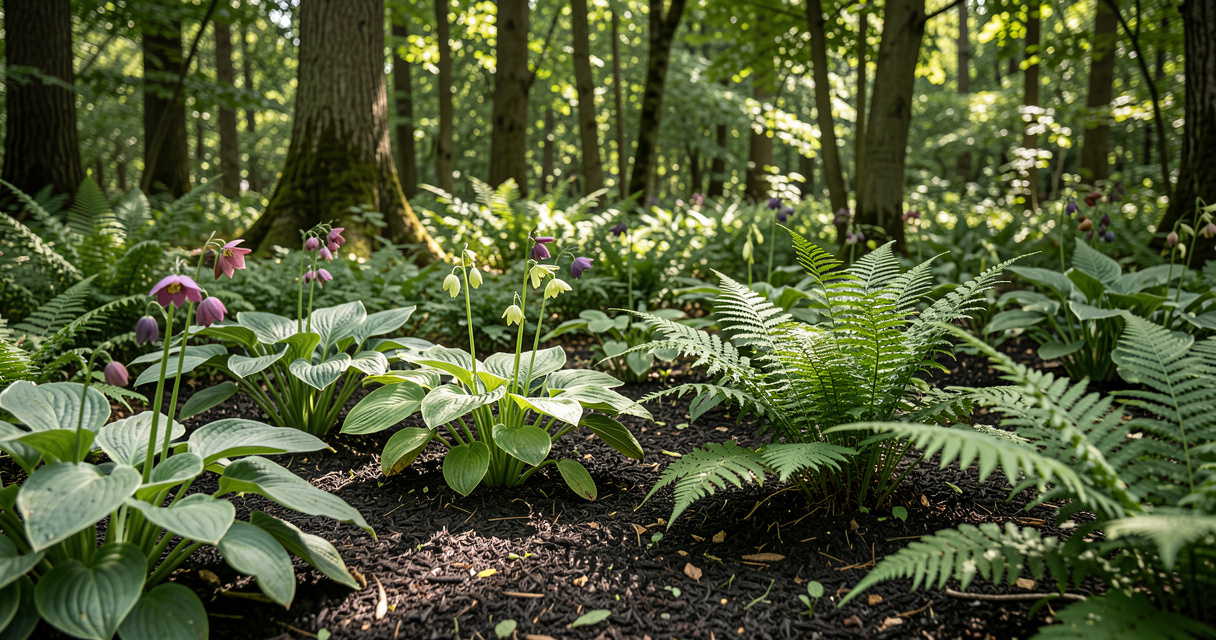
The toughest shade hardy perennials include: Hosta (Zones 3-9), Helleborus orientalis (4-9), Epimedium x rubrum (4-9), Japanese painted fern (3-8), Heuchera villosa (4-9), Solomon’s seal (4-9), Brunnera macrophylla (3-9), Tiarella cordifolia (4-8), Pulmonaria (3-9) and Bergenia cordifolia (4-9). All return year after year in woodland soil and tolerate part shade to full shade.
Below is the full ranked list, split by function so you can shop for what your bed actually needs rather than what the garden centre happens to have stacked at the door.
Foliage First: Hostas, Heucheras, and Ferns
| Common name | Botanical name | USDA zones | Height x spread | Bloom season | Dry shade | Deer resistant |
|---|---|---|---|---|---|---|
| Hosta | Hosta spp. | 3-9 | 12-36 in x 24-48 in | Summer | Moderate | No |
| Coral bells | Heuchera villosa | 4-9 | 18-24 in x 18 in | Summer | Yes | Yes |
| Japanese painted fern | Athyrium niponicum ‘Pictum’ | 3-8 | 12-18 in x 24 in | None (foliage) | Moderate | Yes |
| Foamflower | Tiarella cordifolia | 4-8 | 8-12 in x 12-24 in | Spring | Moderate | Yes |
| Siberian bugloss | Brunnera macrophylla | 3-9 | 12-18 in x 18-24 in | Spring | No | Yes |
Hostas are the workhorses — 30 inches of foliage in a single season, in colours from chartreuse to gunmetal blue. But they are also deer candy, and I will be honest about that below. If deer are a real problem, lean on Heuchera villosa instead. It is the species of coral bells that tolerates dry shade, unlike the more common Heuchera sanguinea, which prefers moisture and richer soil.
Flowering Workhorses: Hellebores, Astilbe, and Bleeding Heart
Hellebores are the plant that makes shade gardening worth it. According to Gardenia’s Zone 7 reference guide, they are evergreen, drought-tolerant once established, deer-resistant and long-lived — blooming when almost nothing else in the garden is awake. That is February through April in most temperate climates, which is a gift.
Add Astilbe for July plumes, Dicentra spectabilis (bleeding heart) for that arching May elegance, and Pulmonaria for blue-and-pink spotted flowers in early spring. Epimedium x rubrum threads red-and-yellow fairy flowers through the whole group from April onwards. Every one of these returns reliably in Zones 4 to 9.
Groundcovers and Woodland Spreaders
Bergenia cordifolia gives you 12 to 24 inches of glossy evergreen paddle leaves and pink spring flowers — a leggy, structural groundcover that looks good even in January. Galium odoratum (sweet woodruff) forms a delicate green carpet with the scent of hay, and does the job in Zones 4-8 on dry shade. Epimedium spreads slowly by rhizome to knit a bed together over three seasons.
Asarum (wild ginger) is underused and deserves more attention. Its heart-shaped leaves sit at six inches and its strange brown jug flowers hide underneath — a curiosity, but a beautiful groundcover for deep shade.
Evergreen Structure for Winter Interest
Helleborus, Bergenia, and evergreen ferns such as Polystichum aculeatum hold the bed together from November to March. Without them, a shade border becomes a black hole in the winter. With them, it looks designed. This is one of those evergreen shade perennials details that most plant lists completely skip.
Top 10 Starter Set for Absolute Beginners
- Hosta (any medium-leaf variety)
- Helleborus orientalis (Lenten rose)
- Athyrium niponicum ‘Pictum’ (Japanese painted fern)
- Brunnera macrophylla (Siberian bugloss)
- Epimedium x rubrum
- Heuchera villosa
- Tiarella cordifolia (foamflower)
- Pulmonaria (lungwort)
- Polystichum aculeatum (hard shield fern)
- Polygonatum (Solomon’s seal)
That list covers every function: foliage, flower, groundcover and evergreen structure. All of these are forgiving of imperfect soil and reliably return in Zones 3 to 9. Now that you have the shopping list, the harder question is matching each plant to the right spot.
Full Shade vs. Part Shade vs. Dry Shade: Matching the Plant to the Spot
A diagnostic framework beats a plant dump every time. Before you buy a single full shade perennials selection, walk the bed at three key moments: 9 am, 1 pm, and 5 pm, on a bright day in July. Note where sun lands.
Sites With No Direct Sun
North walls and the space under dense evergreens often receive zero direct sun. This is true full shade, and it is the easiest of the difficult conditions to plant — because the soil tends to stay cool and moist. Hosta, fern, Epimedium, Solomon’s seal and Asarum are all reliable here. Just accept that flowering will be modest. Foliage is the show.
Morning Sun, Afternoon Shade
This is the best position in a shade garden, and it is where nearly every “part shade” plant actually wants to be. East-facing beds pick up four hours of gentle morning light and then sit in cool shade during the hottest part of the day. Hellebores, Brunnera, Pulmonaria and Tiarella all perform at their peak here.
Reverse this — afternoon sun, morning shade — and the same plants will struggle. The afternoon sun is brutal in a way the morning sun is not.
Why a Shaded Spot Can Still Be Bone Dry
There are two mechanisms for dry shade, and they demand different responses. The first is tree root competition (covered in the next section). The second is a building overhang: a bed tucked under a wide eave or a north wall that keeps rain off entirely. That bed is shaded and dry for entirely different reasons, and it needs drought-adapted plants rather than moisture lovers.
| Site condition | Best-performing shade hardy perennials |
|---|---|
| North wall, cool and moist | Hosta, ferns, Asarum, Solomon’s seal |
| East-facing bed, morning sun | Helleborus, Brunnera, Pulmonaria, Tiarella |
| Under mature tree, dry shade | Epimedium, Helleborus, Heuchera villosa, hardy geranium |
| Under wide overhang | Epimedium, Bergenia, Heuchera villosa, Polygonatum |
| Dappled light through canopy | Japanese painted fern, Heuchera, hardy geranium |
Warning box: Some plants sold as “shade lovers” fail reliably in dry shade. Astilbe and Ligularia are the two worst offenders — both are moisture-dependent and both turn crisp by August under a mature tree. If your shaded bed is dry, do not buy them.
Dry shade deserves its own chapter, because it is where most shade gardens actually fail.
Dry Shade Solutions: 10 Tough Perennials That Handle Root Competition
Why Tree Roots Beat Your Perennials to the Water
Under a mature tree, the fine feeder roots colonise the top 8 to 12 inches of soil — the exact depth where a perennial plug is trying to establish. Every time it rains, the tree drinks first. Every time you water, the tree drinks first. Your perennial is competing with a machine two orders of magnitude larger than itself.
That is the mechanic behind dry shade, and it is why dry shade is the hardest planting condition in temperate gardening. It is not simply a low-moisture problem; it is a chronic competitive problem.
10 Plants That Win in Dry Shade
Gardenia’s Zone 7 shade guide names epimedium, hellebore, hardy geranium, Heuchera villosa and Solomon’s seal as the best dry-shade choices. I would add five more without hesitation: Bergenia cordifolia, Galium odoratum, Liriope muscari, Polystichum aculeatum, and Dryopteris erythrosora.
| Plant | Dry-shade rating | Water needs in year 1 | Water needs once established |
|---|---|---|---|
| Epimedium x rubrum | Excellent | Deep soak weekly | None in most summers |
| Helleborus orientalis | Excellent | Deep soak weekly | None except severe drought |
| Hardy geranium (Geranium macrorrhizum) | Excellent | Deep soak weekly | None |
| Heuchera villosa | Very good | Deep soak weekly | None |
| Polygonatum (Solomon’s seal) | Very good | Deep soak weekly | None |
| Bergenia cordifolia | Very good | Deep soak weekly | None |
| Galium odoratum | Good | Deep soak weekly | Occasional |
| Liriope muscari | Good | Deep soak weekly | None |
| Polystichum aculeatum | Good | Deep soak weekly | Occasional |
| Dryopteris erythrosora | Good | Deep soak weekly | Occasional |
Planting Technique for Root-Filled Ground
Forget amending the whole bed. You cannot win that fight, and you will damage the tree’s roots trying. What you can do is dig a modest pocket — roughly twice the width of the plug, no deeper than the plug itself — and fill it with a 50/50 blend of your native soil and compost or leaf mold. Plant into that pocket. Space plugs 12 to 18 inches apart so each one has its own moisture reservoir.
Water deeply for the first two growing seasons. Not a sprinkler on a timer — a slow hose at the base, twenty seconds per plant, twice a week through dry spells. The third summer, stop. If the plants have not established by then, they never will.
A story I tell every client: A gardener I worked with in Utrecht planted a coveted Astilbe under a mature Norway maple one June. By August it was crisp. By October it was gone. The following fall, she replanted the same spot with Epimedium x rubrum and Heuchera villosa, watered them twice a week for two seasons, and has not touched the bed since. Permanent cover, zero fuss. The plant told her everything — she just had to listen the second time.
Understanding the dry-shade problem is one thing. Composing a garden that reads as designed rather than collected is another.
Designing a Woodland Border With Shade Hardy Perennials
Shade gardens live or die on foliage. Colour, texture and variegation carry a shaded border for eight months of the year. Flowers are the punctuation, not the sentence. Once you accept that, everything else falls into place.
Foliage Texture as the Main Design Tool
Contrast rule: for every bold leaf, plant three fine ones. Hostas and Bergenia are the bold players. Ferns, Tiarella and Epimedium are the fine ones. Heucheras sit in the middle, with ruffled semi-evergreen leaves that bridge the two. That ratio — one bold to three fine — is what makes a shade bed look composed rather than crowded.
The Japanese painted fern is the single best textural accent I know. Its silver, burgundy and green fronds read as jewellery against dark soil. Use it as a repeated motif through the bed and the whole planting gains coherence.
Succession Bloom Calendar for Shade
- February to April: Helleborus, Pulmonaria
- April to May: Epimedium, Brunnera, Tiarella
- May to June: Dicentra spectabilis, Polygonatum
- June to August: Astilbe (in moist shade only), Heuchera
- September to October: Japanese anemone, hardy geranium rebloom
That gives you nine months of interest if you plant it correctly. Very few sunny borders do better.
Three Layout Plans With Real Dimensions
Plan 1 — Front-of-house bed, 6 x 8 ft, full shade: Back row (three plants): Hosta ‘Sum and Substance’ at 24-inch centres. Middle row (five plants): Helleborus orientalis alternating with Tiarella cordifolia. Front row (seven plants): Brunnera macrophylla at 10-inch centres. Mulch with leaf mold to 2 inches.
Plan 2 — Dry-shade strip under a mature maple, 10 ft x 3 ft: Two Epimedium x rubrum anchors at either end. Five Heuchera villosa between them. Three Polygonatum in the middle ground. Interplant with hardy geranium, which will knit the whole thing together by year three.
Plan 3 — Shaded balcony container grouping, 4 x 4 ft: One large pot (18 inches) with Hosta ‘Patriot’. Two medium pots (14 inches) with Heuchera villosa and Japanese painted fern. One small pot with Galium odoratum as a filler. All four in leaf-mold-rich compost, watered weekly.
| Layer | Height range | Recommended shade hardy perennials |
|---|---|---|
| Front | 6-12 in | Tiarella, Brunnera, Asarum, Galium |
| Middle | 12-24 in | Helleborus, Heuchera, Pulmonaria, Epimedium |
| Back | 24-36 in | Hosta, Polygonatum, Japanese anemone, Bergenia |
Tip: Space shade perennials closer than the label recommends — usually two-thirds of the stated spread. Growth in shade is slower and thin soil needs a quick canopy to protect the surface. Do not overthink it; the plants will tell you when they need dividing.
Design is the framework. Execution is what determines whether the plants actually survive it.
Planting, Soil Prep, and the First Season: Getting Shade Perennials Established
When to prepare soil for shade perennials, and how — this is the practical execution section nobody writes well. It is also the one that decides whether your bed succeeds or fails.
Fall Planting Versus Spring Planting
Fall planting is generally superior in Zones 3 to 8. The roots have a full cool season to establish before summer drought stress arrives. A hellebore planted in September will look better the following May than the same plant installed in April — every time. This is the single most underused trick in shade gardening.
Spring planting works, but only if you commit to regular watering through the first summer. Most underperforming hellebores I see in client gardens were spring-planted and then forgotten in July.
| Task | Fall planting | Spring planting | Notes for shade |
|---|---|---|---|
| Dig pocket | Sept-Oct | March-April | Two plugs wide, plug depth only |
| Soil mix | 50% native + 50% leaf mold | Same | No heavy fertilizer |
| Initial soak | Yes, twice weekly | Yes, twice weekly | Reduce once soil stays cool |
| Mulch | 2 in leaf mold | 2 in leaf mold | Keep away from crowns |
| First summer care | Light | Heavy watering | Both need deep soaks |
Building a Woodland Soil Pocket
Do not amend the whole bed. It is a waste of compost and it invites weeds. Build a pocket around each plant, and let the plants knit themselves together over two seasons. Heavily fertilised shade beds produce soft, weak, aphid-prone growth — Gardenia’s guidance to avoid heavy fertilizers in shade beds is correct, and I have seen the aftermath more often than I would like.
Watering Through the First Two Summers
- Hole depth: same as the plug, no deeper
- Crown level: exactly at soil surface, never buried
- Mulch depth: 2 inches of leaf mold or composted bark
- Initial soak: slow, deep, right at the base
- Slug protection: organic pellets or copper tape around the crown
- Watering schedule: twice weekly for eight weeks, then assess
Bare-root versus potted: bare-root perennials are cheaper and establish faster when planted in fall, because there is no potting-soil interface to overcome. Potted plants are more forgiving for beginners and can be installed any time the ground is workable. My own preference is bare-root hellebores in September, potted hostas in April.
Once a plant is through its first two seasons, the maintenance rhythm becomes seasonal and light.
Year-Round Care Calendar: Watering, Mulching, Dividing, and Pest Watch
Spring: Mulch, Feed, and Slug Patrol
Top-dress with 2 inches of leaf mold in March. Skip the granular feed unless the bed is genuinely poor — shade perennials are slow because of low light, not because of low nitrogen. Then start slug patrols.
Summer: Watering in Root-Competitive Beds
Deep weekly soaks in dry-shade beds through July and August. The trick is to water slowly enough that the tree does not steal every drop. A drip line on a timer for 45 minutes once a week beats a quick daily sprinkle every time.
Fall and Winter: Cut Back or Leave Standing
Cut down herbaceous perennials after the first hard frost, but leave evergreen foliage — hellebores and bergenias — completely alone. Clean up dead hosta foliage to break the foliar nematode cycle. Do not cut back ferns until new fiddleheads appear in spring, because the old fronds protect the crown.
| Season | Task | Plants affected | Common mistake |
|---|---|---|---|
| Spring | Mulch + slug patrol | Hosta, Helleborus, Brunnera | Overfeeding shade plants |
| Spring | Divide clump-formers | Hosta, Epimedium, Polygonatum | Dividing too early in cold soil |
| Summer | Deep weekly watering | All newly planted | Daily light sprinkles |
| Summer | Watch for vine weevil | Heuchera, Bergenia | Ignoring chewed leaf margins |
| Fall | Cut back dead foliage | Hosta, Pulmonaria, Astilbe | Cutting hellebore evergreen leaves entirely |
| Winter | Leave structure standing | Helleborus, Bergenia, ferns | Clearing every leaf |
Slugs and snails love damp mulch. Foliar nematodes and powdery mildew disfigure hostas. Vine weevil grubs hollow out heuchera crowns. And the quietest killer of all is crown rot — too much water in slow-draining shade.
Warning box: Overwatering is the most common cause of death in shade beds. Evaporation is slow in low light, so soil stays wet for days after a watering. If you are watering on a schedule without checking the soil first, you are probably killing your hellebores with kindness. Check with a finger test to 2 inches before every watering.
Even with the best care, some failures come from decisions made before planting — and those are the ones worth naming openly.
Five Mistakes That Kill Shade Perennials (and How to Avoid Them)
Mistake 1: Assuming Shade Is Always Moist
The single most expensive mistake in shade gardening is treating every shaded spot as moist. Shade under a mature tree is dry. Shade under an overhang is dry. Shade from a north wall is often moist, but that is not the same condition. Diagnose before you buy.
Mistake 2: Planting Too Deep in Heavy Soil
Hellebores crown-rot if buried even an inch below where they were in the pot. Hostas sulk for a full season if the crown is smothered. The rule is simple: plant so the crown sits exactly at soil level. Not above. Never below.
Mistake 3: Skipping the First Two Years of Watering
Newly planted perennials do not have the root mass to survive a summer without help, no matter how drought-tolerant the mature plant is. Two years of deep watering is the price of admission for a permanent plant.
Two further mistakes round out the list: expecting instant maturity — a shade border takes three seasons to knit — and choosing moisture lovers such as Astilbe or Ligularia for genuinely dry shade. Those two will always fail, and the failure is always the gardener’s error, not the plant’s.
- Symptom: crispy leaf margins in July — cause: dry shade, wrong plant choice. Fix: replant with Epimedium or Heuchera villosa.
- Symptom: yellowing leaves in damp soil — cause: waterlogged roots. Fix: stop watering, improve drainage, check crown depth.
- Symptom: rotted crown at soil line — cause: planted too deep. Fix: lift and replant with the crown exposed.
- Symptom: no return in spring — cause: winter wet plus cold, or wrong zone. Fix: check zone range, ensure drainage.
- Symptom: lace-like holes in leaves — cause: slugs, snails or vine weevil. Fix: organic slug control, nematode treatment for vine weevil.
The pattern behind all of these is the same. Hardy perennials for shade fail when they are matched to the wrong conditions — not because the plants are difficult.
Frequently Asked Questions
What are the best shade hardy perennials for beginners?
Hosta, Helleborus orientalis, the Japanese painted fern, Brunnera macrophylla and Epimedium x rubrum. All five tolerate imperfect soil, return reliably in Zones 3 to 9, and forgive missed waterings once established. Start with those five and you will build confidence before expanding.
Do shade perennials come back every year?
Yes, if they are true herbaceous or evergreen perennials matched to your USDA zone. Distinguish them from tender plants sold alongside them at every garden centre. First-year plants need water until established; from year three onward, most are permanent.
What perennials grow in full shade with no direct sun?
Hosta, ferns, Epimedium, Solomon’s seal and Asarum all perform well in genuine full shade. Bear in mind that almost all of them benefit from at least some indirect or morning light, and flowering will be modest in true deep shade. Foliage carries the bed.
Which perennials survive dry shade under trees?
Epimedium, hellebore, hardy geranium, Heuchera villosa and Solomon’s seal are the reliable five. Remember that even these require deep watering for the first two growing seasons before they become genuinely drought-tolerant.
Are shade hardy perennials deer resistant?
Many are, including hellebores, Epimedium, ferns and Pulmonaria. Hostas are a deer favourite and will be browsed to the ground in high-pressure areas. Deer pressure varies by region and season, so resistance is never absolute — it is a probability, not a guarantee.
When is the best time to plant shade perennials?
Fall planting is generally superior in Zones 3 to 8, because roots establish in cool moist soil before summer heat arrives. Spring planting works if you commit to regular watering through the first summer.
How many hours of sun counts as full shade?
Full shade is fewer than three hours of direct sun daily, or none at all. Part shade is roughly three to six hours per day. Afternoon sun is far harsher than morning sun, so an east-facing bed is effectively a better site than a west-facing one with the same hours.
The Bottom Line on Shade Hardy Perennials
Hardiness is a zone and survival question; shade tolerance is a light question. Buyers who check both — before they spend money — succeed. Those who only read the label under the plant photo usually fail.
Dry shade remains the hardest condition in temperate gardening, and it demands a specific shortlist: Epimedium, hellebore, hardy geranium, Heuchera villosa and Solomon’s seal. For everything else, foliage, evergreen structure and succession bloom carry a shade bed through all four seasons. Fall planting plus two seasons of deep watering is what turns a purchased perennial into a permanent one.
My grandmother’s garden in Leeuwarden had no plan and no straight lines, but it never failed — because she read her plants before she read any book. Before you buy another shade perennial, do you actually know how many hours of direct sun that bed receives in July? Go outside with a light meter and a trowel. The answer is already there, waiting to be measured.

I’ve spent over fifteen years in botanical gardens and nurseries across the Netherlands and Belgium. Now I garden in Haarlem and write what I wish someone had told me sooner. No fluff — just what actually works.