
Reading time: 18 min
Key takeaways
- Diagnose your shade type first — part shade, full shade, deep shade or dry shade. That single call determines every plant choice that follows, and getting it wrong kills more shrubs than cold ever will.
- Build a three-layer border — an evergreen backbone, a flowering mid-layer and a low groundcover skirt. Shade gardens that only bloom for six weeks look hollow for the rest of the year.
- Match shrub to USDA zone — broadleaf evergreens are the riskiest investment in Zones 5 and 6. Needled evergreens and deciduous flowering shrubs carry the colder garden.
- Success in shade is a soil story — amend with leaf mold and compost, mulch 2 to 4 inches, water deeply during establishment and feed sparingly. Low light rewards patience, not fertilizer.
“Is that dark strip behind the garage truly a lost cause — or have you simply been planting the wrong shrubs?” I have been asked some version of that question at least once a month for the past twelve years. The honest answer is almost never “the light is too low.” It is that the gardener has been sold a generic shade plant and dropped it into a specific shade problem it was never equipped to solve.
Because shade is not one thing. Part shade is a different world from full shade. Deep shade under a mature evergreen is a different world again. And dry shade — the root-crowded, bone-dry strip under a maple or a fir — is another world entirely. The best shrubs for shade in one of those conditions will sulk and die in another.
What most people get wrong is buying with their eyes. You see a glossy Aucuba at the garden centre in June and think: that will fill my north-facing corner. Two seasons later it is bare at the base and half the size. Meanwhile the neighbour’s identical plant, in dappled light under a birch, is thriving. Same shrub, different shade, completely different outcome.
This guide sorts that out. I will show you how to diagnose your shade type, then match it against 20 shade tolerant shrubs that genuinely perform — including the handful that will survive full shade where grass will not. No guesswork. Let me show you what actually works.
What Counts as Shade? Part Shade, Full Shade and Deep Shade Explained
Shade is not one condition. Getting that wrong is the single most common reason a “shade tolerant shrub” dies in its first year — and it is entirely preventable if you learn to read your site before you spend money.
Quick definitions before you scroll:
- Part shade: roughly 3–4 hours of direct sun per day, usually morning or late afternoon.
- Full shade: no direct sun, but bright indirect light for most of the day.
- Deep shade: under a dense evergreen canopy or on a north-facing wall — dim even at midday.
- Dry shade: any of the above combined with root competition and low soil moisture.
The industry standard is blunt: part shade usually means 3 to 4 hours of direct sun, while part shade to shade tops out at about 6 hours. Anything below that slides into full shade territory. But in my experience, the useful distinction is not hours — it is quality of light and moisture working together.
The four shade categories that change what you can plant
Four practical categories determine your plant list. Part shade is the easiest and richest: most flowering shrubs will perform here. Full shade — no direct sun but plenty of ambient brightness — narrows the list but still offers flowers and fragrance. Deep shade, under dense evergreen canopy, is a job for foliage-first plants only. Dry shade is a moisture problem wearing a light problem’s clothing, and it deserves its own section later in this article.
Shade gardens are becoming more common, too. As plots shrink and neighbouring buildings creep upward, the sunny border many of us imagine when we start gardening is now the exception. Half of the gardens I consult on in Haarlem and Amsterdam see fewer than four hours of direct sun in midsummer — and that is before the neighbour’s new extension went up.
Why dry shade is harder than deep shade
Counterintuitive as it sounds, deep shade with reasonable moisture is easier than light shade with bone-dry soil. A shrub in deep shade simply grows less; it is lanky, slower, less floriferous, but it lives. A shrub in dry shade dies of thirst in July even though it never saw the sun. The plant will tell you which situation you have within a season. Wilting by mid-morning means dry shade. Pale, elongated growth with no flowers means deep shade. Learn the signal, and you stop guessing.
Dappled light is its own small category, and it shifts week by week as the canopy leafs out. A bed that receives three hours of sun in April may get none by June. Watch your site in late May, not in March, and you will have a truer picture of what you actually have.
| Shade type | Direct sun per day | Typical soil moisture | Shrubs that thrive | Shrubs that fail |
|---|---|---|---|---|
| Part shade | 3–4 hours | Average to moist | Oakleaf hydrangea, Fothergilla, Pieris | Lavender, Cistus |
| Full shade | 0 hours, bright indirect | Average | Aucuba, Sarcococca, Japanese plum yew | Buddleja, roses, Hibiscus |
| Deep shade | 0 hours, dim | Average | Aucuba, Mahonia, Leucothoe | Most flowering shrubs |
| Dry shade | Variable | Low, root-crowded | Aucuba, Mahonia, selected Rhododendron | Hydrangea, Fothergilla |
With the categories clear, here are the twelve shrubs that earn a permanent place in almost any shaded garden, followed by the eight that round out the full twenty.
The Best Shrubs for Shade at a Glance: 12 Proven Performers
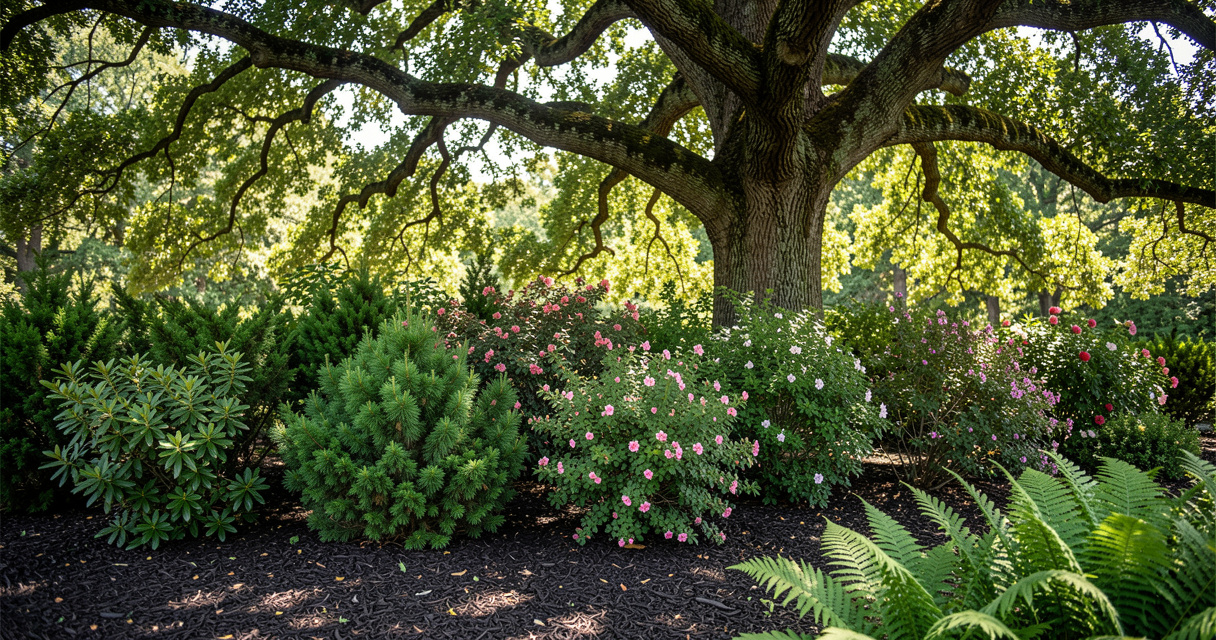
The best shrubs for shade include: (1) Aucuba japonica — evergreen, tolerates deep and dry shade; (2) Oakleaf hydrangea — four-season colour, flowers in part shade; (3) Sarcococca hookeriana var. humilis — fragrant winter flowers and evergreen foliage; (4) Japanese plum yew — evergreen, deer resistant; (5) Clethra alnifolia — fragrant summer blooms; (6) Leucothoe fontanesiana — variegated evergreen foliage; (7) Mahonia — winter fragrance and blue berries; (8) Camellia sasanqua — winter flowers in mild zones.
- Aucuba japonica (spotted laurel) — the deep-shade champion. Evergreen, glossy, red berries in autumn when a male pollinates nearby.
- Hydrangea quercifolia (oakleaf hydrangea) — four-season drama: cones of white flowers, oak-shaped leaves, burgundy autumn colour and peeling bark.
- Sarcococca hookeriana var. humilis (sweet box) — knee-high evergreen with dark leaves and winter flowers you smell before you see them.
- Cephalotaxus harringtonia (Japanese plum yew) — fine-textured, deer-resistant evergreen for structure and hedging.
- Clethra alnifolia (summersweet) — spires of fragrant white or pink flowers in late summer, and bees crowd them.
- Leucothoe fontanesiana — arching evergreen with cream-and-pink variegation that reads brightly in dim corners.
- Mahonia — architectural, spiny evergreen foliage, fragrant yellow winter flowers and blue-black berries in spring.
- Camellia sasanqua — autumn and winter flowers in Zones 7–9, glossy leaves year-round.
The next four round out the dozen, each bringing something the eight above miss: Itea virginica (sweetspire) for a long bloom window and fiery autumn colour; Fothergilla for honey-scented bottlebrush flowers in spring; Pieris japonica for early pink buds and fiery young foliage; and Ilex verticillata (winterberry) for the berries that feed birds through January.
That is twelve. Eight more earn their place: Lonicera nitida ‘Baggesen’s Gold’, Prunus laurocerasus ‘Otto Luyken’, Viburnum × hillieri ‘Winton’, Skimmia japonica, Illicium parviflorum, Gardenia jasminoides ‘Radicans’, Taxus × media ‘Hicksii’ and Hydrangea arborescens. Twenty shrubs, one garden — pick the ones that match your shade and your zone.
Top 12 shade shrubs by use case
| Shrub | Evergreen or deciduous | Mature height × spread | Light level | Standout feature |
|---|---|---|---|---|
| Aucuba japonica | Evergreen | 6–10 ft × 5–7 ft | Deep to part shade | Glossy variegated foliage, red berries |
| Hydrangea quercifolia | Deciduous | 4–8 ft × 4–8 ft | Part shade | Four-season colour |
| Sarcococca hookeriana var. humilis | Evergreen | 18 in × 3 ft | Full to deep shade | Fragrant winter flowers |
| Cephalotaxus harringtonia | Evergreen | 2–10 ft (cultivar-dependent) | Full to part shade | Deer-resistant structure |
| Clethra alnifolia | Deciduous | 3–8 ft × 4–6 ft | Part shade | Fragrant late-summer spires |
| Leucothoe fontanesiana | Evergreen | 3–5 ft × 3–5 ft | Full shade | Arching variegated foliage |
| Mahonia | Evergreen | 3–10 ft (species-dependent) | Full to part shade | Winter fragrance, blue berries |
| Camellia sasanqua | Evergreen | 5–10 ft × 5–8 ft | Part shade | Winter flowers (Zones 7–9) |
| Itea virginica | Deciduous | 3–5 ft × 4–6 ft | Part to full shade | Extended bloom, fiery autumn colour |
| Fothergilla | Deciduous | 3–6 ft × 3–5 ft | Part shade | Honey-scented spring flowers |
| Pieris japonica | Evergreen | 4–10 ft × 4–6 ft | Part shade | Early buds, fiery young foliage |
| Ilex verticillata | Deciduous | 6–10 ft × 6–10 ft | Part to full shade | Winter berries (needs male pollinator) |
Which shade shrub should you pick first?
If you only plant one, plant Aucuba. It is the one shrub on this list that will survive every shade category at once — deep, dry, full, part — and still look like something on purpose. If fragrance matters to you, Sarcococca wins. If you want four-season drama from a single plant, oakleaf hydrangea is unbeatable in part shade.
- Want fragrance? Choose Sarcococca (winter) or Clethra (summer).
- Want berries for birds? Try Ilex verticillata or Mahonia.
- Want winter colour? Leucothoe fontanesiana or Pieris japonica.
- Want fast screening? Aucuba or Prunus laurocerasus ‘Otto Luyken’.
- Small spaces? Sarcococca humilis or dwarf Cephalotaxus.
Those top performers cover the whole garden surface. Now the hard question: what holds the border up when everything else drops its leaves?
Evergreen Shrubs for Shade: Year-Round Structure
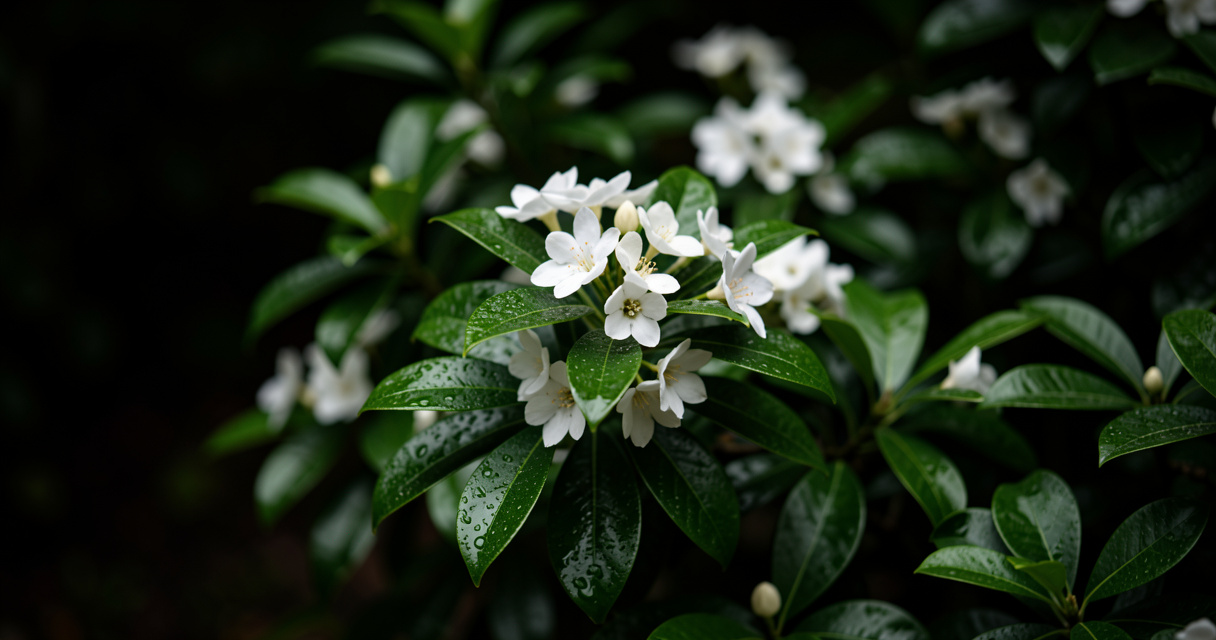
Shade borders look hollow in winter when everything drops its leaves. Evergreen shrubs for shade are the backbone that keeps the whole thing from disappearing in November. Without them you are gardening for six months a year and apologising for the other six.
According to RHS Advice, six shrubs stand out as “really robust” performers for low-light planting, including Lonicera nitida ‘Baggesen’s Gold’, Prunus laurocerasus ‘Otto Luyken’, Sarcococca hookeriana var. humilis, Viburnum × hillieri ‘Winton’ and Mahonia oiwakensis subsp. lomariifolia. I have grown four of these; the RHS list is honest.
Broadleaf evergreens for deep shade
Aucuba japonica is the one that always wins. According to RHS Advice, Aucuba japonica ‘Crotonifolia’ reaches 3 m (10 ft) and produces bright red berries in autumn when a male plant is nearby. Give it room. In my experience, people underplant it too close and then complain it looks bare at the base — but Aucuba is not a shrub that fills from the ground up unless you tip-prune young plants in their first three years.
Leucothoe fontanesiana is the next tier: pink-flushed variegated new growth that reads bright even in deep shade, and a gently arching habit that feels softer than most evergreens. Pieris japonica adds fiery red or bronze juvenile foliage and early spring flowers; the variegated ‘Little Heath’ is worth it purely for the foliage on a dim wall. Skimmia japonica, though not in every list, holds its red buds through winter and earns its keep on north-facing balconies.
Needled evergreens and conifer-type shrubs for shade
Taxus × media (yew) and Cephalotaxus harringtonia (Japanese plum yew) both tolerate shade far better than most conifers, and both are deer resistant. Cephalotaxus is the one to reach for if you want that soft, ferny, fine-textured look without the aggressive framework of traditional yew hedging. Give it well-drained soil; it resents wet feet, and clay-heavy beds will prove it within a winter.
Variegated foliage: the brightness trick for dark corners
Plain green foliage disappears into shade. Variegated foliage with cream, gold or white pushes back against it — the lighter areas reflect whatever ambient light is left. What most people get wrong is assuming variegation equals weakness; in fact the variegated forms of Aucuba, Leucothoe and Pieris are among the toughest evergreens available for low light. Don’t overthink it. If a corner feels dim and dead, swap the plain green leaf for a variegated or golden one and the entire bed reads brighter without moving a single stone.
| Shrub | Evergreen type | Light tolerance | Mature size | Winter interest |
|---|---|---|---|---|
| Aucuba japonica | Broadleaf | Deep to part shade | 6–10 ft | Variegated leaves, red berries |
| Sarcococca hookeriana var. humilis | Broadleaf | Full to deep shade | 18 in | Fragrant flowers |
| Leucothoe fontanesiana | Broadleaf | Full shade | 3–5 ft | Arching variegated foliage |
| Pieris japonica | Broadleaf | Part shade | 4–10 ft | Coloured buds through winter |
| Mahonia oiwakensis subsp. lomariifolia | Broadleaf | Full to part shade | 8–12 ft | Fragrant yellow flowers |
| Prunus laurocerasus ‘Otto Luyken’ | Broadleaf | Full to part shade | 3–4 ft × 6 ft | Glossy leaves, upright spikes |
| Viburnum × hillieri ‘Winton’ | Semi-evergreen | Full to part shade | 6–10 ft | Bronze new growth |
| Taxus × media | Needled | Full to part shade | Cultivar-dependent | Fine dark green texture |
| Cephalotaxus harringtonia | Needled | Full to part shade | 2–10 ft | Ferny foliage, deer resistant |
| Lonicera nitida ‘Baggesen’s Gold’ | Small-leaved evergreen | Part shade | 3–5 ft | Golden foliage |
Advisory: Several shade evergreens — Aucuba, Pieris and Leucothoe among them — carry toxic foliage or berries and should be avoided in gardens with curious children or pets that chew. Aucuba and Ilex verticillata also need a male pollinator nearby for fruit set. If you want berries, buy one male per five females and place it upwind of the prevailing winter wind.
Evergreens give the border its bones. But the flowers are what make people stop and look — and shade does not have to mean a flowerless garden.
Flowering Shrubs for Shade: Blooms That Beat the Low Light
The myth that shade means no flowers is the biggest missed opportunity in garden design. Flowering shrubs for shade absolutely exist, and some of them bloom for four months of the year. The trick is matching species to shade category and pruning at the right time.
Shade shrubs by bloom season
Late winter into early spring belongs to Pieris japonica (pink or white bell flowers in part shade) and Mahonia (fragrant yellow in full shade). Camellia sasanqua colours late autumn and winter in Zones 7–9. From late spring, Fothergilla brings its honey-scented bottlebrush flowers, and oakleaf hydrangea starts its long cone-flower display that peaks in midsummer.
Late summer is where shade gardening gets interesting. Clethra alnifolia sends up spires of fragrant white or pink flower from July through September, and bees and butterflies crowd them. Itea virginica follows with racemes that hold into early autumn, then turns fiery red in October. Hydrangea arborescens ‘Annabelle’ — that oversized white ball of a shrub — is another mid-season option, though it wants moisture and part shade rather than deep shade.
Be honest about the deep-shade end of the spectrum. In genuine deep shade under an established evergreen canopy, most flowering shrubs will survive without blooming. They earn their place on foliage and structure, not on flowers. Only Mahonia and some winter-flowering Camellias reliably produce colour in that level of light.
| Shrub | Bloom months | Flower colour | Fragrant | Pollinator value | Pruning timing |
|---|---|---|---|---|---|
| Pieris japonica | Feb–Apr | White/pink | Light | Medium | After flowering |
| Mahonia | Dec–Mar | Yellow | Strong | High (winter bees) | After flowering |
| Camellia sasanqua | Oct–Jan | White/pink/red | Light | Low | After flowering |
| Fothergilla | Apr–May | White | Honey | Medium | After flowering |
| Hydrangea quercifolia | Jun–Aug | White | None | Medium | Late winter (new wood) |
| Clethra alnifolia | Jul–Sep | White/pink | Strong | Very high | Late winter |
| Itea virginica | Jun–Aug | White | Light | Medium | Late winter |
| Hydrangea arborescens | Jun–Sep | White | None | Medium | Late winter (new wood) |
Pruning rules that protect next year’s flowers
Shrubs that bloom on old wood — Pieris, Mahonia, Camellia, Fothergilla — should be pruned immediately after flowering. Cut them in spring before they bloom and you sacrifice the entire display. Shrubs that bloom on new wood — Hydrangea quercifolia, H. arborescens, Clethra, Itea — respond better to late-winter or early-spring pruning because the flower buds form on that season’s growth. Get the rule backwards and you get cycles where a shrub alternates between flowering and not, with no obvious cause.
Fragrant shade shrubs for doorways and paths
Fragrance carries better in still, shaded air than in bright sun — no evaporation, no wind stripping the scent away. Place Sarcococca where you walk past it in January, Mahonia near the front door, and Clethra where you sit in the evening. My grandmother taught me that the best-scented plants belong along the path, not in the bed — you get the fragrance a dozen times a day instead of once.
Tip: If you want blooms in deep shade rather than just full shade, Mahonia and winter-flowering Camellias are your best bets. Oakleaf hydrangea, Clethra and Itea will flower in light full shade but not in the dim light beneath evergreen canopies. Choose by the light you have, not the light you wish you had.
Flowers are the reward. Whether they arrive at all depends on one thing most shade-plant lists ignore entirely: your USDA zone.
Shade Shrubs by USDA Zone: Zone 5, 6, 7 and 8+
Zone matters more for shade shrubs than for sun shrubs, because the evergreen backbone is the most cold-sensitive part of the planting. A shrub that flowers beautifully in Zone 7 may be a bare stick every March in Zone 5 — and it never quite fills back in.
Cross-zone workhorses that perform from Zone 5 to Zone 8
According to Gardenia.net’s 2025-reviewed zone guides, five shrubs appear on both the Zone 6 and Zone 7 top-performer lists — each drawn from a thirty-shrub recommendation set: oakleaf hydrangea, Aucuba, Fothergilla, Clethra and Sarcococca. Those five are the safest cross-zone bets. I would add Pieris and Japanese plum yew to that group for evergreen structure, with the caveat that Pieris needs protection from drying winter wind in Zone 5.
Zone 5: Focus on deciduous flowering shrubs and needled evergreens. Aucuba is risky except in a sheltered microclimate with good snow cover. Camellia is unrealistic. Japanese plum yew and Taxus are the reliable evergreen choices, and Fothergilla earns its place for autumn colour alone.
Zone 6: This is the sweet spot. Almost everything except the tender Camellia species works. Broadleaf evergreens like Aucuba, Sarcococca and Pieris hold up well as long as they are not hit by a hard freeze right after a thaw — which is what actually kills them most winters, not the cold itself.
Zone 7: Add Camellia sasanqua, Illicium (anise) and evergreen Mahonia to the list. This is the first zone where you can have a genuinely green winter border without wrapping anything in fleece.
Zone 8+: Almost anything works — but heat and humidity become the limiting factor. In hot-summer zones, afternoon shade is a benefit, not a limitation. Fatsia japonica, Aspidistra and evergreen Hydrangea species all thrive where summer temperatures would stress them in full sun.
Fast-growing shade shrubs for quick screening
Fast-growing shrubs for shade used as privacy screens come down to three reliable picks: Aucuba, Prunus laurocerasus ‘Otto Luyken’ and Japanese plum yew. If you need a screen in two seasons rather than five, Aucuba is the fastest reliable evergreen for shade. Oakleaf hydrangea and Itea virginica also grow quickly, but they are deciduous and somewhat leggy, so they fill rather than truly screen. Be prepared for annual shaping: fast growth in low light often produces sparse, elongated stems that need cutting back every spring.
| USDA Zone | Best evergreen | Best flowering | Best dry-shade performer | Cautions |
|---|---|---|---|---|
| Zone 5 | Cephalotaxus, Taxus | Fothergilla, Hydrangea quercifolia | Mahonia | Aucuba risky; Camellia not viable |
| Zone 6 | Aucuba, Sarcococca, Pieris | Clethra, oakleaf hydrangea | Aucuba, Mahonia | Winter burn on broadleaf evergreens |
| Zone 7 | Camellia sasanqua, Illicium | Camellia, Itea virginica | Leucothoe, Mahonia | Summer drought stress |
| Zone 8+ | Fatsia, Aspidistra | Encore azalea, Gardenia | Most species | Heat, humidity, spider mites |
Verify your zone: Use the updated USDA Plant Hardiness Zone map (current as of 2026) rather than an old printed guide. Then adjust by half a zone for microclimate — a walled garden, a sheltered city plot or a slope facing the morning sun will all push you warmer than the raw map suggests.
Zone tells you what is possible. But there is one spot in every garden where even the right shrub struggles, and it deserves a section of its own.
Tough Spots: Dry Shade, Under Trees and Root Competition
This is the hardest real-world problem in shade gardening: the strip under a mature maple, oak or pine where nothing survives. It is where “shade plants” go to die, and where the right shrub choice and the right planting method matter more than anywhere else in the garden.
Why trees beat new plantings to water
A mature oak’s root system extends two to four times its canopy width, with feeder roots concentrated in the top twelve inches of soil — exactly where your new shrub’s roots are trying to establish. Every watering you do, the tree takes first. Every rainstorm, the canopy intercepts 30 to 50 percent of the water before it reaches the ground. Surface irrigation evaporates fast and rarely penetrates to where it counts, which is why so many gardeners give up on dry shade before they have really tried.
The answer is not more water. It is different water: fewer, deeper soakings that push moisture below the tree’s feeder roots so that your shrub — planted slightly smaller, with a root ball that establishes fast — can reach it first.
Planting sequence for dry shade under canopy
The shrubs for dry shade that genuinely work are a short list: Aucuba japonica, Mahonia, Leucothoe and selected Rhododendron (the smaller Yakushimanum hybrids are the most reliable). All four handle intense root competition and remain attractive with minimal supplemental water. Do not try Hydrangea or Fothergilla here — they will tell you within one season, and the message will not be ambiguous.
The planting protocol matters as much as the plant. Amend the soil with leaf mold and compost to mimic a woodland floor and improve drainage, plant small stock — a one-gallon shrub settles in faster than a five-gallon one and catches up within two seasons — water deeply but infrequently for the first two seasons, and mulch 2 to 4 inches deep to regulate temperature and retain moisture. Gardenia.net’s shade shrub guides recommend that exact mulch depth for good reason (2025): it is deep enough to suppress weeds and hold moisture, shallow enough to let rain through.
- Amend with leaf mold and compost
- Plant small stock (1-gallon preferred)
- Water deeply for the first two seasons
- Mulch 2–4 inches, keeping it off the trunk
- Feed sparingly — low fertility suits these plants
- Never mound soil against the tree trunk
Warning: Raising the soil level over tree roots and digging deeply near the trunk can kill the tree that creates the shade you actually want. Keep new soil at no more than 2 inches over existing grade and hand-till rather than fork. A dead shade tree means a full-sun bed two years later, and you will spend a decade redesigning around that mistake.
Under pines, oaks and rhododendrons, the litter is acidic and slowly decomposes into a natural mulch. Acid-loving shrubs suit this environment: Rhododendron, Pieris, Leucothoe and most Mahonia. Do not lime the soil — you will be fighting the tree for the next decade and losing. The plant will tell you it belongs there within one season; trust it.
Not every shade problem is a woodland problem, though. If your shaded spot is a narrow strip against the house, the challenge changes completely.
Foundation and Small-Space Shade Shrubs
Foundation planting in shade is its own skill. You are choosing shrubs that stay compact, tolerate reflected heat off brick or siding, and cope with a north-facing wall — three conditions that rule out more than half the general shade shrub list. Foundation shrubs for shade also have to read from the street, which means form and structure matter more than flowers.
Compact shade shrubs under three feet
The proven foundation picks are Japanese plum yew (Cephalotaxus) and hybrid yews like ‘Hicksii’ for evergreen structure and fine texture. Add Mahonia for winter fragrance and architectural foliage, Illicium (anise) for glossy leaves, and Gardenia or Encore-type Azaleas where the climate allows repeat bloom. Sarcococca humilis caps out at 18 inches and quietly does more work than any other small shade shrub I know.
A size rule that saves a lot of frustration: keep foundation shrubs below the sill line of the nearest window. If the shrub will mature at four feet and the sill is at three, either pick a smaller shrub or move the planting out two feet. Also leave 12 to 18 inches of clearance from the wall for airflow — crowded shrubs in shade are the first to develop fungal problems, and once black spot or leaf blight arrives on a shade shrub it is tedious to remove.
Shade shrubs for containers and balconies
Shade-tolerant shrubs in containers work better than most people expect. Dwarf forms of Cephalotaxus, Sarcococca humilis, Pieris ‘Little Heath’ and Skimmia japonica ‘Rubella’ all thrive in a north-facing balcony pot provided drainage is excellent and you do not let the pot dry out completely. Use a compost-based, loam-enriched potting mix rather than cheap multi-purpose — the extra structure matters in shade because re-wetting a dry pot is difficult and the root zone stays colder than it does in sun.
| Shrub | Mature height × spread | Evergreen | Why it works at the foundation | Climate limits |
|---|---|---|---|---|
| Cephalotaxus harringtonia ‘Fastigiata’ | 4–8 ft × 2–3 ft | Yes | Narrow upright form, deer resistant | Zone 6–9 |
| Taxus × media ‘Hicksii’ | 8–12 ft × 3–4 ft | Yes | Fine-textured hedge, shade tolerant | Zone 4–7 |
| Mahonia aquifolium | 3–6 ft × 3–5 ft | Yes | Winter fragrance, low maintenance | Zone 5–8 |
| Illicium parviflorum | 6–10 ft × 4–8 ft | Yes | Glossy foliage | Zone 7–10 |
| Gardenia jasminoides ‘Radicans’ | 1–2 ft × 2–3 ft | Yes | Repeat bloom, fragrance | Zone 8–11 |
| Sarcococca hookeriana var. humilis | 18 in × 3 ft | Yes | Groundcover evergreen | Zone 6–8 |
| Pieris japonica ‘Little Heath’ | 2–3 ft × 2–3 ft | Yes | Variegated foliage, compact | Zone 5–8 |
Design rule: Keep foundation shrubs below the window sill and leave 12–18 inches of clearance between foliage and the wall to allow airflow and prevent moisture-driven disease.
Choosing plants is half the work. The other half — the part that determines whether the border thrives in year three or quietly declines — is what you do after planting.
Planting, Care and Design: Making a Shade Border Actually Work
Selection is 50 percent of the job. The other half is care and design, and it is where shade gardens are won or lost. Shade garden design is less about collecting plants and more about building structure that reads in low light — the same bones a good interior decorator uses when a room faces north.
Three years ago I started converting a north-facing border in my own Haarlem garden — 14 square metres of clay, in the permanent shadow of a neighbour’s wall, with a mature birch root system running through it. Year one, I lost an azalea, a dwarf hydrangea and two heucheras. I learned: the birch was drinking everything. Year two, I planted Aucuba, Sarcococca humilis and Japanese plum yew. All three thrived. By year three the border no longer looked like a compromise. Two shrubs — Aucuba and Japanese plum yew — carry the entire design. Everything else is decoration.
A month-by-month maintenance calendar
- January–February: Prune deciduous shrubs that bloom on new wood (Clethra, Itea, Hydrangea arborescens). Apply a 2–4 inch mulch layer if the bed is thin.
- March–April: Top-dress with compost. Prune evergreens lightly if needed. Watch for slug damage on new growth.
- May–June: Water deeply during establishment. Deadhead early bloomers. Prune spring-flowering shrubs only after they finish.
- July–August: Monitor moisture under tree canopies. Do not fertilise — soft growth in shade is a liability, not a benefit.
- September–October: Plant new shrubs — autumn is the best season for establishment in shade. Gather leaf mold for next spring’s amending.
- November–December: Leave the structure standing. Resist the urge to cut everything down. Berries feed birds; seed heads and evergreen shape give the border something to say in the darkest months.
Three-layer planting for dark corners
Build every shady border in three layers. The evergreen backbone — Aucuba, Cephalotaxus, Mahonia — gives structure and shape. The flowering mid-layer — oakleaf hydrangea, Clethra, Pieris, Fothergilla — provides seasonal colour. The groundcover skirt — Sarcococca humilis, Epimedium, ferns — knits everything together and suppresses weeds. Without the third layer the transition between shrub and soil looks unfinished.
Repeat a single species rather than collecting one of everything. Rhythm reads as intention; chaos reads as a nursery clearance. Choose white or pale flowers, which stand out in low light better than dark colours. Use variegated and gold foliage to lift corners. And resist the urge to fill every square inch — negative space is what makes a shade garden feel calm rather than crowded. The best shade borders I have designed in twelve years had fewer than a dozen species each.
- Winter structure: Evergreen foliage, coloured stems, bare branch form
- Spring bloom: Pieris, Fothergilla, Camellia, Mahonia
- Summer fragrance: Clethra, Itea, Fothergilla
- Autumn colour: Oakleaf hydrangea, Itea, Fothergilla
- Winter berries: Ilex verticillata, Mahonia, Aucuba
Frequently Asked Questions
What is the best shrub for full shade?
Aucuba japonica is the top all-rounder for deep shade, followed by Sarcococca for winter fragrance and Japanese plum yew for evergreen structure. Remember that “full shade” still means bright indirect light — no shrub will grow in a black corner with no light at all.
Do shade shrubs need fertilizer?
Generally no heavy feeding. Most shade shrubs prefer organic, low-fertility soils, and overfeeding pushes soft growth that burns in limited light. Top-dress with compost in spring instead of using synthetic fertiliser, and let the soil biology do the work.
Can hydrangeas grow in full shade?
Oakleaf hydrangea and smooth hydrangea handle part shade to light full shade, but flowering declines in deep shade. Give them morning sun for the best bloom and keep the soil consistently moist — they do not tolerate dry shade and will not forgive a summer drought.
Which shrubs stay green in shade all year?
Aucuba, Sarcococca, Leucothoe, Pieris, Taxus and Cephalotaxus are the reliable broadleaf and needled evergreens. Variegated forms brighten dark corners better than plain green, and Sarcococca humilis is the best of the lot for a low, spreading evergreen in deep shade.
What is the fastest growing shrub for shade?
Oakleaf hydrangea, Itea virginica, Fothergilla and selected Viburnums fill quickly. Be warned: fast growth in low light often means leggy, sparser form that needs annual pruning to stay full, so plan on shaping them every spring.
Are shade shrubs deer resistant?
Some are far better than others. Japanese plum yew, Leucothoe, Pieris and Mahonia are relatively unpalatable. Aucuba and Hydrangeas are frequently browsed and should be protected with netting or repellent in high-deer areas.
What can I plant under a tree where nothing grows?
Aucuba, Mahonia and Leucothoe handle dry root-crowded shade best. Amend with leaf mold and compost, plant small stock, water deeply for two seasons and mulch 2–4 inches without touching the trunk. Do not dig deeply — you will damage the tree roots that create the shade in the first place.
Where Shade Gardening Actually Begins
Identify your shade type first. Part, full, deep or dry — that single diagnosis determines everything else you do, from plant choice to watering routine. Get it wrong and even the toughest shrub struggles; get it right and plants you would never have considered suddenly look obvious.
Build a three-layer border. Evergreen backbone, flowering mid-layer, groundcover skirt. The structure gives the border weight in winter; the flowering layer earns its keep from spring to autumn; the skirt knits the whole thing into the soil.
Match shrub to USDA zone — and treat broadleaf evergreens as the riskiest choice in colder zones. In Zone 5, lean on needled evergreens and deciduous flowering shrubs; in Zone 7 and above, you can build a nearly all-evergreen shade garden that looks intentional in every month of the year.
Success in shade is a soil story. Amend with organic matter, mulch 2 to 4 inches, water deeply during establishment and feed sparingly. Shade-loving shrubs do not want rich food — they want good structure, consistent moisture and time.
So which corner of your garden are you finally going to reclaim this autumn? Don’t overthink it. Start with one Aucuba, one Sarcococca, and a bag of leaf mold. The rest will follow.

I’ve spent over fifteen years in botanical gardens and nurseries across the Netherlands and Belgium. Now I garden in Haarlem and write what I wish someone had told me sooner. No fluff — just what actually works.