

Reading time: 18 min
Key Takeaways
- Shade is not one thing. Full shade, partial shade, and dappled shade each call for different plants — match the species to the light, not the other way around.
- Moisture matters more than light. Dry shade under mature trees is a completely different habitat from wet shade beside a downspout, and the plant lists barely overlap.
- Layer like a woodland. Combining canopy, mid-story, and groundcover plants mirrors natural succession and gives you four seasons of interest from one bed.
- Foliage first, flowers second. In low light, leaf colour, texture, and form carry the design — bloom is the bonus, not the foundation.
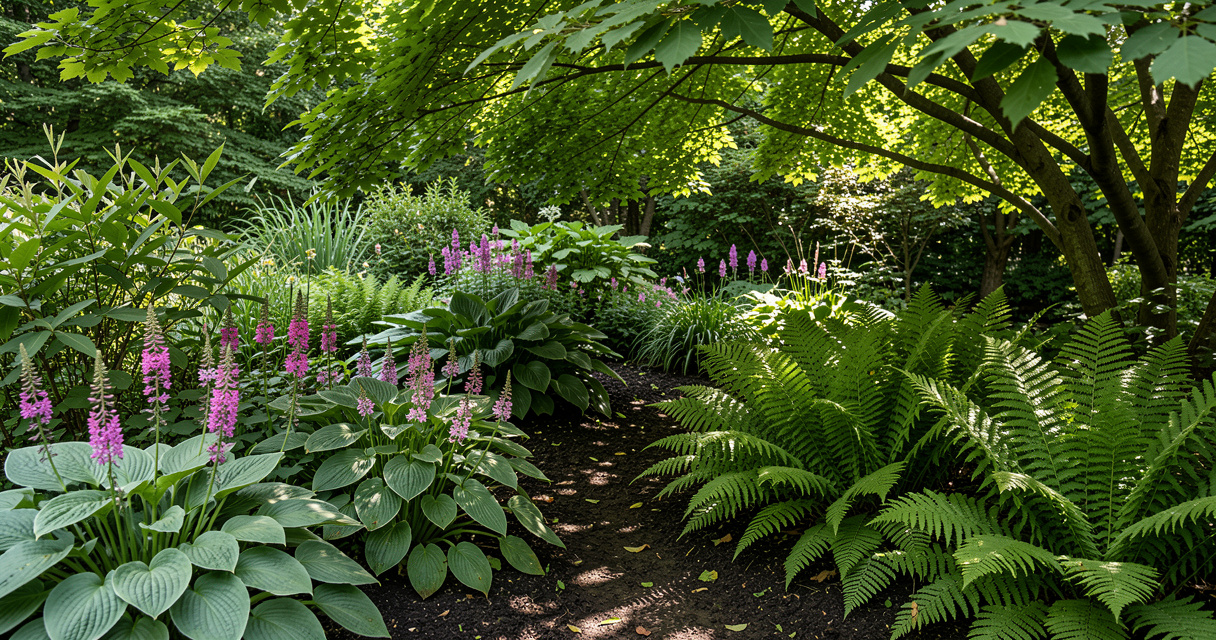
Is your garden’s shadiest corner a dead zone, or could it become your most vibrant retreat? I have lost count of the gardeners who tell me their north-facing bed is ‘good for nothing.’ In my experience, that is rarely true — it usually means the wrong plants were tried in the wrong soil. Shade garden design is not about settling. It is about working with a completely different set of rules.
Over twelve years consulting for botanical gardens in the Netherlands and Belgium, I have planted more shade beds than sunny ones. My grandmother’s Friesland garden — all ferns, hostas, and wild grasses — taught me early that low-light spaces can be lush, layered, and alive. This guide gathers what actually works: the best shade loving flowers by category, zone, and moisture level, plus the design framework I use to turn a gloomy corner into a shade garden you will want to sit in. Whether you are dealing with deep low-light under a maple or the filtered glow beneath a birch, there is a plant for it. Let me show you what actually works.
What Are Shade-Loving Flowers? Light Levels, Soil, and Microclimates Explained
Shade-loving flowers are plants that thrive in less than six hours of direct sunlight. They include perennials like hostas, astilbes, and hellebores, plus annuals such as impatiens and torenia. Most prefer moist, humus-rich soil and are ideal for woodland gardens, north-facing beds, and under trees.
That is the short answer. The longer one — the one that separates a thriving shade bed from a sad collection of leggy plants — depends on understanding which kind of shade you actually have. Full shade flowers perform in fewer than three hours of direct sun. Partial shade flowers handle three to six hours, ideally in the morning. And dappled shade, my personal favourite, gives plants filtered light all day long under a high canopy.
Types of Shade: Full, Partial, and Dappled
I measure shade with a simple trick: stand in the spot at 10 am, 1 pm, and 4 pm on a clear day and note whether you cast a sharp shadow. Sharp shadow equals sun. Soft, blurred shadow equals dappled or partial shade. No shadow at all means full shade — and that is where foliage plants and a handful of tough bloomers earn their keep.
| Shade Type | Sun Hours | Best Flower Examples |
|---|---|---|
| Full shade | Less than 3 hours | Hellebore, bleeding heart, hosta (foliage), torenia |
| Partial shade | 3–6 hours | Astilbe, columbine, lungwort, Japanese anemone |
| Dappled shade | Filtered all day | Epimedium, brunnera, heuchera, wild geranium |
| Deep shade | Under dense evergreen | Ferns, ivy, sweet woodruff — foliage only |
Definition: Dappled Shade
Dappled shade is sunlight that filters through a leafy canopy, creating a shifting mosaic of light and shadow across the ground. Because plants receive brief, gentle bursts of sun throughout the day rather than a single intense block, they experience less heat stress and less leaf scorch. It is the closest thing to ideal for most woodland perennials.
Soil Preparation for Shade Gardens
What most people get wrong is treating shade soil like sunny soil. It is not. Shade beds dry out more slowly, hold more organic matter from fallen leaves, and often sit on compacted ground because the tree roots above have been competing for decades. Before you plant a single perennial, dig a test hole and check two things: drainage and pH.
Most shade perennials want a pH between 6.0 and 7.0 and a soil that feels like a wrung-out sponge — moist but never waterlogged. If your soil is heavy clay, work in two to three inches of leaf mould or well-rotted compost to a depth of about 20 centimetres. If it is sandy and drains instantly, add the same compost plus a thin layer of mulch to hold moisture. Wageningen University trials have shown that a 5 cm organic mulch layer reduces summer watering needs in shade beds by roughly 30% — one of the simplest wins in gardening.
Microclimates: Why Some Shady Spots Are Drier
Two spots can both be north-facing and still behave completely differently. A bed under a mature Norway maple is bone-dry all summer because the tree’s surface roots intercept every drop of rain. A bed beside a north wall may stay damp for days because air movement is restricted and evaporation is slow. Neither is better — they simply support different plants.
Once you know your shade type and your moisture level, plant selection becomes straightforward. The next section walks through the perennials that form the backbone of every shade garden I design.
Top 15 Perennial Shade-Loving Flowers for Year-After-Year Color
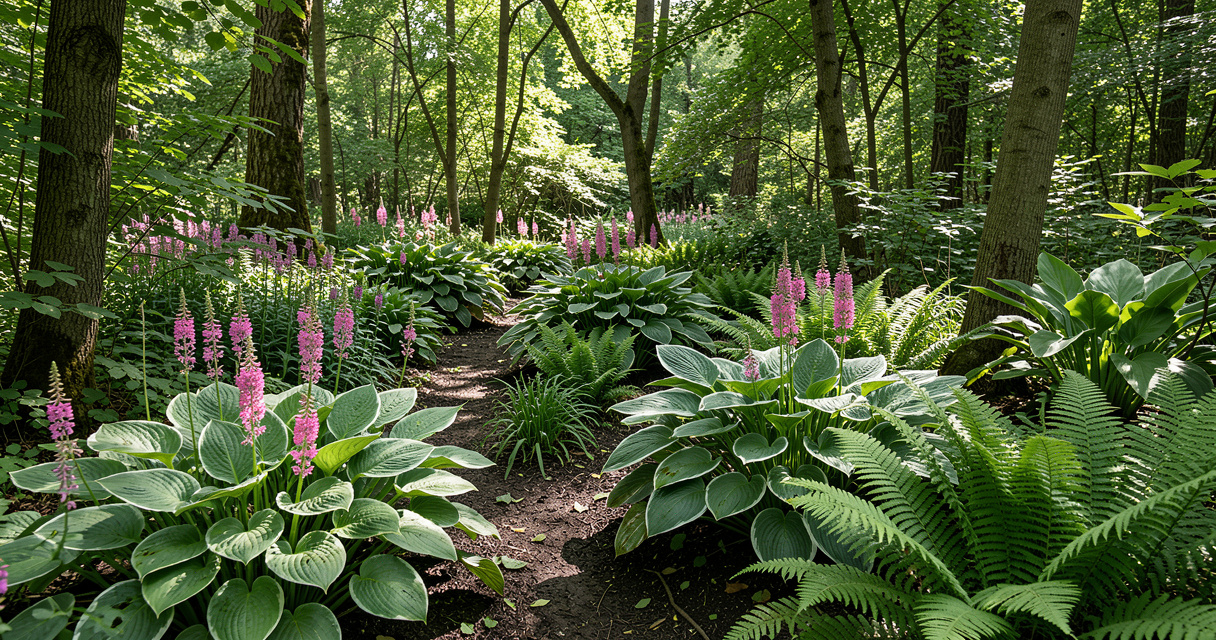
Perennials are the investment layer of a shade garden. They cost more up front than annuals, but they return every spring, divide freely, and give a bed its permanent architecture. Here are the fifteen I reach for most often, grouped by their peak season.
Early Spring Bloomers: Hellebores and Bleeding Hearts
Hellebore (Helleborus spp.) opens in late winter, often while snow still lingers, with nodding cup-shaped flowers in cream, plum, and dusty rose. Height 30–45 cm, zones 4–9, evergreen foliage. It is the single best plant for extending the shade season backwards.
Bleeding heart (Lamprocapnos spectabilis) follows in mid-spring with arching stems of heart-shaped pink flowers. Height 60–90 cm, zones 3–9. It goes dormant by midsummer — plant it behind hostas so the gap is filled.
Lungwort (Pulmonaria) starts blooming with the hellebores and gives spotted silver foliage all season. Zones 3–8, height 25–30 cm.
Columbine (Aquilegia) is the shade pollinator champion — hummingbirds cannot resist its nodding spurs. Zones 3–9, height 45–75 cm.
Summer Stars: Astilbe, Ligularia, and Toad Lily
Astilbe delivers feathery plumes in pink, red, and white from June to August — the workhorse of the summer shade bed. Height 45–90 cm, zones 3–8. Needs consistent moisture.
Ligularia (‘The Rocket’, ‘Britt-Marie Crawford’) brings drama with bold leaves and tall golden spires. Zones 4–8, height 90–150 cm. Wants wet soil.
Toad lily (Tricyrtis) blooms in late summer and autumn with orchid-like spotted flowers — an unusual, collector’s choice. Zones 5–9, height 60–90 cm.
Japanese anemone (Anemone hupehensis) finishes the season with waving white or pink flowers from August to October. Zones 4–8, height 90 cm.
Brunnera (Brunnera macrophylla) produces forget-me-not-blue sprays in spring and heart-shaped silver foliage all summer. Zones 3–8, height 40 cm.
Evergreen and Foliage Perennials: Hosta, Heuchera, and Ferns
Hosta is the defining shade plant of the northern hemisphere — hundreds of cultivars from 15 cm miniatures to 90 cm giants. Zones 3–9. Grown for leaf colour, texture, and form rather than flowers.
Heuchera (coral bells) offers foliage in amber, plum, lime, and nearly black, with delicate wands of tiny flowers in early summer. Zones 4–9, height 25–40 cm.
Japanese painted fern (Athyrium niponicum var. pictum) is the most beautiful foliage plant in any shade garden — silver, burgundy, and green on one frond. Zones 5–8, height 40 cm.
Epimedium (barrenwort) is drought-tolerant and produces delicate spring flowers above semi-evergreen leaves. Zones 4–8, height 25 cm.
Solomon’s seal (Polygonatum) has arching stems with dangling white bells. Zones 3–8, height 60–90 cm.
Wild geranium (Geranium maculatum) blooms pink in spring in dry shade and turns reddish in autumn. Zones 3–8, height 45 cm.
| Plant | Bloom Time | Height | Zone | Light | Moisture |
|---|---|---|---|---|---|
| Hellebore | Late winter–early spring | 30–45 cm | 4–9 | Full to partial shade | Moist, well-drained |
| Bleeding heart | Mid-spring | 60–90 cm | 3–9 | Partial to full shade | Moist |
| Lungwort | Early–mid spring | 25–30 cm | 3–8 | Partial shade | Moist |
| Columbine | Late spring | 45–75 cm | 3–9 | Partial shade | Medium |
| Astilbe | Early–late summer | 45–90 cm | 3–8 | Partial shade | Consistently moist |
| Ligularia | Midsummer | 90–150 cm | 4–8 | Partial to full shade | Wet |
| Toad lily | Late summer–autumn | 60–90 cm | 5–9 | Partial shade | Moist |
| Japanese anemone | Late summer–autumn | 90 cm | 4–8 | Partial shade | Medium |
| Brunnera | Spring | 40 cm | 3–8 | Partial to full shade | Moist |
| Hosta | Summer (foliage) | 15–90 cm | 3–9 | Full to partial shade | Moist |
| Heuchera | Early summer | 25–40 cm | 4–9 | Partial shade | Well-drained |
| Japanese painted fern | Non-flowering | 40 cm | 5–8 | Full to partial shade | Moist |
| Epimedium | Spring | 25 cm | 4–8 | Partial to full shade | Dry to medium |
| Solomon’s seal | Late spring | 60–90 cm | 3–8 | Partial to full shade | Moist |
| Wild geranium | Spring | 45 cm | 3–8 | Partial shade | Dry to medium |
Tip: How to divide hostas and heucheras for free plants
Lift clumps in early spring just as the new shoots emerge. Slice through the crown with a sharp spade, keeping at least three ‘eyes’ per division. Replant at the same depth, water well, and mulch. A single mature hosta can yield four or five new plants in one morning — the cheapest way I know to fill a large shade bed.
These perennials give you permanent structure, but shade gardens can feel slow to colour up. That is where annuals earn their place — quick impact while the perennials settle in.
Best Annual Shade-Loving Flowers for Instant Color and Containers
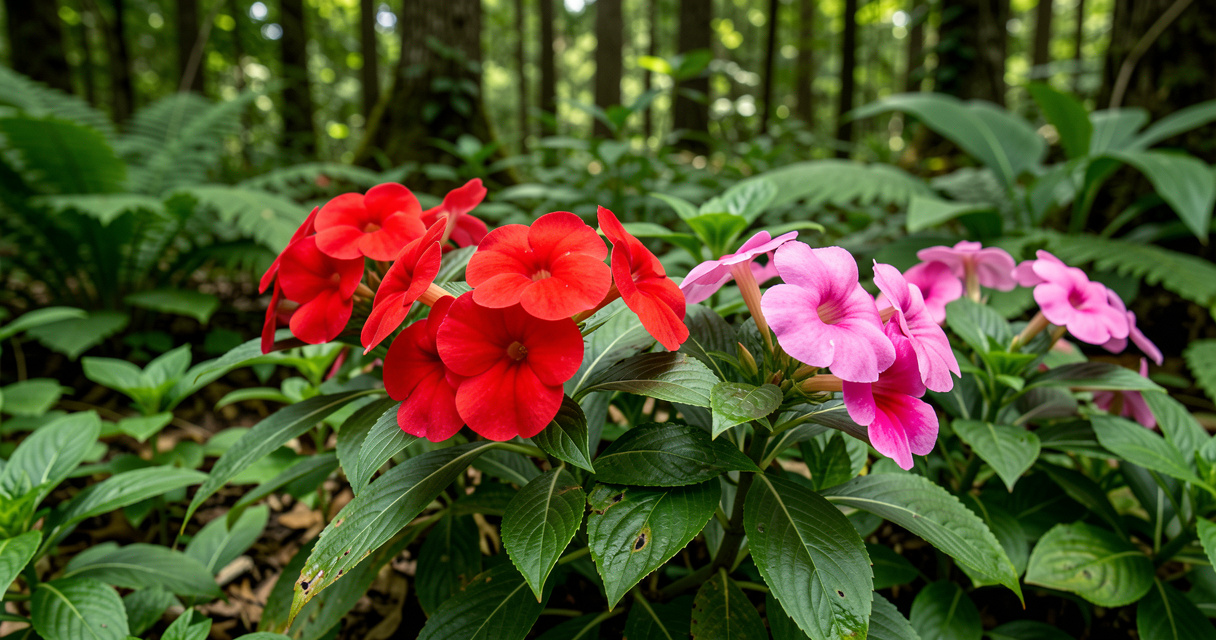
If you want colour this season — not next — annuals are the answer. They are also the best solution for shaded balconies, patios, and front-door pots, where perennials struggle with the confined root space. The three questions I hear most are simple, so let me answer them directly: yes, impatiens grow in full shade; yes, annuals flower all summer in low light; and no, they are not more work than sun annuals — they are usually less, because they do not bake dry.
Impatiens, Torenia, and Wishbone Flower
Impatiens (Impatiens walleriana) is still the most reliable flowering annual for shade, provided you choose the disease-resistant ‘Beacon’ or ‘New Guinea’ series. Height 25–60 cm, spreads into a soft mound, blooms from early summer to frost. Available in nearly every colour except true blue.
Torenia (wishbone flower, Torenia fournieri) is the thinking gardener’s impatiens — trumpet-shaped flowers with yellow throats in violet, pink, and white. It tolerates more heat and humidity than impatiens, self-cleaning, and rarely needs deadheading. Zones 2–11 as an annual.
Wishbone flower ‘Catalina Pink’ and its cousins make excellent trailing basket plants — they cascade 30–45 cm without becoming straggly, which is rare for a shade annual.
Coleus and Caladium for Foliage
Coleus (Coleus scutellarioides) is the single best annual for shade foliage drama. Modern cultivars (the ‘ColorBlaze’ and ‘Main Street’ series) hold their colour without pinching, in combinations of lime, burgundy, pink, and rust. Height 30–90 cm.
Caladium offers heart-shaped leaves in white, pink, and red with striking veins — ideal for brightening deep shade where flowers simply will not perform. Height 30–60 cm. Needs warm soil above 20°C before planting.
Container Combinations for Shade
- Choose a pot at least 35 cm across with drainage holes — small pots dry out too fast even in shade.
- Use a peat-free potting mix with 20% perlite for airflow around roots.
- Water when the top 2 cm feels dry — check daily in midsummer, weekly in spring.
- Feed every two weeks with a half-strength balanced liquid fertilizer. Never full strength in shade — weak growth follows.
- Rotate pots a quarter turn weekly so all sides develop evenly.
Field note from a north-facing balcony in Haarlem: A client had given up on her balcony — three square metres, north-facing, permanently shaded by the building opposite. We filled three tall pots with ‘Beacon’ impatiens in soft coral, edged with ‘ColorBlaze Lime Time’ coleus, and added one trailing torenia per pot. By mid-July the balcony looked like a small green room. She told me weeks later that neighbours were stopping on the street to ask what she had done. Nothing complicated — just the right plants for the right light.
Containers handle the low-light spots, but the real design challenge is whether the soil under your perennials is dry or damp. Get that wrong and even the best plants sulk.
Dry Shade vs. Wet Shade: Matching Flowers to Moisture
This is the distinction that decides whether a shade garden thrives or fails, and it is the one most guides skip. Light tells you what will survive. Moisture tells you what will flourish. Get out your trowel and dig a hole 30 cm deep in the middle of your shade bed. Fill it with water. If it drains within an hour, you have dry shade. If it still sits there after three hours, you have wet shade.
Plants for Dry Shade: Epimedium, Geranium macrorrhizum, and Carex
Dry shade — the reality under most mature trees and along north-facing walls — is the hardest garden condition there is. The tree takes the water, the shade slows evaporation but not enough, and every plant has to fight for scraps. These five earn their place:
- Epimedium — semi-evergreen, delicate spring flowers, drought-tolerant once established.
- Geranium macrorrhizum — pink spring flowers, aromatic foliage, spreads to form weed-suppressing mats.
- Carex (sedges) — evergreen grassy texture, tolerates root competition better than almost any grass.
- Liriope — grassy foliage with late-summer lilac spikes, extremely tough.
- Dryopteris filix-mas (male fern) — the most drought-tolerant of the common ferns.
Plants for Wet Shade: Ligularia, Astilbe, and Siberian Iris
Wet shade is a gift. It appears beside downspouts, along north walls where rain lingers, and in low corners where water pools. Here the plants that fail in dry beds absolutely shine:
Ligularia — the star of wet shade, with bold foliage and towering golden spires up to 1.5 m. Astilbe — plumes in pink, red, and white from June to August. Siberian iris (Iris sibirica) — elegant blue-violet flowers in early summer, zones 3–8. Rodgersia — architectural leaves up to 60 cm across, cream flower plumes in summer. Primula — spring woodland colour in yellow, pink, and purple.
| Condition | Soil Amendment | Top 5 Plants |
|---|---|---|
| Dry shade | 5 cm leaf mould + 2 cm compost, no fertilizer | Epimedium, Geranium macrorrhizum, Carex, Liriope, Dryopteris |
| Wet shade | 3 cm compost + 2 cm grit for drainage in heavy clay | Ligularia, Astilbe, Siberian iris, Rodgersia, Primula |
| Average shade | 5 cm leaf mould, top-dress annually | Hosta, Heuchera, Brunnera, Hellebore, Ferns |
Improving Soil Moisture Retention
For dry shade, the fix is organic matter, applied patiently. Spread 5 cm of leaf mould or compost over the bed each autumn and let the worms work it in. Never cultivate deeply under trees — you will sever the surface roots that keep them alive. For wet shade, the fix is drainage: fork the soil, add grit, and if water truly stands, plant in slight mounds so crowns stay above the water table.
Test this yourself: dig a 30 cm hole, fill it with water, and time how long it takes to drain. Under one hour is dry shade. Over three hours is wet shade. Between the two, you have average shade and the widest plant palette of all.
Warning: Avoid planting under shallow-rooted trees like birch, willow, and poplar without protecting the root zone. Every fork of the soil damages fine feeder roots, and the tree will respond by sending up suckers. Instead, plant in pockets between major roots, or use containers sunk into the ground with their bases intact.
Moisture is the foundation. Design is what turns a collection of good plants into a garden that holds your eye for the whole season.
Shade Garden Design: Layering, Texture, and Succession of Bloom
Shade garden design works on the same principles as a woodland: you build vertically, you repeat with restraint, and you let foliage do most of the visual heavy lifting. My grandmother’s garden in Friesland had no plan and no straight lines, and yet it worked — because she instinctively copied the layers she had seen in the forest.
Layering Canopy, Mid-Story, and Groundcover
Every great shade bed has three layers. The canopy is the structure above — usually a tree or large shrub you are planting around, but sometimes a tall perennial like ligularia. The mid-story is where most colour lives: astilbe, hellebore, hosta, heuchera. The groundcover closes the floor: wild ginger, sweet woodruff, epimedium, or simply a good mulch. Design like this and the bed reads as a single living thing rather than a row of plants.
| Layer | Height | Plant Examples |
|---|---|---|
| Canopy | 200+ cm | Japanese maple, dogwood, hydrangea, ligularia |
| Mid-story | 40–120 cm | Hosta, astilbe, hellebore, heuchera, bleeding heart |
| Groundcover | 10–30 cm | Epimedium, wild ginger, sweet woodruff, lungwort |
Using Foliage for Texture and Contrast
In shade, flower colour is muted by default — most shade bloomers are white, pink, yellow, or violet, rarely hot orange or scarlet. The compensating gift is foliage. Combine broad hosta leaves with fine fern fronds. Set silver brunnera against deep burgundy heuchera. Put strap-like liriope beside the feathery fronds of Japanese painted fern. Texture carries more design weight than colour in low light because every leaf is visible without glare.
Planning for Succession of Bloom
Nothing looks worse than a shade garden that peaks for three weeks in June and sighs for the rest of the year. Plan for staggered bloom in the same bed: hellebores in February, bleeding hearts in April, astilbe in June, toad lilies in September, Japanese anemones in October. The full calendar is laid out further down this guide — the point here is that the planning happens on paper before a single plant goes in.
From a designer’s woodland garden in Gelderland: The entire bed — thirty metres long — relies on only four flowering species. Everything else earns its keep through foliage form and autumn colour. It looks richer than beds with three times the species count, because nothing competes and every leaf reads clearly.
Design is choice. Care is discipline — and the care mistakes I see most often in shade gardens all come back to one thing: too much love.
Common Mistakes and Expert Care Tips for Shade-Loving Flowers
If a shade plant is failing, the answer is almost never ‘not enough sun.’ It is water, drainage, or roots. Fix those three and the plants take care of themselves.
Watering and Drainage: The #1 Killer
Shade soil dries slowly. Gardeners who water on a fixed schedule drown their plants without realising it. Water only when the top 3 cm of soil feels dry to the touch — in most shade beds, that means once a week in summer and once every two weeks in spring. If your bed is waterlogged, the fix is not less water, it is better drainage: fork in grit, raise the crown of plants on small mounds, or switch to plants that thrive in wet conditions.
Pest and Slug Management
Slugs and snails love the cool, damp conditions of a shade garden. In twelve years of shade work, the two things that have always worked for me are: a copper ring around vulnerable plants (hostas, especially), and a night patrol with a torch during the first rainy week of spring. Beer traps work for some gardeners, but they need emptying daily — and by morning they smell far worse than the slugs they caught.
Deer are the other pressure. Deer resistant shade plants include daffodils, hellebores, ferns, astilbe, epimedium, and Japanese anemone. Hostas and impatiens, sadly, are deer candy. In high-pressure areas, fencing is the only reliable solution — no repellent works forever.
Fertilizing Shade Plants: Less Is More
Shade plants grow slowly. Slow growth does not need heavy feeding. What most people get wrong is reaching for the same fertilizer they use on roses or tomatoes. A single top-dressing of compost in early spring is enough for most shade perennials. If a plant looks pale, water it with a half-strength balanced liquid feed once — and stop there.
- Spring: Cut back winter-damaged hellebore foliage, top-dress with 3 cm compost, divide overgrown clumps.
- Summer: Water deeply once a week in dry spells, mulch to 5 cm, patrol for slugs after rain.
- Autumn: Leave seedheads for birds, mulch again, divide peonies and anemones if clumps are crowded.
- Winter: Do nothing — except enjoy the evergreen structure of hellebores, ferns, and heuchera.
Warning: Over-fertilizing shade plants causes weak, floppy growth, fewer flowers, and greater susceptibility to slugs and disease. Rich soil grows big hostas and pale astilbes. Moderate feeding grows the plants you actually want.
Good care keeps plants alive. Choosing natives keeps the garden alive with wildlife — pollinators, birds, and everything in between.
Native and Pollinator-Friendly Shade-Loving Flowers
Yes, shade flowers attract pollinators — but the visitors are different from a sunny meadow. You will see fewer honeybees and more solitary bees, hoverflies, and moths. Hummingbirds will visit columbine and bleeding heart in partial shade. Native plants matter because local pollinators evolved alongside them; a non-native astilbe feeds a bee, but a native wild geranium feeds a whole ecosystem.
Northeast and Midwest Natives: Wild Geranium, Solomon’s Seal
Wild geranium (Geranium maculatum) blooms pink in spring and is a larval host for several moth species. Solomon’s seal (Polygonatum biflorum) dangles white bells in late spring and feeds bumblebees. Wild columbine (Aquilegia canadensis) is a hummingbird magnet from April to June. Foamflower (Tiarella cordifolia) creates a pollinator-friendly groundcover.
Southeast Natives: Columbine, Foamflower
Eastern columbine (Aquilegia canadensis) thrives in the Southeast’s humid shade. Foamflower (Tiarella) prefers the cooler, damper corners of southern gardens. Wild ginger (Asarum canadense) provides unusual brown flowers at ground level for beetles and flies.
Pacific Northwest Natives: Inside-Out Flower, Vanilla Leaf
Inside-out flower (Vancouveria hexandra) is a delicate groundcover with white petals that curl backward. Vanilla leaf (Achlys triphylla) has fan-shaped leaves and a soft vanilla scent when dried. Redwood sorrel (Oxalis oregana) tolerates deep shade better than almost any native.
| Region | Native Flower | Pollinator Attracted |
|---|---|---|
| Northeast | Wild geranium, Solomon’s seal, wild columbine | Bumblebees, solitary bees, hummingbirds |
| Southeast | Eastern columbine, foamflower, wild ginger | Hummingbirds, beetles, small flies |
| Midwest | Wild geranium, Jacob’s ladder, woodland phlox | Native bees, hoverflies |
| Pacific Northwest | Inside-out flower, vanilla leaf, redwood sorrel | Bumblebees, moths |
Tip: Avoid invasive species — including some widely sold ‘shade groundcovers’ such as lesser periwinkle, bishop’s weed, and English ivy. Check your regional native plant society’s list before you plant. The plant will tell you if it is too happy: if it spreads into neighbours’ beds, it is not a groundcover, it is a problem.
Natives anchor the ecology of a shade garden. The final piece is knowing when everything blooms, so you can plan for colour from February to November.
Seasonal Shade Garden Calendar: What Blooms When
A shade garden that blooms all season is not an accident. It is a calendar. Here is the month-by-month sequence I plan from, with zone notes for hardiness.
| Month | Blooming Shade Flowers | Zone Notes |
|---|---|---|
| Feb–Mar | Hellebore (Helleborus niger, H. orientalis) | Zones 4–9 |
| Mar–Apr | Lungwort, early daffodils, snowdrops | Zones 3–8 |
| Apr–May | Bleeding heart, columbine, wild geranium | Zones 3–9 |
| May–Jun | Solomon’s seal, brunnera, epimedium | Zones 3–8 |
| Jun–Jul | Astilbe, heuchera, torenia | Zones 3–9 |
| Jul–Aug | Ligularia, impatiens, wishbone flower | Zones 4–9 |
| Aug–Sep | Toad lily, Japanese anemone, hardy begonia | Zones 5–9 |
| Sep–Oct | Japanese anemone, cyclamen (Cyclamen hederifolium) | Zones 5–9 |
| Nov–Jan | Evergreen foliage, berries (skimmia, holly) | Zones 5–9 |
Overlap is the goal. Aim for at least three species in bloom in every month from March to October, and the foliage of evergreen structure — hellebores, ferns, heuchera, liriope — through the depths of winter. That is how a shade garden reads as alive all year, not just at its peak.
Frequently Asked Questions
What are the best shade-loving flowers for full shade?
Hostas, astilbes, hellebores, bleeding hearts, impatiens, and torenia all tolerate less than three hours of direct sun. For deep shade in particular, focus on foliage plants and early bloomers — they carry the bed when flowers simply cannot.
Do shade-loving flowers need a lot of water?
Most prefer moist, well-drained soil. Dry shade plants like epimedium need less water, while wet shade plants like ligularia thrive in consistently damp soil. The real mistake is overwatering — check the top 3 cm before you pour.
Can shade-loving flowers grow in containers?
Yes. Impatiens, coleus, caladium, and torenia are outstanding in containers. Choose a potting mix with good drainage, always have drainage holes, and water only when the top layer feels dry.
What flowers bloom in deep shade?
Very few. Hellebores, bleeding hearts, lungwort, and some ferns provide colour and texture. For reliable performance in true deep shade, focus on foliage — the visual impact is every bit as strong.
Are shade-loving flowers deer resistant?
Some are: daffodils, hellebores, ferns, epimedium, and astilbe. Deer may nibble hostas and impatiens heavily. In high-pressure areas, use repellents plus fencing — no spray works forever.
How do I prepare soil for shade-loving flowers?
Amend with compost, ensure good drainage, and never work compacted soil without adding organic matter. Test pH for specific plants — most shade perennials want 6.0 to 7.0.
What shade-loving flowers attract pollinators?
Astilbe, columbine, bleeding heart, and native wild geranium attract bees, butterflies, and hummingbirds. Plant in groups of three or more for the best visibility to passing pollinators.
Bringing Shade to Life
Everything above comes down to four moves. Match plants to your shade type and soil moisture — that decision alone rules out half the failures I see. Combine perennials and annuals so the bed has both permanent architecture and instant colour. Design with layering, texture, and succession of bloom, copying the woodlands that have solved this problem for millions of years. And avoid the classic care mistakes — overwatering, overfeeding, and planting too deep — that undo months of good work in a week.
Not every plant will thrive. My first shade bed in Haarlem taught me that the hard way — three ligularias died in dry soil before I understood what ‘dry shade’ really meant. But the hostas, the epimediums, the astilbes, and the hellebores came back bigger every year, and so did the bumblebees. Don’t overthink it. The plant will tell you what it needs — you just have to look.
With the right shade-loving flowers, even the darkest corner can shine — what will you plant first?

I’ve spent over fifteen years in botanical gardens and nurseries across the Netherlands and Belgium. Now I garden in Haarlem and write what I wish someone had told me sooner. No fluff — just what actually works.