

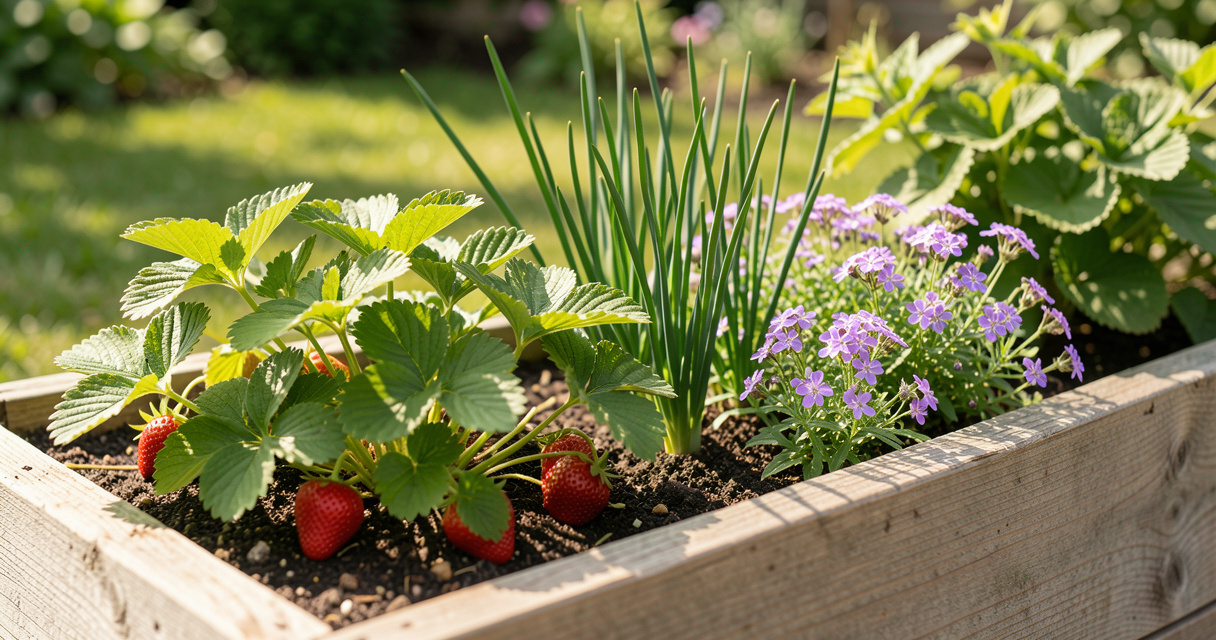
Reading time: 18 min
Key takeaways
- Match the companion to the setup first. A patio pot, a raised bed, and an in-ground row need completely different neighbors, and the best companion plants for strawberries are simply the ones that fit your space.
- Choose by function, not by folklore. Pollinator flowers, living mulches, and pest-disrupting alliums do measurable work; aromatic plants alone do not repel insects.
- Keep Verticillium hosts out. Tomatoes, potatoes, peppers, eggplants, melons, and okra share a soilborne wilt with strawberries and belong in a different rotation block.
- Companion planting is one layer of IPM. Spacing, crown clearance, airflow, scouting, and five-year rotation decide more of your harvest than any single neighbor plant.
What if the plants beside your strawberries could cut pest pressure, smother weeds, and bring in more pollinators without a single spray?
That is the promise of companion planting, and in my experience roughly half of it holds up. The companion plants for strawberries that actually earn their space are the ones matched to a specific job: a flower that feeds hoverflies, a low green cover that keeps fruit clean, an allium that confuses a pest at the right moment. The other half of what you read online is repetition of repetition.
What most people get wrong is not the plant list. It is everything around it. The best companion plants for strawberries will still fail if they shade the crowns, steal the irrigation, or sit eight inches from a row of potatoes that carry the same wilt. So I have built this as a working strawberry companion planting guide: decision tables, spacing cues, timing windows, and the honest risks — organized by what you are actually growing in.
How Companion Planting Works for Strawberries
Strip away the folklore and strawberry companion planting comes down to four levers. Two of them are strong, one is useful but oversold, and one is widely misunderstood. Knowing which lever you are pulling is the difference between a bed that works and a bed that merely looks busy.
Definitions, because these words get muddled: Companion planting is growing two plants near each other on purpose, expecting one to help the other. Intercropping is growing two crops in the same bed for yield, not for mutual benefit. Trap cropping means planting something a pest prefers so it attacks that instead of your main crop. Living mulch is a low ground-covering plant that stays in place all season. A strawberry bed usually needs several of these ideas at once — but they are different tools with different rules.
Pest Disruption and Beneficial Insect Habitat
The reliable half of companion planting is habitat. Adult hoverflies, parasitoid wasps, and lacewings need nectar and pollen to produce eggs, and their larvae eat aphids. A strawberry bed that offers nothing but strawberry leaves is a food desert for those insects. A bed edged with sweet alyssum keeps them on site, hunting.
The unreliable half is the idea that strong-smelling plants create an invisible barrier. Some aromatic foliage does mask host-plant cues for a while, and interplanted alliums can complicate a pest’s search. But a gust of wind, a flush of new growth, and the effect resets. Treat scent as a small assist, not a fence.
Results also vary by climate, cultivar, and spacing — the three variables almost every list ignores. An June-bearing strawberry in Friesland and an everbearing strawberry on a Mediterranean balcony do not experience the same pest calendar, so the same companion cannot deliver the same result.
Living Mulch, Moisture, and Soil Nitrogen
Strawberries hate bare, splashing soil. Rain hitting open ground throws spores and grit onto low fruit, and the crowns sit right at that height. A living mulch of lettuce, spinach, or white clover closes that gap, keeps the surface cooler and moister, and suppresses weeds at the same time. That is a real, repeatable benefit you can see in a single season.
Nitrogen fixation is where honesty matters. Legumes nodulate and fix nitrogen through rhizobia, but most of that nitrogen goes into the legume itself. The strawberry beside it gets a modest share; the real payoff arrives with the next crop after you cut and incorporate the residue. White clover is a genuine nitrogen fixer and a good pollinator plant when mown low, but it also spreads. Grow it only where you can edge it or mow it regularly.
From the field: At a nursery in Boskoop where I consulted for three seasons, one strawberry block was bordered by a band of sweet alyssum and the next block was bare soil. The alyssum block had visibly fewer aphid outbreaks in May and June — but it also received more consistent drip irrigation, and the alyssum was replaced mid-season when it got leggy. When we repeated the arrangement without the watering discipline, the difference shrank to almost nothing. The plant will tell you where the real limit is, and it usually is not the neighbor.
Once you know which lever you are pulling, choosing neighbors gets much easier — so let us go through the plants that earn their place, function by function.
What Are the Best Companion Plants for Strawberries?
The short answer, in order of reliability:
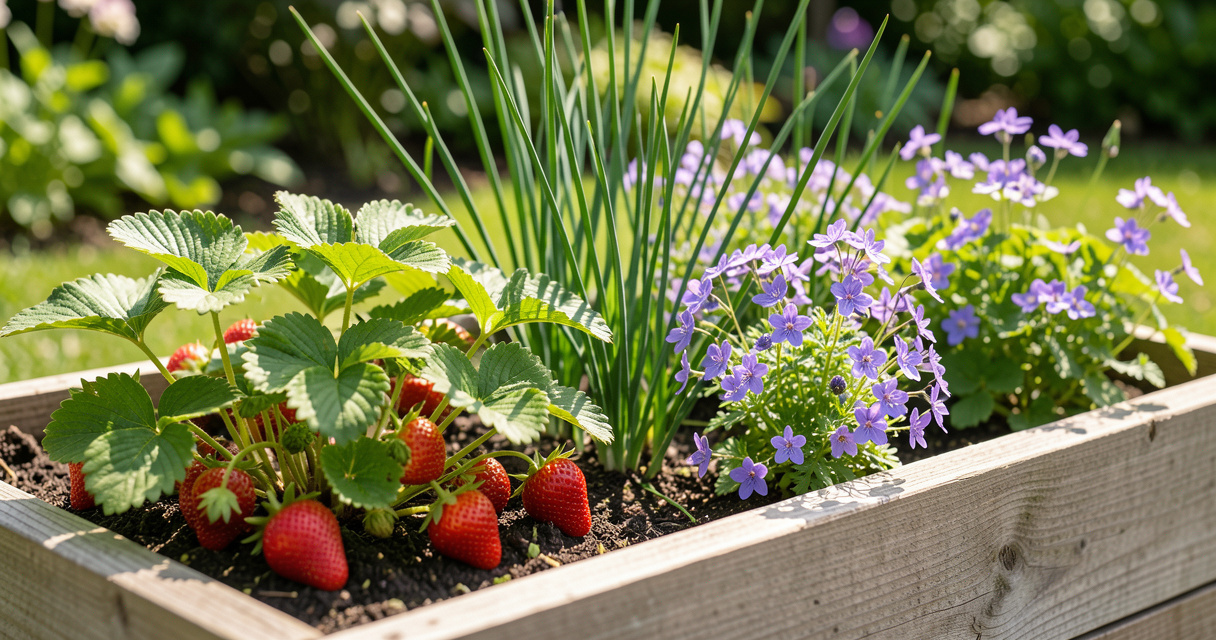
- Borage for pollinators and beneficial insects.
- Sweet alyssum as a low living mulch and pollinator magnet.
- Chives or onions for pest disruption without garlic’s reported growth inhibition.
- Thyme for ground cover and moisture retention.
- Lettuce or spinach as cool-season living mulch.
- Bush beans or peas for nitrogen fixation.
- Marigolds for nematode suppression and color.
That list is the skeleton. What makes it work in a real bed is distance, timing, and knowing when to pull a plant out. Below is the reasoning behind each choice, and where the evidence gets thin.
Flowers That Attract Pollinators and Beneficial Insects
Borage (Borago officinalis) is my first recommendation for any bed with room at the edge. The blue star flowers refill nectar quickly, which is exactly what bumblebees need on a cold May morning, and the plant self-seeds politely in most gardens. What most people get wrong is planting it in the middle of the row. Borage grows knee-high with big, floppy leaves — put it on the north or east edge where its shade falls away from the crowns.
Sweet alyssum (Lobularia maritima) is the workhorse. Ten to fifteen centimeters tall, shallow-rooted, and covered in tiny flowers that small parasitoid wasps and hoverflies can actually reach. It works as a living mulch along the bed edge and between containers. It does need water and it does get leggy by midsummer — shear it back by half and it recovers in two weeks.
Calendula (Calendula officinalis) blooms early and keeps going in cool weather, which fills the gap before the main flush. Be honest about it, though: in humid summers it mildews and it can host aphids of its own. Use it as an early-season bridge, not a permanent fixture.
Phacelia (Phacelia tanacetifolia) is arguably the strongest hoverfly plant in a Dutch garden, but it is tall and short-lived and self-seeds with enthusiasm. Row ends and the far side of a path are the right places.
And the flavor myth: does borage improve strawberry flavor? There is no credible mechanism and no data behind it. What pollination does improve is berry shape and size, because a fully pollinated flower sets more achenes and you get a fuller, less lopsided fruit. The benefit is real — it is just not a flavor effect.
Herbs and Alliums for Pest Disruption
Chives (Allium schoenoprasum) are the safest allium in a strawberry bed. Clump-forming, shallow-rooted, and handsome in flower — and the purple pom-poms are one of the best bee plants you can put at a bed edge. Set clumps 20 to 30 centimeters from the crowns, one every meter or so.
Onions work the same way in a different shape. Spring-sown sets are harvested by midsummer, so they vacate the space exactly when the strawberry canopy closes. That timing is the whole point.
Thyme (Thymus vulgaris) is my favorite ground-cover herb for the front edge of a raised bed. It is drought-tolerant, low, and evergreen, and it tolerates foot traffic better than most. It needs drainage — in heavy clay it sulks and rots over winter. Space plants 20 to 30 centimeters apart.
Sage (Salvia officinalis) belongs at the end of a row, not in the middle; give it 20 to 60 centimeters and expect it to get woody after three or four years. Basil needs 30 to 60 centimeters, real heat, and regular water — and here is the part nobody mentions: in dry weather aphids colonize basil faster than they colonize strawberries. Basil is a signal plant, not a repellent force field. If you find aphids on it, that is your early warning system working.
Carrot-family herbs — dill, cilantro, parsley — bring in tiny parasitic wasps with their flat flower heads. Let a few bolt on purpose at the row end, then pull them before they carpet the bed in seedlings.
Garlic: the contested neighbor. You will find garlic listed as both a good and a bad companion for strawberries, sometimes on the same website. The case for it is allium pest disruption. The case against is a growth-inhibition claim repeated across several sources, including Gardenia.net, with little experimental detail behind it. Here is what I would do: choose chives or onions when you want allium benefits with less risk, and if you want to try garlic, put it in one small patch at the far end, keep it well away from the crowns, and note what happens. Do not gamble a whole bed on a contested claim.
Vegetables and Living Mulches for Ground Cover
Lettuce (Lactuca sativa) is the most useful cool-season living mulch I know for strawberries. Shallow roots, fast growth, and it covers the soil exactly when spring rain is splashing. Set loose-leaf types between the crowns in March and April, cut them young, and pull the plants the moment they start to stretch. A bolting lettuce is a tall, bitter, water-hungry competitor — it stops being a companion at that point.
Spinach does the same job and bolts even faster once the heat arrives. It is a March-to-May tool, full stop. In my experience, gardeners who leave bolted spinach in a strawberry bed in June are the same gardeners who complain that companion planting does not work.
White clover (Trifolium repens) is the classic perennial living mulch: nitrogen-fixing, pollinator-friendly when mown low, and capable of knitting a path together in one season. It also walks into places you did not invite it. Use it between beds or in a mown strip, not pressed against the crowns, unless you are prepared to edge it twice a year.
Legumes for Nitrogen Fixation
Bush beans (Phaseolus vulgaris) and peas (Pisum sativum) both nodulate and fix nitrogen, and both are useful in a strawberry rotation — but read the fine print. The nitrogen they fix feeds the legume first. Your strawberries get the leftovers and, more importantly, the following crop gets the residue when you cut the plants at soil level and leave the roots.
Peas are the better fit for a matted row because they finish by late June, just as the strawberry harvest peaks. Give beans 30 to 45 centimeters of separation from the crowns; they compete hard for water in July. Do not plant legumes expecting a visible boost to this year’s berries. Plant them because they leave the bed better than they found it.
| Companion | Primary benefit | Planting distance and timing | Cautions |
|---|---|---|---|
| Borage | Pollinators, long nectar window | North or east edge, 30–45 cm from crowns; sow April–May | Self-seeds; large leaves shade if placed mid-row |
| Sweet alyssum | Hoverflies, parasitoid wasps, low living mulch | Bed edge or pot rim, 15–20 cm band; sow April, resow July | Needs water; goes leggy, shear by half |
| Chives | Pest disruption, bee forage | Clumps 20–30 cm from crowns, one per meter; spring or fall | Divide every 2–3 years or the clump dies out in the center |
| Onions | Pest disruption, then vacates space | Sets in March, 10–15 cm apart, one row; harvest by July | Do not overwater near ripening bulbs |
| Thyme | Ground cover, moisture retention, drought tolerance | Front edge, 20–30 cm apart; plant April–May | Needs sharp drainage; rots in wet clay |
| Lettuce | Cool-season living mulch, splash protection | Between crowns, 20 cm apart, March–May | Pull at first sign of bolting |
| Spinach | Early ground cover | Between crowns, March–April only | Bolts fast in heat; remove promptly |
| White clover | Nitrogen fixation, living mulch, pollinator flowers | Paths and bed margins, mown; not against crowns | Spreads aggressively; needs edging or mowing |
| Bush beans | Nitrogen fixation, residue for next crop | 30–45 cm from crowns; sow after last frost | Competes for water; benefit mostly to the following crop |
| Peas | Early nitrogen fixation, finishes before harvest peak | Row ends or a neighboring row; sow March | Needs support; remove vines after cropping |
| Marigolds (Tagetes patula) | Nematode suppression in the root zone, color, generalist nectar | Bed edge, 20–60 cm apart; transplant after frost | Effect is local and seasonal; not a whole-bed cure |
A container story: A reader in Haarlem grows six strawberries in three terracotta pots on a south-facing balcony. She planted a ring of sweet alyssum at the rim of each pot and tucked two lettuce seedlings between the crowns in early April. The alyssum brought in hoverflies by mid-May and the lettuce covered the compost surface through the wettest weeks. In June she pulled the lettuce as it stretched, which opened airflow around the ripening fruit and — her words — “stopped the grey fuzz before it started.” Nothing exotic. Just timing and a bit of discipline.
Knowing what to plant is half of the decision. The other half is knowing what to keep at a distance — and there the reasons matter more than the names.
Worst Companion Plants and Risky Neighbors
Most avoid-lists for what not to plant with strawberries name nightshades and brassicas and stop there. That is not useful enough. A neighbor can hurt strawberries in five distinct ways: shared soilborne disease, shade, root competition for water and nutrients, allelopathy, and invasive spread. Once you can name the mechanism, you can judge any new plant yourself.
Disease-Linked Neighbors: Verticillium Hosts
This is the one that actually costs you plants. Verticillium wilt is caused by soilborne fungi — mainly Verticillium dahliae in European soils — that survive as microsclerotia for many years, commonly reported at ten years or more in the literature. Strawberries are susceptible. Infected plants look thirsty, then the outer leaves wilt and collapse while the inner crown shows a reddish-brown discoloration. Plants decline over one or two seasons and rarely recover.
Because it is soilborne, proximity matters through root contact and shared soil, and it matters even more through rotation history. Tomatoes, potatoes, eggplants, peppers, melons, okra, brambles, and stone fruits are all listed hosts. If your strawberry bed sits where last year’s tomatoes grew, you have already made the decision. Where space allows, keep a five-year gap between a Verticillium host and a strawberry crop in the same ground.
Can you plant strawberries with tomatoes? In a word, no. Not because they dislike each other, but because they can share a pathogen that persists in soil long after both crops are gone.
Shade, Root Competition, and Invasive Spread
Corn is the classic mistake. It looks like a nice windbreak until you realize that a mature corn row shades a strawberry bed for most of the day and pulls moisture from a meter away. Tall sunflowers add allelopathy to the shade problem — their roots release compounds that suppress nearby seedlings — so keep them at the far end of a garden, not at the edge of a fruit bed.
Brassicas are not disease-linked the way nightshades are, but cabbage, kale, and broccoli are heavy feeders with big leaves. Next to strawberries they compete for nitrogen and water and they can shade low crowns at exactly the wrong moment.
Fennel deserves its reputation: it is allelopathic and suppresses neighbors, and it self-seeds. Mint is a runner, not a plant — keep it in a pot set on paving, never in open ground beside a strawberry bed. Roses are a quieter problem: heavy water and nutrient demand, plus spider mites and thrips that happily relocate to strawberry foliage in a dry August.
| Plant to avoid or limit | Why it can be a problem | Better alternative or mitigation |
|---|---|---|
| Tomato | Verticillium host; shared soilborne wilt | Separate rotation block, 5-year gap; interplant with chives instead |
| Potato | Verticillium host; heavy feeder; digging disturbs crowns | Move to a distant bed; use lettuce as living mulch |
| Pepper | Verticillium host (listed in most sources) | Grow in containers on the patio; keep bed soil separate |
| Eggplant | Verticillium host, strong feeder | Grow under cover in a different rotation block |
| Cabbage family | Competition for water and nitrogen; leaf shade | Rotate to a separate bed; use spinach as the cool-season cover |
| Corn | Heavy shade, root competition, heavy feeder | Keep at least 2–3 m away; use borage at the bed edge instead |
| Tall sunflowers | Shade plus allelopathic root exudates | Plant along a distant fence, not at the fruit-bed edge |
| Fennel | Allelopathic; self-seeds; competes | Grow in a pot; use dill or cilantro at row ends instead |
| Mint | Rampant runners invade crowns | Contain in a pot sunk into paving; use thyme as ground cover |
| Roses | Water and nutrient competition; spider mites, thrips | Keep a path’s width away; monitor mites in dry spells |
| Okra | Verticillium host | Separate block; not a good northern-climate neighbor anyway |
| Melons | Verticillium host, sprawling competition | Grow vertically on a separate frame |
Not all warnings are equal. The Verticillium advice is backed by plant pathology and holds up across climates. The claim that garlic inhibits strawberry growth is contested and thinly documented. The claim that a given herb “repels” a given insect usually comes from a single observation repeated online. Treat the first as a rule, the second as a trial, and the third as a hypothesis you can test in your own bed.
With the good and the risky both mapped out, the next question is the practical one: what actually fits where you garden?
Companion Planting by Garden Setup: Containers, Raised Beds, and In-Ground
This is where companion plants for strawberries in containers and companion plants for raised beds stop being the same question. In a pot, water and root volume are the limits. In a raised bed, airflow along the edges is the limit. In open ground, rotation history is the limit. Same plants, different rules.
Container and Patio Strawberry Pots
Containers are tight. Every companion you add is stealing water from the strawberries, so only choose compact, shallow-rooted plants and only one or two per pot. Sweet alyssum at the rim is the best single choice: low, useful, and it does not compete below ground. Chives in a small clump at the edge are second. Thyme works if your compost is gritty and free-draining. Lettuce is fine in spring, then out.
What to avoid in a pot: anything tall, anything vigorous, and anything with a taproot. Two or three strawberry crowns in a 30 to 40 centimeter pot is already full. Keep the crowns above the compost line, and remember that a pot dries out roughly twice as fast as a raised bed.
Raised Beds and In-Ground Rows
In a raised bed, use the edges. A band of alyssum along the south face, chives or thyme at the corners, and borage or sage on the north side where its shade falls away. That arrangement gives you pollinator habitat, ground cover, and pest disruption without ever crowding a crown. In-ground rows follow the same logic at larger scale, plus one extra rule: write down what grew in that ground for the last four years before you plant.
| Garden setup | Best companions | Spacing cue | Main risk |
|---|---|---|---|
| Containers and patio pots | Sweet alyssum, chives, thyme, spring lettuce | One companion type per pot; crowns 8–10 cm apart, companions at the rim | Water competition and crown rot from overcrowding |
| Raised beds | Alyssum edge, chives, sage, borage on the north side, lettuce between crowns | Plants 20–45 cm apart; tall plants only on the north edge | Airflow loss if greens are left to bolt |
| In-ground annual beds | White clover in paths, peas or beans in the prior year, marigolds at row ends | Rows 75–90 cm apart; clover mown, never against crowns | Verticillium history and clover spread |
- Keep crowns clear of soil and mulch at all times.
- Put every tall plant on the north side.
- Pull bolting greens the week you see the stem stretch.
- Water deeply and less often, so roots go down instead of sideways.
- Scout for aphids twice a week from April, on the companions as well as the crop.
Layout settled, the next layer is the one people skip: using companions as part of an actual pest strategy instead of hoping they work alone.
Pest Control and Pollinator Strategy for Strawberries
2025–2026 update — what the evidence actually supports. A large share of companion-planting claims circulating online are observational: one gardener saw fewer aphids, wrote it down, and the claim traveled. That does not make them wrong, but it makes them weak. What holds up more consistently is the integrated approach: habitat creation for beneficial insects, well-managed living mulch, sanitation, and rotation. Peer-reviewed work on floral field margins and on Tagetes root exudates for nematode suppression is stronger than anything published on scent-based repelling, and even that work is site-specific. Date every study you rely on, and treat the rest as a trial in your own garden.
Beneficial Insects and Pollination
The strawberry companion plants for pest control that earn their keep are the ones that feed predators. Hoverfly larvae are aphid machines; parasitoid wasps lay eggs inside aphids; ladybugs need pollen between aphid booms. Small, open flowers — alyssum, phacelia, dill, cilantro, chive blossoms — are accessible to those insects in a way that big double flowers are not.
Pollination is the other half. Strawberry flowers are self-fertile but yield better with insects moving pollen, and better-pollinated flowers produce fuller, more even berries. Never spray anything during bloom, and never spray a flowering companion that pollinators are working.
Slug, Aphid, and Nematode Management
Slugs are a mulch problem before they are a plant problem. Keep mulch pulled back 10 centimeters from crowns, water in the morning, and set boards or traps out to monitor. Aphids need scouting, not panic: check the underside of new leaves twice a week, and let the habitat do its work before reaching for anything. Nematodes are where French marigolds (Tagetes patula) genuinely help — their roots release compounds that suppress root-knot nematodes in the root zone. The effect is local and seasonal. Marigolds do not sterilize a bed, and they will not rescue a bed with a serious infestation.
| Pest or goal | Companion strategy | Monitoring action |
|---|---|---|
| Aphids | Alyssum, phacelia, dill at row ends to host hoverflies and parasitoids | Twice-weekly check of new growth, including on basil and calendula |
| Slugs | Thyme as low cover, mulch kept back from crowns, no damp litter | Night check with a torch after rain; trap boards |
| Thrips | Avoid dry, dusty edges; keep roses and other hosts at a distance | Tap flowers over white paper in July and August |
| Root-knot nematodes | French marigolds at bed edges, in the root zone, for a full season | Dig and inspect roots of a spare plant at season end |
| Pollination | Borage, chive blossoms, alyssum for a continuous nectar supply | Count insect visits for five minutes at midday in bloom |
Tip: companion plants support pest control best when combined with sanitation, mulch management, and weekly scouting. The plants create the conditions; your eyes do the work.
Now let us put all of this onto a plan you can draw with a stick in the soil.
How to Plan a Strawberry Companion Planting Layout
A good strawberry companion planting layout is decided in six steps, in this order. Do them out of order and you will redo the bed in July.
- Map sun and airflow. Note where shade lands at 10 a.m. and 4 p.m., not just at noon.
- Confirm the setup: container, raised bed, or open ground.
- Choose two or three functions, not five — pollinator support, living mulch, pest disruption.
- Set spacing for the strawberries first, then fit companions into the gaps.
- Schedule cool-season companions early and remove them on time.
- Check the rotation history against Verticillium hosts before anything goes in.
A Simple 4×8 Raised-Bed Plan
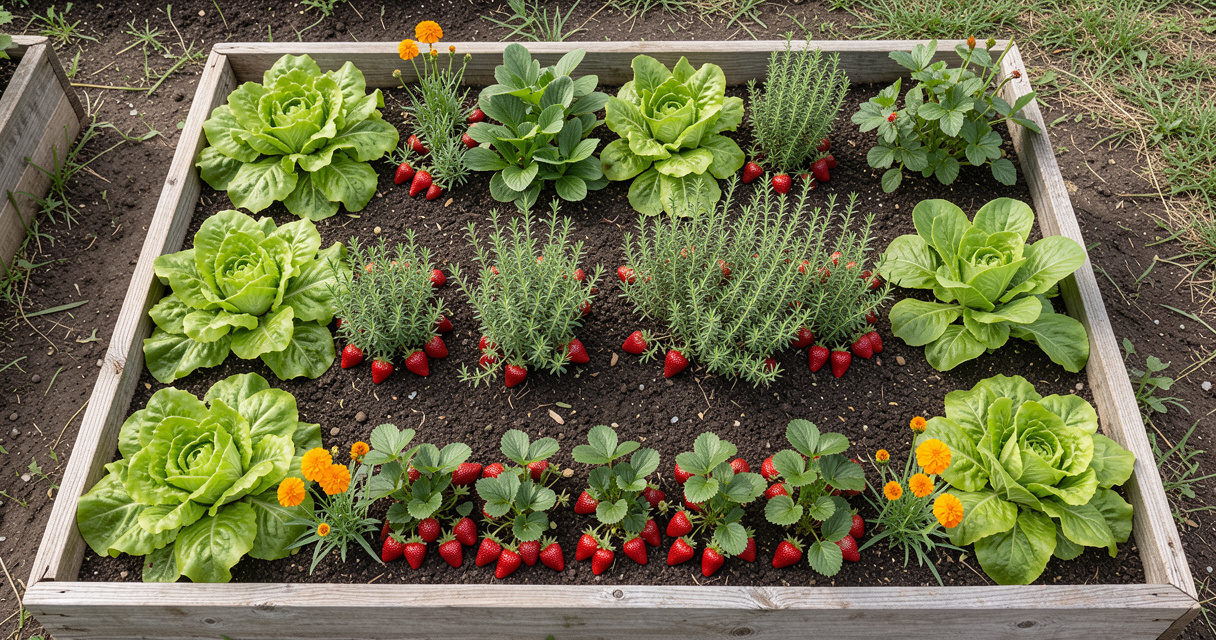
Here is what I would do with a 4 by 8 foot bed. Two rows of strawberries running the long way, 45 centimeters apart, plants 35 to 40 centimeters apart — roughly twelve crowns. A 20 centimeter band of sweet alyssum along the south face. Three chive clumps and two thymes at the corners. Borage and sage on the north edge, where their height casts shade away from the fruit. Lettuce between the crowns in April, pulled by early June. One row of French marigolds at the east end, where they get full sun and stay out of the picking path.
Container and Row-End Placement
In containers, work outward from the crown: crowns first, then a 5 centimeter clear ring of compost, then companions at the rim only. In open ground rows, use the row ends for anything tall or self-seeding — dill, phacelia, borage, marigolds — and keep the picking aisles clear.
- Sun exposure mapped before planting
- Airflow unobstructed along both long edges
- Crown clearance of 5 cm minimum
- Tall plants on the north side only
- Harvest timing written into the plan
- Rotation history checked for Verticillium hosts
From the field: A gardener in Alkmaar had planted a double row of sweet corn along the south edge of her strawberry bed, on the theory that it would block wind. By July the strawberries were pale, the fruit ripened unevenly, and picking meant pushing through leaves. We replaced the corn with a low band of alyssum and three chive clumps, moved the corn to the far vegetable plot, and the following season she had better airflow, cleaner fruit, and — her measurement — ten minutes less work per picking. Same garden, same plants, different geometry.
A plan only helps if you avoid the handful of errors that undo it. Here are the ones I see most often.
Common Mistakes and Expert Tips for Strawberry Companion Planting
Most strawberry companion planting mistakes are spacing and timing errors, not plant-selection errors. Seven to watch for:
- Overcrowding. Two companions per square meter is plenty; more steals water and airflow.
- Tall plants on the sunny side. Borage, sage, and sunflowers belong north.
- Letting lettuce and spinach bolt. A bolted green is a competitor, not a companion.
- Assuming garlic is always helpful. It is contested; chives and onions are safer.
- Ignoring Verticillium history. Check the last four years before planting.
- Planting mint in open ground. Pots only, always.
- Expecting instant pest control. Habitat takes a season or two to build.
Spacing, Airflow, and Timing Mistakes
Airflow is the invisible companion. A bed that is too full holds humidity against the fruit, and grey mould moves in. Keep a clear 20 centimeters along each long edge, pull finished greens promptly, and never let a companion lean over a ripening cluster. Timing mistakes cost more than spacing mistakes: a lettuce left in place three weeks too long will outcompete a strawberry crown for water at exactly the moment the fruit is sizing up.
Record-Keeping for Better Results
Don’t overthink it, but do write it down. One page per bed, one line per week: what is flowering, what has aphids, what looks stressed. Two seasons of notes will tell you more about your own garden than any list online, mine included.
Expert tip: photograph each bed on the first of every month, from the same angle. Note pest outbreaks, pollinator visits, and how each companion performed. In three years you will have a site-specific dataset that no generic guide can match.
Frequently asked questions
What should not be planted next to strawberries?
Avoid or limit Verticillium hosts such as tomatoes, potatoes, peppers, eggplants, melons, and okra. Watch out for tall shade casters like corn and sunflowers, invasive mint, and heavy-feeding brassicas. Garlic is contested in the sources, so choose chives or onions if you want allium benefits with less risk.
Do marigolds help strawberry plants?
French marigolds are widely recommended for nematode suppression and pest disruption, and their root exudates do affect root-knot nematodes in the root zone. Treat them as a support plant, not a standalone cure: plant them at bed edges, give them a full season, and keep monitoring.
Can you plant garlic with strawberries?
Sources disagree. Some praise alliums for pest repellency, while Gardenia.net warns that garlic can inhibit strawberry growth. Choose chives or onions first, and trial garlic only in a small area where you can observe the result for a full season.
What are the best companion plants for strawberries in containers?
Use compact, shallow-rooted companions such as sweet alyssum, chives, thyme, and spring lettuce. Avoid vigorous or tap-rooted plants that crowd the crowns or steal water, and never fill more than the rim of the pot.
Can strawberries be planted with tomatoes?
Generally no. Tomatoes are Verticillium wilt hosts and can share soilborne disease with strawberries that persists for years. Keep them in separate rotation blocks with a five-year gap where possible.
Do strawberries benefit from clover?
White clover works as living mulch and a nitrogen fixer, and its flowers feed pollinators when mown low. It also spreads, so use it in paths and margins where you can edge or mow it, not pressed against the crowns.
What herbs grow well with strawberries?
Chives, thyme, sage, basil, and carrot-family herbs such as cilantro, parsley, and dill are commonly listed. Place them at row ends or bed edges, give basil heat and water, and watch it for aphids — it is often the first plant to show them.
Where to start with your own strawberry companion planting plan
Everything in this guide comes back to four decisions, and you can make all of them this week. Match the companion to the setup — containers, raised beds, or in-ground rows — because the same plant behaves differently in each. Prioritize pollinator flowers and living mulches that also support airflow and weed control, since those deliver results you can see in one season. Keep Verticillium hosts, shade casters, invasive mint, and contested neighbors like garlic out of the bed. Then lean on spacing, timing, scouting, and rotation instead of expecting any plant to work alone.
My grandmother taught me that a garden is a set of relationships, not a collection of plants. She never used the phrase companion planting, and she never grew a strawberry without chives somewhere nearby — mostly, I suspect, because she liked chives. That is allowed too. Observation first, affection second, and the plants will tell you the rest.
So: which single change will you make first in your strawberry bed this season — the alyssum edge, the north-side borage, or simply moving next year’s tomatoes two beds away?

I’ve spent over fifteen years in botanical gardens and nurseries across the Netherlands and Belgium. Now I garden in Haarlem and write what I wish someone had told me sooner. No fluff — just what actually works.