

Reading time: 19 min
Key takeaways
- Choose by function, not by folklore. Every companion in a strawberry bed should do one of five jobs: feed pollinators, cover soil, disrupt pests, fix nitrogen, or improve airflow.
- Spinach and lettuce are the workhorses. They shade soil, suppress weeds and keep fruit cleaner, provided they are thinned and harvested before they bolt and shelter slugs.
- Borage is a pollinator plant, not a magic bullet. It brings bees to the edge of the bed, but it self-seeds aggressively and will not make your berries taste sweeter.
- Avoid cabbage-family crops and gladioli. Keep crowns at soil level, keep air moving, and renovate the bed after harvest so companions help rather than compete.
Why do some strawberry beds produce clean, sweet berries while others collapse into slug damage, weeds and dry soil?
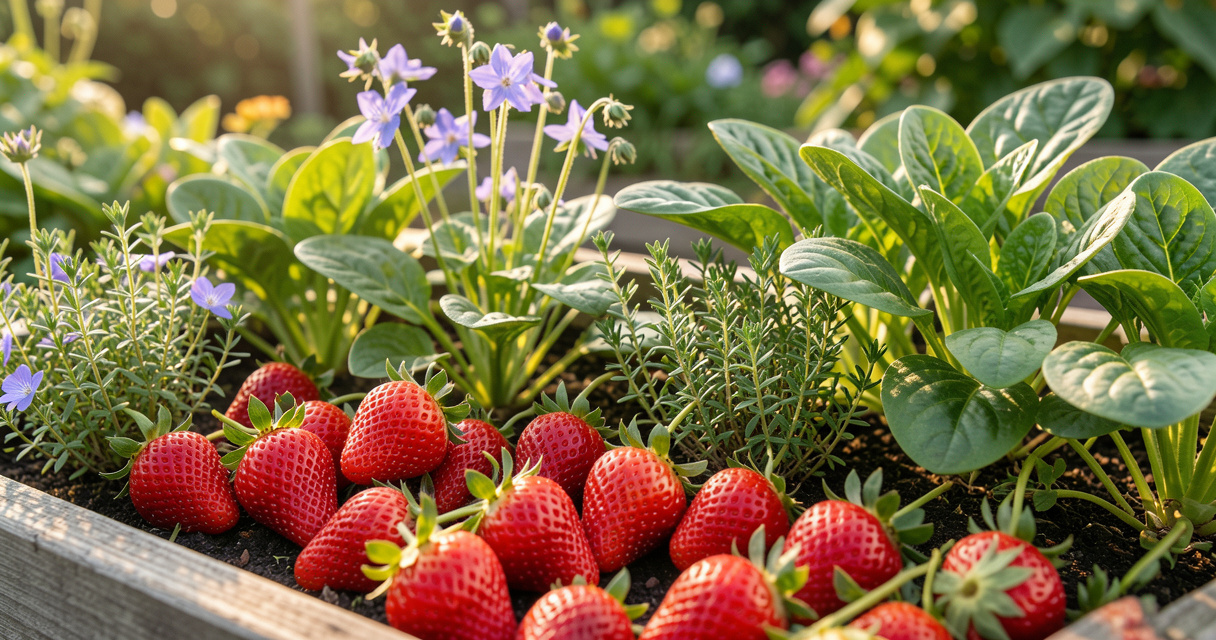
In my experience, the answer is almost never the strawberry variety. It is what grows around the crowns. Companion planting strawberries is not about scattering a few friendly flowers and hoping for the best. It is about assigning each plant a job in the bed: feeding pollinators, covering bare soil, disrupting pests, fixing nitrogen, or keeping air moving around ripening fruit.
I learned this the slow way. My first strawberry bed in Haarlem was a rectangle of bare soil, and I spent three seasons chasing problems instead of preventing them. Co-planting strawberries changed how the whole bed behaves. Strawberry companion plants do real work, but only when you pick them by function rather than by habit.
This guide builds a function-first framework: five jobs, the plants that do them well, the ones that do them badly, and the spacing and seasonal maintenance that hold the system together. Let me show you what actually works.
What Is Companion Planting for Strawberries — and Why Does It Work?
Companion planting for strawberries is the deliberate placement of other plants in and around the bed so that each one performs a specific job: feeding pollinators, covering soil, disrupting pests, fixing nitrogen, or keeping air moving around the fruit. It is applied ecology, not folklore. Every choice should answer a question you can actually name out loud.
Strawberries are woodland-edge plants. In the wild they creep along the forest floor, rooted shallowly in leaf litter, with their fruit hanging just above damp ground. That inheritance explains almost every problem we create for them. Bare soil dries out, splashes onto berries and invites weeds. A crowded bed traps moisture under the canopy. And a bed with no flowers at all is a bed with no pollinators in residence at the exact moment the flowers open.
Definition: companion planting strawberries means pairing crops to support pollination, pest balance, soil cover and airflow. It does not mean crowding as many plants as possible into the same square metre.
The ecology behind strawberry companion planting
Three mechanical realities sit underneath the whole practice. Once you see them, you cannot unsee them.
First, strawberry roots are shallow. Most feeding roots sit in the top 15 to 20 centimetres. Whatever competes at that depth competes directly with the plant’s ability to size up fruit.
Second, the fruit ripens at soil level. Every raindrop or watering can that hits bare earth sends a plume of soil particles upward, and those particles carry Botrytis cinerea spores onto the berries. Ground cover is a disease strategy before it is a weed strategy.
Third, strawberries flower early and fast. A single open flower may only be receptive for a few days. If pollinators are not already in the neighbourhood, you get small, lopsided fruit — the classic nubbed berry with seeds set on one side only. Companion planting strawberries is partly about making sure the bees already live there before the first flower opens.
What co-planting strawberries can and cannot fix
Let me be honest about the limits, because the internet rarely is. Co-planting strawberries will not fix bad drainage, exhausted soil or crowns planted too deep. It will not turn a shaded, compacted corner into a productive bed. And no companion plant eliminates slugs on its own — I have watched a fat grey slug slide straight past a chive clump without a flicker of concern.
What it does do reliably, in my experience, is shift the balance. Denser soil cover means fewer weed seeds germinating. More flowers over a longer period means more hoverflies and bees in residence. Better airflow means less grey mould after a wet June. Those are cumulative effects, not single-plant miracles, and they compound season after season.
- Pollinator support — flowers that feed bees, hoverflies and lacewings across the whole bloom window.
- Living mulch — low plants that shade soil, hold moisture and smother weed seedlings.
- Pest disruption — aromatic plants that confuse or deter pests, and habitat for the predators that eat them.
- Nitrogen fixation — legumes that feed the soil food web rather than depleting it.
- Airflow and clean fruit — structure and spacing that keep humidity down and soil splash off the berries.
Get those five jobs straight and the plant list becomes simple. Here is how the best companion plants for strawberries actually sort out.
The Best Companion Plants for Strawberries: A Practical Chart
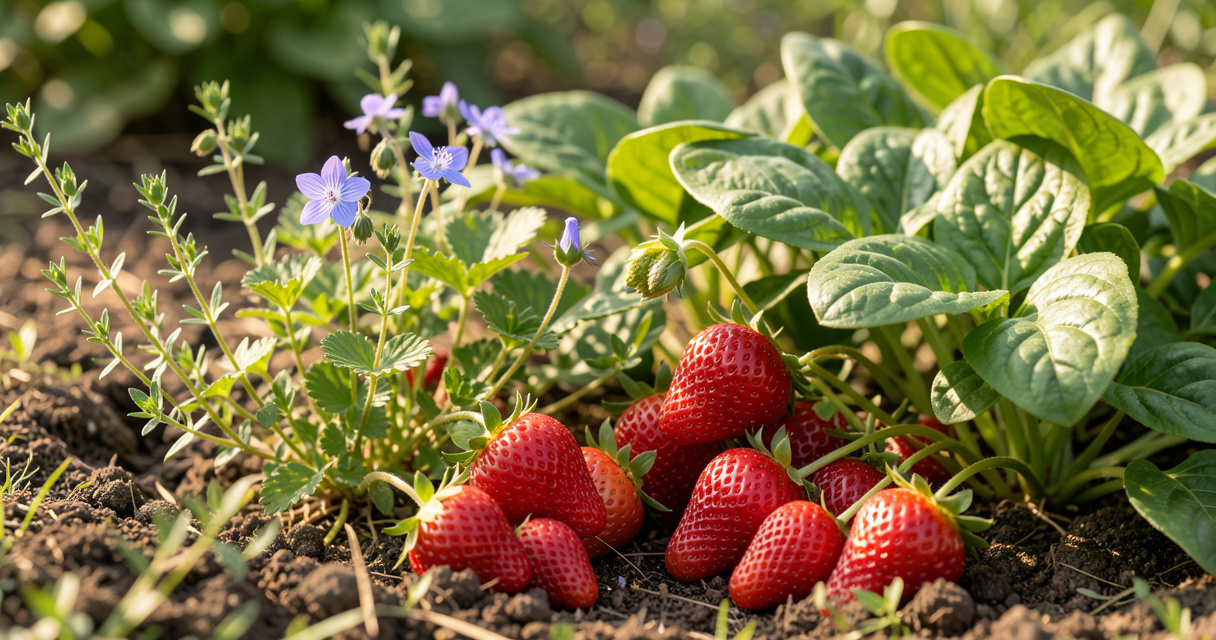
Best strawberry companion plants by function:
- Borage — attracts bees and beneficial insects; place at bed edges.
- Spinach — acts as living mulch and protects shallow roots; keep it thinned.
- Lettuce — shades soil and suppresses weeds; harvest early.
- Thyme and sage — support pollinators and may disrupt some pests.
- Chives — traditional pest-repelling neighbour; keep clumps small.
- Clover or lupines — fix nitrogen; use where they will not crowd crowns.
Avoid cabbage-family crops and gladioli.
Top pollinator and pest-repelling herbs
Herbs earn their place at the edge of a strawberry bed for two reasons: they flower early and repeatedly, and their foliage is chemically interesting. Thyme is my first choice. A low mat of Thymus vulgaris in full sun flowers just as strawberry blossom opens, and those tiny flowers are a magnet for hoverflies. Hoverfly larvae are aphid predators, so you are effectively farming your own pest control. Thyme also insists on sharp drainage, which is exactly what a strawberry bed edge wants.
Sage works on the same principle. Its leaves carry cineole and camphor, compounds that can disrupt the sensory receptors of some insect pests. I plant single sage plants at the corners of a bed rather than in the middle — partly for airflow, partly because sage grows woody and domineering within three years.
Chives are the traditional answer to the slug question, and I use them, but with realistic expectations. A tight clump of Allium schoenoprasum at each corner is tidy, flowers beautifully in late spring and gives you something to snip. It does not build a slug-proof wall. Divide the clumps every two to three years or they hollow out in the centre.
And then there is borage. What most people get wrong about borage is expecting it to be a yield booster. The claim that it improves strawberry flavour circulates widely and is not something I have ever been able to verify in a garden. What borage genuinely does is feed pollinators, in volume, for weeks. Plant it at the edge, not in the row, and cut it back before the seeds drop — a single plant will otherwise colonise the entire bed within two seasons.
Living mulches and nitrogen fixers
Spinach and lettuce are the most useful companions in a working strawberry bed, and neither is glamorous. Both germinate fast in cool spring soil, both cover ground within three weeks, and both can be harvested before the strawberry canopy closes. That is the whole trick: they cover soil when the bed is otherwise bare, then leave before they compete.
For nitrogen, white clover in the paths between beds is quietly effective. It fixes nitrogen, tolerates mowing and flowers low enough to feed small pollinators. Do not sow it into the row itself — clover spreads and will happily run into the crowns. Lupines are the structural alternative: deep taproots, tall spires of flower in June, and nitrogen nodules on the roots. Give them a permanent spot on the perimeter, because they resent being moved.
Quick-reference strawberry companion planting chart
| Companion plant | Main function | Best placement | Cautions or best use case |
|---|---|---|---|
| Borage | Pollinator support | Bed edge, 40–50 cm back from crowns | Self-seeds aggressively; not a proven flavour booster |
| Spinach | Living mulch, spring soil cover | Between rows, 15–20 cm from crowns | Bolts in heat; shelters slugs if left dense |
| Lettuce | Living mulch, quick ground cover | Between rows, harvested early | Crowds crowns if unthinned |
| Thyme | Pollinator support, pest disruption | Sunny bed edge strip | Needs sharp drainage; rots in wet mulch |
| Sage | Pest disruption, beneficial habitat | Bed corners or perimeter | Grows woody; keep away from ripening fruit |
| Chives | Pest disruption | Small clumps at corners | Divide every 2–3 years; not a slug barrier |
| White clover | Nitrogen fixation, living mulch | Paths and outer edges only | Outcompetes crowns if sown in the row |
| Lupines | Nitrogen fixation, pollinator structure | Permanent perimeter border | Deep taproot; dislikes transplanting |
Tip: choose two or three companions by function rather than planting every option on the list. A bed with thyme at the edge, spinach between the rows and one borage plant at the corner is more useful than a botanical collection.
The single most valuable of those living mulches deserves a closer look, because the way its roots behave underground is the reason it works at all.
Strawberries and Spinach: The Living Mulch Strategy Explained
Spinach as living mulch for strawberries is one of the few companion combinations that pays off in the first season. Spinach germinates in cold soil, grows flat and dense, and covers the ground between crowns exactly when the bed is most exposed — early spring, before the strawberry canopy fills in.
The bunk bed effect: root stratification
Here is the mechanism, and it is the part most articles skip. Strawberry roots feed shallowly, with the bulk of the active root mass in the top 15 centimetres. Spinach sends down a taproot that goes considerably deeper and draws moisture from a layer the strawberry rarely touches. In practice the two crops are stacked like bunk beds: spinach working the lower storey, strawberries working the upper one.
That stratification is why they can share space at all. It is not a free pass, though. The competition happens at the surface, where both plants still need moisture for germination and establishment, and where spinach leaves can shade a crown into a humid, stagnant pocket. The bunk bed only works if you manage the top bunk.
Spacing, timing, and relay planting
Sow spinach in a band roughly 15 to 20 centimetres from the crown, never directly against it. Keep the band narrow — two rows of spinach between strawberry rows is plenty. If you are growing in a raised bed, sow along the outer edge first and leave the crown zone clear.
Timing matters more than spacing. Sow spinach in early spring, harvest it hard through May, and pull the plants before the strawberry harvest begins in earnest. In a mild Dutch autumn you can repeat the trick in reverse: a late sowing of winter spinach covers soil through November and December after the strawberry leaves die back. That relay pattern — spinach, then strawberries, then spinach again — keeps the bed covered for most of the year without ever letting either crop dominate.
When spinach becomes a problem
Spinach turns against you in three specific situations. It bolts in heat, shooting up a flower stalk and going coarse within days of a warm spell. It shelters slugs when the leaves lie flat and dense against wet soil. And it competes for moisture in a dry spring, which shows up as small, hard strawberries rather than big juicy ones.
Field observation: one of my raised beds held six strawberry crowns with spinach sown in the gaps and a single borage plant at the south corner. The spinach covered the soil beautifully through April and May and the berries in June were noticeably cleaner — almost no soil splash, very little grey mould. But the spinach bolted in the first warm week of June and I left it four days too long. The bolted stems collapsed across two crowns, airflow dropped, and I found slug damage underneath for the first time that season. Cleanup, not plant choice, was the lesson. I now cut bolting spinach at soil level rather than pulling it, so I do not disturb the strawberry roots beside it.
Warning: dense spinach left too long will shelter slugs and compete for moisture. Thin it, harvest it, and remove bolted plants promptly.
Cover the ground well and the next question becomes who visits the flowers above it.
Companion Plants That Attract Pollinators and Beneficial Insects
Strawberry companion plants for pollinators are not decorative extras. Pollination determines berry shape as much as berry size. A strawberry flower has multiple pistils, and each one must be visited for the fruit around it to swell. Miss a section and you get the lopsided berry every gardener recognises.
Borage, thyme, and sweet alyssum
Borage is the loudest pollinator plant you can grow. Bees work it relentlessly, and it flowers for months if you keep cutting it back. Place it at the bed edge where it can lean outward rather than over the crowns.
Thyme is the quieter, more useful option, because it blooms early and low. Sweet alyssum fills the gaps at the front of a bed with a haze of tiny white flowers that attracts small parasitic wasps. Calendula and scabiosa work the same shift at slightly taller heights — good for a bed edge that faces a path, and good for cutting.
Hoverflies, lacewings, and aphid control
Beneficial insects need nectar and pollen, not just pest prey. A hoverfly adult feeds on open flowers; its larva eats aphids. If you want the larva, you must grow the flower. The same logic applies to lacewings and parasitic wasps, which are far more effective at keeping aphid populations in check when there is a reliable nectar source within a few metres.
- Plant in drifts rather than single specimens, so pollinators can forage efficiently.
- Stagger bloom succession so something is open from April through September.
- Never spray during bloom, even with soft products.
- Keep taller herbs at the perimeter so they do not shade the fruit.
- Allow a few chive and thyme flowers to go over rather than deadheading everything.
Flowers bring in the helpers. The next layer of companions works on the pests directly — and on the conditions that let disease take hold.
Companion Plants That Repel Pests and Reduce Disease
Strawberry companion plants for slugs and other pests sit in an awkward category, because the honest answer is that plants support pest management rather than replacing it. There is a difference between repelling a pest, housing its predator and removing the conditions it loves. Good planting does all three at once.
Slug and snail management with sage and chives
Sage and chives are the traditional pairing here, and they earn it partly through scent and partly through structure. Aromatic foliage makes the immediate area less inviting, and clumps of chives create small dry islands in an otherwise damp bed. Neither will stop a determined slug.
Thyme does something slightly different: it supports the hoverflies whose larvae clean up aphid colonies, and it keeps the bed edge dry and open. Combine any of these with evening hand removal, morning watering instead of evening watering, and removal of damp debris under the canopy. The plant will tell you whether the balance is working — chewed shoulders on ripening berries mean it is not.Airflow, soil splash, and Botrytis prevention
Grey mould, Botrytis cinerea, is the disease that ruins more strawberry harvests than any pest. It needs two things: spores and a wet surface. Low groundcover reduces the splash that delivers spores upward, and open planting structure reduces the humidity that lets them germinate. That is why living mulch and airflow are not opposites, provided the mulch stays low and the tall plants stay at the edge.
| Pest or disease | Companion strategy | Supporting practice | What not to expect |
|---|---|---|---|
| Slugs and snails | Sage, chives at bed corners | Evening hand removal, morning watering, clear damp debris | Total elimination |
| Aphids | Thyme in flower, sweet alyssum | Tolerate small early colonies and let predators arrive | Instant knockdown |
| Botrytis cinerea | Low living mulch plus perimeter airflow | Lift fruit off soil, remove dead leaves, avoid overhead watering | A cure once fruit is infected |
| Weeds and soil splash | Spinach, lettuce between rows | Thin and harvest before bolting | A permanent weed-proof mat |
Warning: companion plants are not a standalone slug cure. Use them alongside cleanup, watering discipline and hand removal, or you will be disappointed by week three.
Knowing what helps is only half the map. The other half is knowing what actively makes a strawberry bed worse.
What Not to Plant Next to Strawberries
The worst companion plants for strawberries are not mysterious. They fall into a short, specific list: the cabbage family and gladioli. Everything else on this page is negotiable. This list is not.
Cabbage-family crops and gladioli
Keep cabbage, cauliflower, Brussels sprouts and broccoli away from strawberry beds. The reasons are practical rather than mystical. Brassicas are hungry, deep-rooted and large-leaved; they compete for water and nutrients at exactly the moment strawberries are swelling fruit, and their foliage throws shade over a crop that wants full sun. They also share pest pressure with the wider garden, and a bed full of brassica debris gives slugs and other problem insects somewhere to shelter.
Gladioli are the other classic exclusion. They are tall, they bulb up, and they occupy the same ground with a completely different water and nutrient rhythm. In a small garden the temptation is to fill every gap — resist it here.
Why some neighbours compete rather than help
A companion should leave the bed in better condition than it found it. Plants that shade the crowns, dry the soil at fruiting time or crowd the airflow around ripening berries do the opposite. The test I use is simple: at the end of the season, would I have been better off with bare soil? If the answer is yes, it belongs somewhere else.
Warning: avoid cabbage-family crops and gladioli near strawberries. Never bury the crowns, and never let any companion crowd the airflow around ripening fruit.
- Need soil cover where a brassica would have gone? Use lettuce or spinach.
- Need pest disruption? Use chives or sage.
- Need pollinators? Use borage at the edge.
- Need nitrogen? Use clover in the path or lupines on the perimeter.
With the right list settled, the practical question becomes geometry: how far apart everything goes, and where the companions actually sit.
How to Plan, Space, and Plant a Strawberry Companion Bed
Strawberry plant spacing decisions come first, because companions fit into whatever gap the strawberry layout leaves. The commercial figures are a useful anchor even if you garden in a four-square-metre raised bed.
According to Grange Co-op, high-density planting uses an 18 in x 4 ft array at 7,260 plants per acre, while normal-density planting uses a 2 ft x 4 ft array at 5,445 plants per acre (year not stated). The same source notes that some bed culture systems run 10,000 to 12,000 plants per acre but does not recommend that density for amateur gardeners. For planning purposes, Grange Co-op suggests a yield estimate of about 1 pound of strawberries per plant (year not stated).
Translated into home-garden terms: a 30-centimetre spacing between crowns in the row and 90 to 120 centimetres between rows is a sensible middle ground. That gives you a working path, decent airflow and a strip of soil between rows where a living mulch can sit without touching the crowns.
Strawberry spacing and bed layout
| Setting | Strawberry spacing or density | Companion placement | Notes |
|---|---|---|---|
| In-ground matted row, normal density | 2 ft x 4 ft, 5,445 plants per acre | Spinach or lettuce between rows; thyme at edges | Room for runners and for a real path |
| High-density annual bed | 18 in x 4 ft, 7,260 plants per acre | Edge herbs only; skip in-row mulch | Too tight for interplanted greens |
| Intensive bed culture | 10,000–12,000 plants per acre | Not applicable at home scale | Not recommended for amateur gardeners |
| Raised bed, home garden | 25–30 cm in row, 2 rows per 1.2 m bed | Spinach band 15–20 cm from crowns; chives at corners | Companion plants for strawberries in raised beds must stay low and harvestable |
| Containers and troughs | One crown per 20–25 cm of trough length | Thyme at the end, nothing in the crown zone | Airflow matters more than cover here |
Planting sequence for spring, summer, and fall
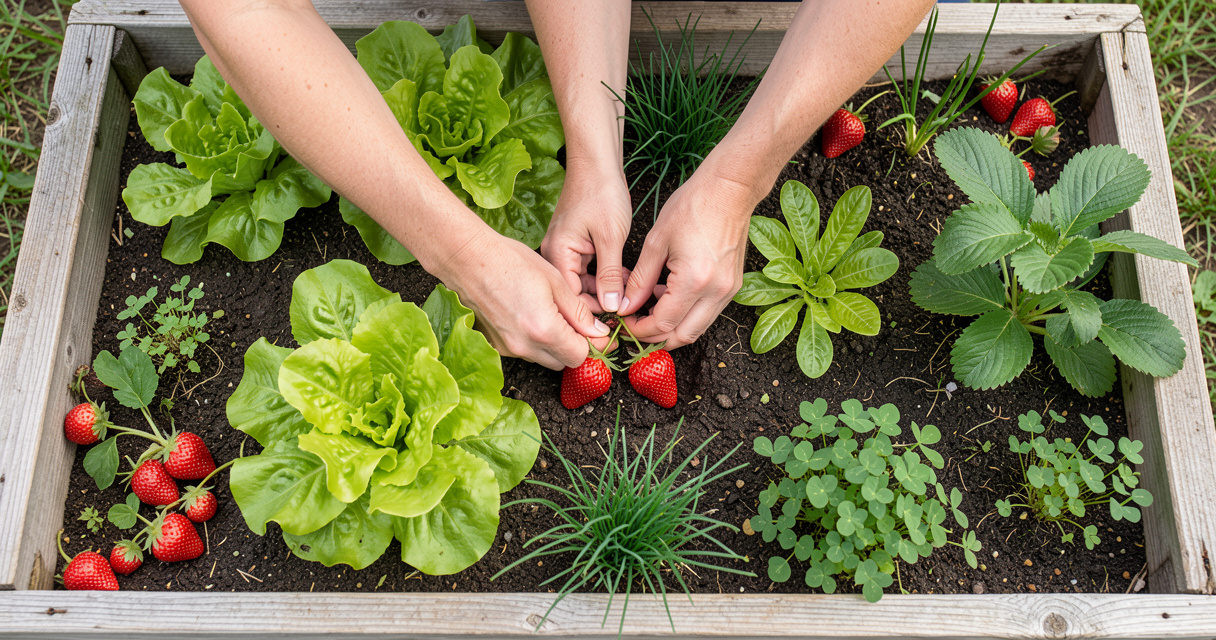
Set strawberries first, always. Plant crowns so the base of the crown sits exactly at soil level — the growing point must be visible, not buried, and the roots must be spread rather than wadded into a ball. Water them in, then leave a week before sowing anything between them.
Then sow spinach or lettuce in the between-row strip. In summer, after the greens are out, plant nothing new in the row itself; use the gap to top up the perimeter herbs. In autumn, a late spinach sowing covers soil through the winter dieback. That sequence is the practical answer to the question of how close companion plants should be: close enough to cover ground, never close enough to touch a crown.
Container and raised-bed adaptations
\p>In raised beds and containers, airflow beats ground cover. A raised bed dries faster and warms faster, so a dense living mulch can actually steal moisture from shallow strawberry roots in June. Here I keep the mulch to the outer 15 centimetres and rely on thyme and chives for the rest of the structure. In containers, skip living mulch almost entirely — one thyme plant at the end of the trough is enough.Tip: keep the strawberry crown at soil level. Do not bury it and do not wad the roots. A buried crown is the single most common reason a new strawberry bed fails in its first year.
Layout gets you through the first season. Maintenance is what keeps the system working into the next one.
Seasonal Care, Harvest, and Late-2026 to 2027 Planning
Standing in my Haarlem garden in November 2026, the strawberry bed is quiet but not finished. This is the month where next year’s companion plan is decided, because everything you do now determines how much room the plants have in April.
Spring to fall maintenance
In spring, let thyme and chives flower before you tidy them — that early nectar is the whole point. Keep the living mulch thin. Through summer, watch the moisture line: if spinach leaves are wilting before the strawberries do, the mulch is too dense and it is time to cut it back.
According to Grange Co-op, everbearing strawberries should have their flowers picked off until June 1–15 after planting so the plant establishes before it fruits (year not stated). That is a hard instruction to follow when the first flowers look so promising, and it is worth following anyway.
Renovation after harvest
Renovation is where most companion plantings fall apart. Grange Co-op advises mowing old leaves off after harvest, just above the crowns, then thinning runners so they sit 3–5 inches apart in autumn, with tops mowed again in January or February where practical (year not stated).
\p>Mow first, then deal with the companions. Cut bolted spinach and lettuce at soil level instead of pulling, refresh the perimeter herbs, and clear every leaf that lies flat against the soil. This is the moment slug populations are decided for the following spring.Planning the 2027 companion bed
For spring 2027, rotate: move the strawberry rows into the strip that held spinach this year, and move the living mulch into the old row. Nitrogen-fixing clover stays in the paths. If the bed has been in strawberries for three seasons, plan a full break crop before replanting.
- April–May: support pollinators, keep mulch thin, monitor slugs weekly.
- June: harvest, then mow leaves just above the crowns.
- September–October: thin runners to 3–5 inches apart, refresh edge herbs.
- November–December: winter mulch, clear debris, draft the 2027 rotation.
- January–February: mow tops where practical and sow nothing.
Frequently asked questions
What are the best companion plants for strawberries?
Borage, spinach, lettuce, thyme, sage, chives, clover and lupines all earn a place, but each does a different job. Group them by function — living mulch between rows, pollinators and pest disruption at the edges, nitrogen fixers in the paths — and place them accordingly.
What should not be planted next to strawberries?
Cabbage, cauliflower, Brussels sprouts, broccoli and gladioli are the main plants to avoid. Use lettuce or spinach for soil cover and chives or sage for pest pressure instead.
Does spinach help strawberries grow?
Yes, when it is managed. Spinach works as a living mulch, shading soil and suppressing weeds in spring. Left too dense or too long, it competes for moisture and shelters slugs.
Can I plant strawberries and lettuce together?
Yes. Lettuce makes an excellent low living mulch if you keep it thinned and harvest it early. Do not let it crowd the crowns or block airflow around ripening fruit.
What companion plants deter slugs around strawberries?
Sage, chives and other aromatic herbs are traditional choices at bed corners. They help, but they are not standalone slug control — pair them with cleanup, morning watering and hand removal.
How close should companion plants be to strawberries?
Keep low companions 15 to 20 centimetres from the crowns and never let them touch. Taller herbs belong at the perimeter so they do not shade berries or reduce airflow.
Do strawberries benefit from borage?
Borage is genuinely useful for attracting bees and beneficial insects, especially at bed edges. Treat it as pollinator support rather than a guaranteed flavour or yield booster, and cut it back before it self-seeds.
The Bed You Plant Now Is the Bed You Harvest From
Strawberry companion planting works when you stop thinking in lists and start thinking in jobs. Match each plant to a clear function — pollinators, living mulch, pest disruption, nitrogen fixation, airflow — and the bed starts solving its own problems.
Use spinach and lettuce as living mulch between the rows, borage and thyme for pollinators, chives and sage for pest pressure. Keep cabbage-family crops and gladioli out of the bed entirely. Keep the crowns exposed, the air moving and the fruit off the soil.
\p>Then plan the spacing and the seasonal renovation so the companions help rather than compete. My grandmother taught me that a garden is a set of relationships, not a set of objects — and nowhere is that clearer than in a strawberry bed that has finally found its balance.
Before you plant another strawberry crown in bare soil, ask which job you need a companion to do: feed pollinators, cover soil, repel pests, or fix nitrogen?

I’ve spent over fifteen years in botanical gardens and nurseries across the Netherlands and Belgium. Now I garden in Haarlem and write what I wish someone had told me sooner. No fluff — just what actually works.