

Reading time: 15 min
Key Takeaways
- Best time to prune roses: prune in late winter or early spring, just as buds swell and before leaves expand.
- Match pruning to rose type: hybrid teas need hard pruning, shrub roses need the one-third rule, Knock Out roses get a once-a-year 12-inch cut.
- Cut above an outward-facing bud: place the cut 1/8 to 1/4 inch above a bud that faces away from the center.
- Avoid fall hard pruning: it stimulates tender new growth that frost can kill.
Are you cutting your roses back at the wrong time and wondering why the blooms keep shrinking? You’re not alone. The confusion around the pruning of rose plant always comes down to three questions: when, how much, and where to cut. Get those right, and your shrub roses will reward you with more flowering wood, better airflow, and far fewer disease problems. Get them wrong, and you’ll end up with either no blooms or winter die-back. Let me show you what actually works.
Why Prune a Rose Plant? The Real Benefits
Skip the pruners for one season and a rose will forgive you. Skip them for five years and the story changes. The flowers get smaller, the stems tangle, and the center of the plant fills with dead wood. In my experience, most beginner gardeners don’t prune because they’re afraid of killing the rose. What most people get wrong is the opposite: not pruning is what slowly kills the bloom count.
Think about energy allocation. A rose bush has a finite amount of energy stored in its roots and canes. When you leave every old, weak, and diseased cane in place, the plant tries to feed everything. The result is a dense thicket with thin twiggy growth and small, sparse flowers. When you remove unproductive wood, the remaining canes receive a surge of energy and produce strong flowering laterals.
Here’s a definition that will help you decide what to remove: old wood is usually thicker than your thumb, gray, woody, and covered in bark. Weak wood is anything thinner than a pencil. Diseased wood shows dark streaks, cankers, peeling bark, or black spots. All of that needs to go.
The simplest structural prune for modern shrub roses is the one-third rule. According to the University of Illinois Extension, modern shrub roses should have one-third of the oldest canes removed in spring. This keeps the plant open, encourages new flowering canes, and prevents the overgrown thicket that most people mistake for a healthy rose.
Get the timing right first, because a perfect cut at the wrong moment can do more harm than no cut at all. Ready? Let’s look at the calendar.
When to Prune Roses: Spring Timing by Zone and Type
Best time to prune roses at a glance:
- Prune in late winter or early spring, just as buds swell but before leaves expand.
- Wait until forsythia blooms if you want a natural signal.
- Hybrid teas, floribundas, and grandifloras: prune when about half the buds are swollen.
- Shrub roses: prune when you see new shoots growing from the canes.
- Knock Out roses: cut back once a year to 12 inches high to maintain a 3-to-4-foot plant.
- Avoid hard pruning in early fall; tender new growth can be winter-damaged.
Signals: swollen buds, new shoots, forsythia blooms
Can you rely on a calendar? Only as a rough guide. In my experience, the plant is a better calendar than any app. My grandmother taught me that a rose tells you when it is ready; the calendar is only a rumour. In Haarlem, I prune hybrid teas around mid-March, but I only start after I see the first swollen buds near the top of the canes. The University of Arkansas Division of Agriculture’s 2010 guidance puts the window for shrub roses in late February through early March, and the same signal works across similar zones: cut when the plant is still dormant but clearly waking up.
Swollen buds mean the rose has broken dormancy and can heal the cuts quickly. New shoots at the base mean the root system is active. Forsythia bloom is the classic signal because forsythia flowers at exactly the right moment in many temperate regions.
Regional timing by rose type
| Rose type | Spring window | Key signal |
|---|---|---|
| Hybrid tea, floribunda, grandiflora | Late February to early April depending on zone | About half the buds are swollen |
| Modern shrub rose | Late February through early March in Arkansas guidance (2010) | New green shoots 1–2 cm at the base |
| Knock Out rose | Late winter to early spring, once a year | Before new growth gets long |
| Climber | After the first main flush of bloom | Spent flowers and one or two very old canes |
For gardeners in cold zones, shift the window two to three weeks later. In warm zones, shift it earlier. If you’re not sure, wait until you see two or three swollen buds on a cane. The plant will tell you.
Here’s the 10-second decision tree I use in workshops:
- Once-blooming old garden rose? Remove dead and crossing wood only after flowering.
- Hybrid tea, floribunda, or grandiflora? Wait until half the buds swell, then hard prune to 3–6 canes.
- Modern shrub rose or Knock Out? Use the one-third rule, or cut Knock Out to 12 inches.
- Climber? Keep it light, remove old canes after the first flush.
Once the timing is right, the cutting itself is just a seven-step sequence. Here’s the exact routine I use in my own city garden.
How to Prune a Rose Plant in 7 Steps
This is the sequence I teach at every workshop, and it works for almost every repeat-flowering rose. Don’t overthink it. Just move through the steps in order.
Steps 1–3: clean, remove, thin
- Step 1: Wait for the plant’s signal. Wait until buds swell or tiny new shoots appear. Pruning too early while the cane is still fully dormant invites frost damage into the cut. Pruning too late wastes energy the rose has already spent on growth.
- Step 2: Disinfect tools. Before making the first cut, wipe your bypass pruners with 70% isopropyl alcohol or a bleach solution. If you move between roses, disinfect again. Roses carry viruses and bacteria, and a single dirty blade can spread them through the whole border.
- Step 3: Remove dead, damaged, and diseased wood. Cut these canes out entirely. Work from the tip downward until you hit white or cream pith. If the center is brown, keep cutting down until the pith is healthy. If the cane is dead to the ground, remove the whole thing at the base.
Steps 4–7: cutting angles, outward buds, and opening the center
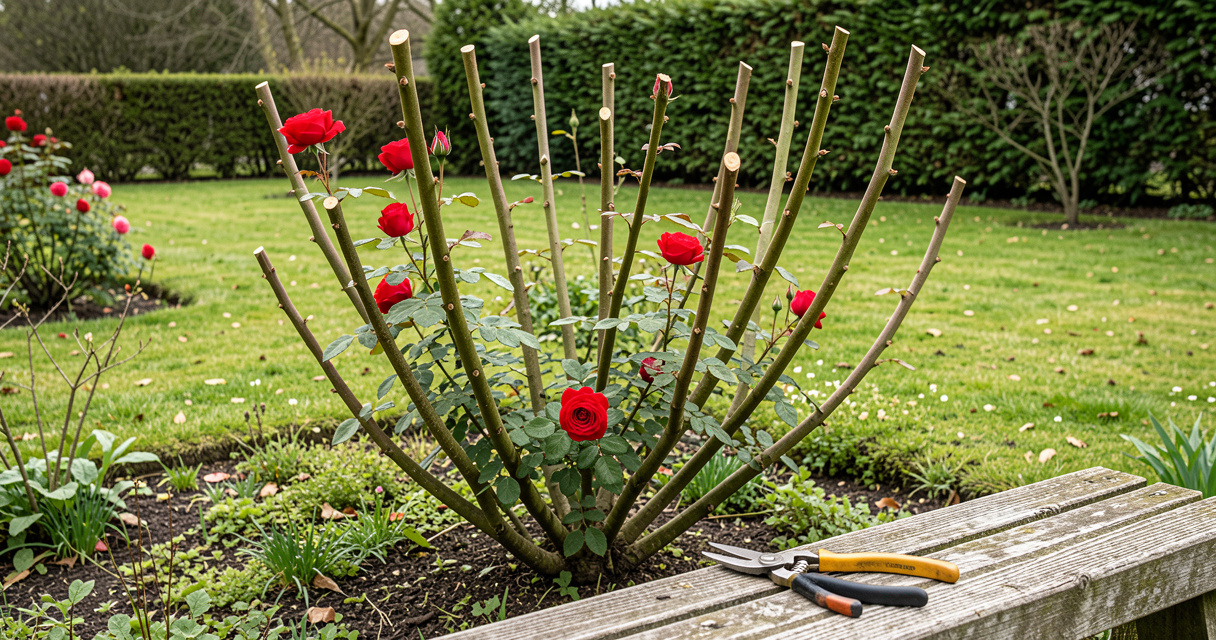
- Step 4: Remove weak canes and the oldest thickest canes. This is where the one-third rule comes in. For a modern shrub rose, take out one-third of the oldest canes at ground level. For hybrid teas and floribundas, reduce to the 3–6 strongest young canes. Weak canes thinner than a pencil have no future.
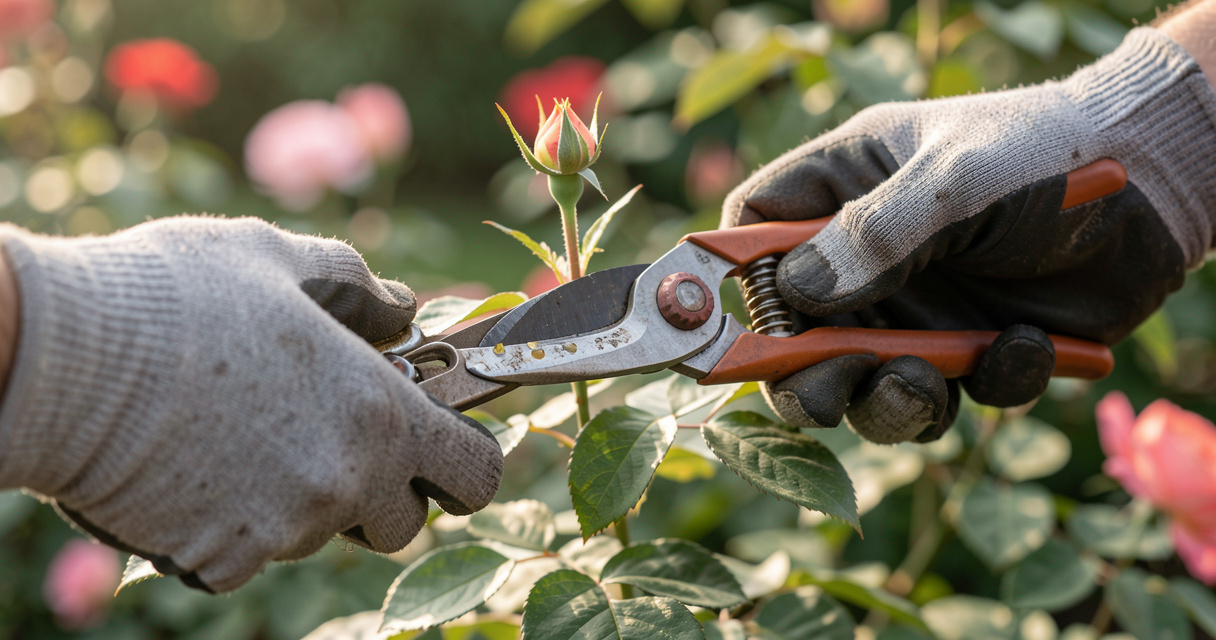
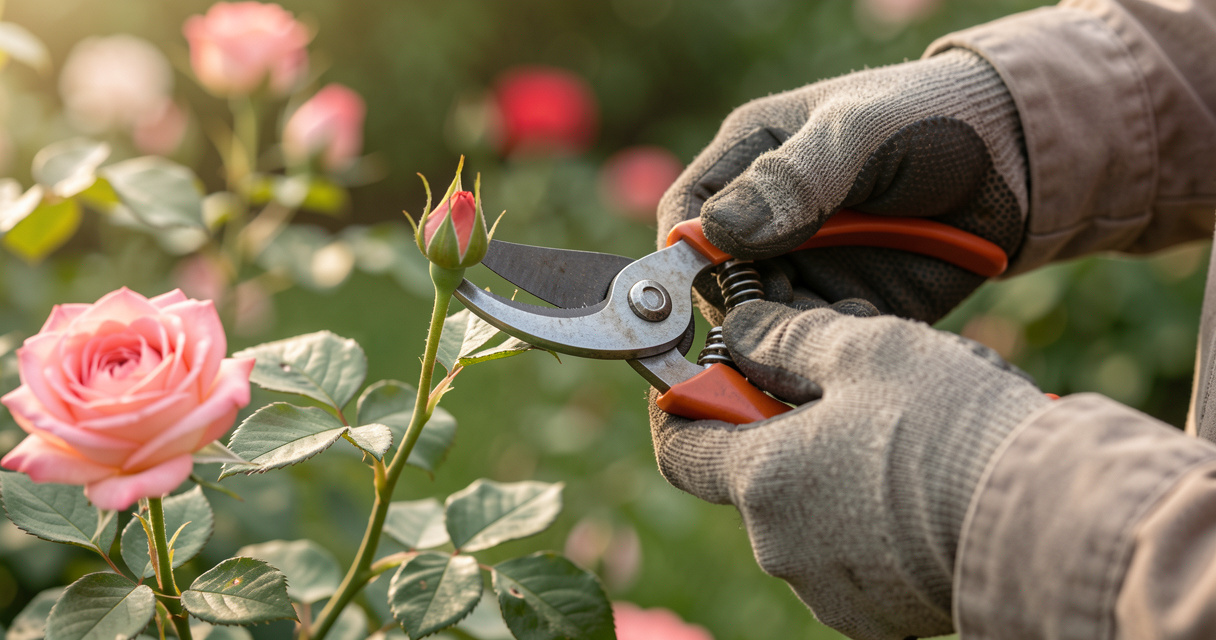
- Step 5: Cut remaining canes to an outward-facing bud. The cut should be 1/8 to 1/4 inch above a bud that faces the outside of the plant, according to Swansons Nursery. Angle the cut away from the bud so water runs away. This one detail determines the future shape of the plant.
- Step 6: Open the center. Remove any cane that grows inward, crosses another cane, or rubs against a neighbor. You want light and air to move through the center. An open center dries quickly, and that is your best defense against black spot.
- Step 7: Clean up and remove old foliage. Collect every leaf, clipping, and old petal from around the base. David Austin’s advice is to never compost old rose leaves. Many fungal diseases survive on leaf litter and reinfect the plant when the weather warms.
After step 5, your remaining canes should stand at roughly 6–12 inches for hybrid teas, 12–18 inches for shrub roses, and 12 inches for Knock Out roses.
Now let’s match this method to the different families of roses in your garden.
Pruning by Rose Type: Shrub, Hybrid Tea, Climber, Knock Out
What most people get wrong is pruning every rose as if it were a hybrid tea. A shrub rose and a climber have completely different growth patterns, and treating them the same way will either make them look terrible or stop them flowering.
According to the New York Botanical Garden, hybrid teas, floribundas, and grandifloras should have 1/3 to 2/3 of their cane length removed, cutting to an outside bud, and should be reduced to 3 to 6 canes. That is hard pruning, and it is right for those plants.
| Rose type | Level of pruning | Cane count left | Height after cut |
|---|---|---|---|
| Hybrid tea / Floribunda / Grandiflora | Hard pruning | 3–6 canes | 6–12 inches |
| Modern shrub rose | Selective one-third method | Remove oldest 1/3, keep the rest | Varied heights, roughly 18–24 inches |
| Knock Out rose | Once-a-year cut | All canes tipped to 12 inches | 12 inches, then grows to 3–4 feet |
| Petite Knock Out | Hard cut | Cut back to 4–6 inches | Under 18 inches |
| Climber | Light pruning after first flush | Remove 1–2 oldest canes | Canopy thinned, not lowered |
Modern shrub roses don’t need the harsh treatment we give hybrid teas. Use the one-third rule: remove one-third of the oldest canes at ground level, then head back the remaining canes to an outward-facing bud. Leave the plant with a mixture of stems at different ages. That mixture gives you continuous flowering.
Knock Out roses are even simpler. According to Knock Out Roses, cut them back once a year to 12 inches high to maintain a 3-to-4-foot plant. Petite Knock Out should be cut back to 4–6 inches high in late winter or early spring if you want a plant under 18 inches. Here’s what I’d do with a neglected Knock Out: cut it to 12 inches in late winter and don’t look back. It recovers quickly.
Climbers are the exception. They need light pruning after their first main flush of bloom. Remove one or two of the oldest, thickest canes at ground level and tie in new flexible canes. Don’t hard prune a climber in early spring or you will cut off the current season’s flowers.
For once-blooming old garden roses, use the less-is-more method: remove dead wood and old spent flowering shoots in summer after bloom. Hard winter pruning will remove the wood that would have flowered.
Now let’s look at the actual techniques behind those numbers.
Pruning Methods: Hard Pruning, Thinning, Heading Back, One-Third Rule
The words hard pruning, thinning out, and heading back get thrown around a lot, but they mean very different things.
| Method | What it does | Use when | Don’t use when |
|---|---|---|---|
| Hard pruning | Cuts all canes back to 6–12 inches above the graft or ground | Hybrid teas and floribundas in late winter | Once-blooming climbers and weak shrub roses |
| Thinning out | Removes entire canes where they originate | Shrub roses, overgrown Knock Out, crowded centers | If you only want to reduce height |
| Heading back | Shortens a cane to an outward-facing bud | Shaping, controlling height, strengthening flowering laterals | If the center is already crowded |
| One-third rule | Removes the oldest third of canes at ground level | Modern shrub roses each spring | As the only method for hybrid teas that need renewal |
Let me give you a before-and-after that explains why the one-third rule works. Last spring I pruned a neglected 5-year-old shrub rose in a century-old garden near Leiden. The plant was a mess: six or seven gray canes, no airflow, and one small cluster of blooms at the top. On the first spring, I removed dead wood, took out one-third of the oldest canes at ground level, and headed back the rest to outward-facing buds. It flowered better but was still crowded. The second spring I did the same thing again: another third of old canes, thinning out the center, heading back the survivors. By June, the plant had nearly double the flowering laterals, noticeably larger flowers, and almost no black spot. Two springs of one-third is often enough to renovate a rose without losing the whole crown.
The technique matters less than the tool in your hand and the mistakes you avoid.
Rose Pruning Tools and Mistakes That Kill New Growth
Tools that make clean cuts
- Bypass pruners for canes up to half an inch.
- Loppers for thick old wood at the base.
- A small pruning saw for very old canes.
- Leather gauntlet gloves.
- Isopropyl alcohol or diluted bleach for cleaning blades.
Top 4 mistakes and how to avoid them
- Cutting too far from the bud. Leaving a long stub invites die-back.
- Cutting too close to the bud. This damages the bud and dries it out. Aim for 1/8 to 1/4 inch above an outward-facing bud.
- Cutting to an inward-facing bud. This creates crossing canes that crowd the center.
- Not sterilizing tools. A dirty blade spreads disease from rose to rose.
Never leave a stub. A stub has no living bud and it will die back, sometimes into the whole cane. Always cut to an outward-facing bud.
The calendar also influences how risky a cut is. Let’s talk about the seasons you should leave alone.
Summer and Fall Pruning: What’s Safe and What Hurts
Summer: light corrective pruning only
Can I prune roses in August? Yes, but only lightly. According to the University of Arkansas Division of Agriculture, light corrective pruning in summer helps: remove spent blooms, dead wood, and wayward canes. What you should not do is a heavy structural prune. Summer heat stresses recovery, and the plant needs its leaves to feed the next flush of flowers.
Fall: why most roses should wait until spring
Should I prune Knock Out roses in fall? Not unless you are covering the rose for winter. Fall pruning stimulates new tender growth that will not harden off before frost. That new growth then dies, sometimes taking the whole cane with it. If you must reduce height for a winter cover, remove the minimum and accept the risk. The real cut comes in spring.
After the spring cut, your job isn’t done. The plant needs the right aftercare to turn those cuts into blooms.
Aftercare: Help Your Rose Recover and Bloom Hard
Clean-up: leaves and debris
After pruning, remove every leaf and clipping from the ground. Old rose leaves carry black spot and rust spores. A gardener I know kept battling black spot every year until we cleared the old foliage from underneath the bush. The disease never came back with the same force. Don’t compost diseased leaves; put them in the trash.
Watering, mulching, and first spring feed
Water only if the soil is dry. Roses prefer a consistent level, not a flood. Once you see new growth, apply a mild spring feed around the root zone. Follow the product’s rates, because overfeeding produces soft growth that aphids love. Add a 2-to-3-inch layer of mulch, but keep it a few centimeters from the canes.
Watch for new shoots. The plant will tell you if you got it right. Strong red or green shoots from the base mean the rose is investing in new canes. If some canes stay bare, wait a little longer; not every bud wakes at the same time.
According to OSU Extension Service, repeat-blooming roses, including climbers, bloom more profusely if faded blossoms are removed. This means deadheading in summer is part of aftercare too. Knock Out roses are self-cleaning and often don’t need deadheading, but many hybrid teas and floribundas do.
Frequently Asked Questions
When is the best time to prune roses?
Prune in late winter or early spring when buds begin to swell. In many regions, forsythia blooms are a reliable signal. Avoid hard pruning in early fall.
How much of a rose bush should I cut back?
It depends on the rose type. Hybrid teas and floribundas are often cut by one-half to two-thirds; modern shrub roses use the one-third method; Knock Out roses are cut to 12 inches high.
Can I prune roses in summer?
Light corrective pruning is fine in summer: remove spent blooms and wayward canes. Avoid extensive pruning because the plant is concentrating energy on flowers and summer heat stresses recovery.
What is the one-third rule for pruning roses?
Remove one-third of the oldest canes at ground level in spring. This keeps the plant open, encourages new flowering canes, and prevents an overgrown thicket.
Should I prune Knock Out roses every year?
Yes, cut Knock Out roses back once a year to 12 inches high if you want a 3-to-4-foot plant. Petite Knock Out can be cut back to 4–6 inches for a size under 18 inches.
What happens if I prune roses too early in spring?
Pruning before the last hard frost can expose cuts to freeze damage and die-back. Wait until buds are swollen or new shoots appear.
Do I need to seal rose pruning cuts?
In most cases no. Clean cuts with sharp bypass pruners heal naturally. Sealing cuts is only needed for specific disease-prone situations, and many experts now advise against it.
Final Cut: Prune With Confidence
At this point, the confusion around pruning a rose plant in spring should be gone. The short version: wait for the buds to swell, remove dead and weak wood first, use the right method for the rose type, and never cut hard in fall.
Before you put away the pruners, ask yourself: does that cut open the center and let light move through the plant all summer? If the answer is yes, your rose will thank you with exactly the kind of bloom display that makes this work worthwhile.

I’ve spent over fifteen years in botanical gardens and nurseries across the Netherlands and Belgium. Now I garden in Haarlem and write what I wish someone had told me sooner. No fluff — just what actually works.