
Reading time: 3 min
Key takeaways
- Early detection: A shepherd’s crook shoot, a blackened leaf, or sticky amber ooze is your signal to act fast.
- Timing matters: Pruning in dry weather, not wet springs, is the single most effective measure I have used in Dutch orchards.
- Know when to quit: If the trunk is more than half girdled, removal is kinder than years of chasing symptoms.
Why pear trees are so vulnerable
Let me show you what actually works. In my experience, pears are the drama queens of the orchard when it comes to fire blight, caused by the bacterium Erwinia amylovora. I have watched a mature ‘Conference’ pear collapse in three weeks while the apple trees twenty metres away barely flinched. The bacterium enters through blossoms, wounds, or fresh green shoots, then travels through the vascular tissue. Wageningen University research confirms that pear cultivars carry less genetic resistance than most apples, which is why Dutch growers are taught to respect this disease from day one.
What most people get wrong is assuming they can treat it like a fungal problem. Fire blight is bacterial, so most garden fungicides do nothing. The plant will tell you what you are dealing with, if you know the language.
Signs that should make you stop and look
My grandmother taught me that a burned-looking branch in June is not summer heat. Here is what I scan for, in order of appearance:
- Blossom blight: Flowers turn brown-black and cling to the tree instead of dropping.
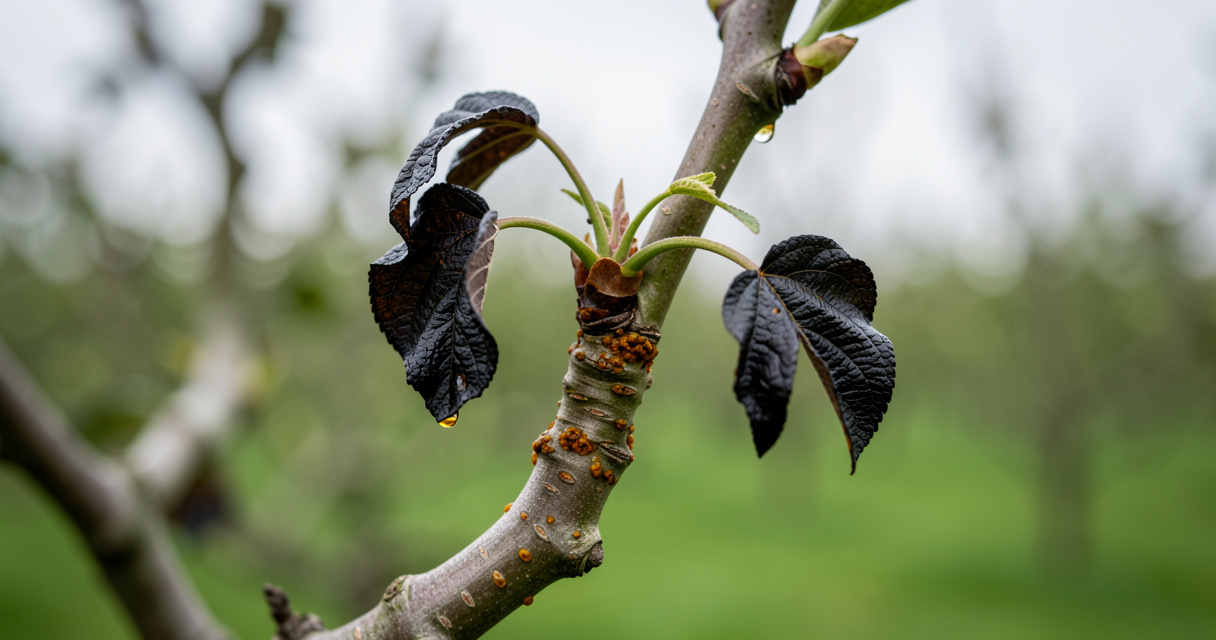
- Shepherd’s crook: New shoots bend over like a hooked cane, leaves blackening from the tip backward.
- Oozing cankers: Amber or milky droplets seep from bark lesions in warm, humid weather.
- Dead wood: Sunken, dark areas on branches that crack as they dry.
Do not overthink the first three. If you see a shepherd’s crook next to blossom blight, that is usually enough.
Recognizing it versus other lookalikes
Here is what I tell nursery colleagues: compare before you cut. Fire blight blackens leaves but leaves them attached. Pear leaf blister mite causes raised red blisters, not black. Pseudomonas blossom blast looks similar but usually lacks the sticky bacterial ooze. The plant will tell you: crook plus ooze equals fire blight, almost every time.
What I actually do about it
Don’t overthink it. Sanitation is the core. Prune infected branches 30 to 45 centimetres below the visible damage, always into clean wood, in dry weather. Disinfect your secateurs with 70% alcohol between every cut. Burn or bag the prunings, never compost them. In my experience, a copper spray at bud break reduces blossom infection, though it is not a cure.
If the trunk is more than half girdled, removal is the honest choice. I have seen too many gardeners nurse a dying pear for three seasons. Let me show you what actually works: remove the tree, choose a less susceptible cultivar for replanting, and give the new tree air. ‘Doyenné du Comice‘ and ‘Conference‘ are among the most vulnerable; ‘Harrow Sweet‘ offers better resistance.
A note for beginners
If you are facing this for the first time, I understand the panic. My first season with fire blight, I cut too little and lost a whole branch framework. The learning curve is real. Hygiene, timing, and honest observation will carry you further than any product. The plant will tell you whether you are winning.

I’ve spent over fifteen years in botanical gardens and nurseries across the Netherlands and Belgium. Now I garden in Haarlem and write what I wish someone had told me sooner. No fluff — just what actually works.