
Reading time: 6 min
Key Takeaways
- Identifying humus-rich soil starts with your own hands: dark colour, soft crumb structure, an earthy smell, and earthworms tell you more than any test strip.
- Drainage first, planting later: humus holds water like a sponge, so improving the soil structure prevents waterlogging from killing roots.
- Right plant, right place: choose species that genuinely love humus-rich soils, such as ferns, astilbes, and Japanese maples, and let the plant tell you whether it’s happy.
A dark soil can hide a few surprises
In my experience, humus-rich soil is often confused with wet soil. They are not the same thing, and that confusion causes more plant deaths than any pest. Humus is decomposed organic matter that gives soil its dark colour and spongy feel. In the Netherlands we tend to call it humushoudende grond — humus-bearing soil — and it’s considered a treasure. But a treasure that needs a little management.
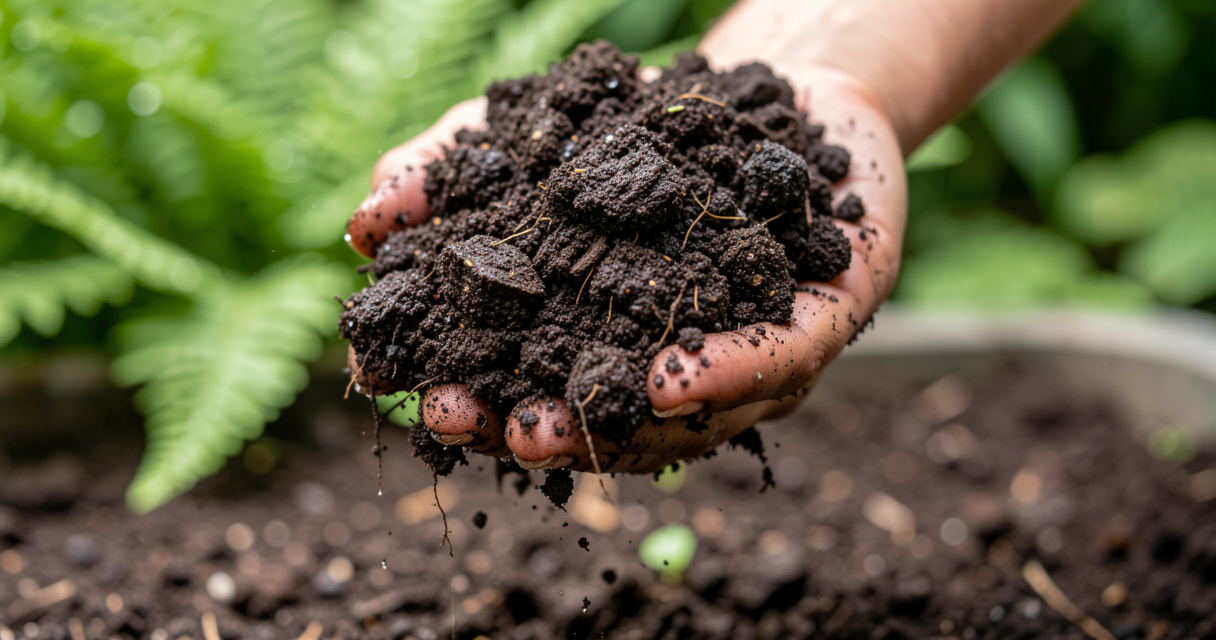
Let me show you what actually works when you’re standing in a garden bed with dark, crumbly earth at your feet. My grandmother in Leeuwarden taught me the simplest test: squeeze a moist handful. If it holds together and then breaks softly when you poke it, you have good humus-rich soil. If it smears into a greasy brick, you have clay or a waterlogged layer underneath.
How to identify humus-rich soil at home
What most people get wrong is relying on colour alone. Dark soil can also come from ash, old charcoal, or a past application of compost, without any real humus structure. Here is the practical checklist I use with clients in their gardens.
- Colour: deep brown to near-black on the surface, but not uniform all the way down.
- Touch: crumbly, soft, slightly elastic in the hand; it does not squash into a paste.
- Smell: a clean, forest-floor scent. Sour or bad-egg odors mean poor aeration.
- Ease of digging: a fork can enter without a fight. Weed roots come out relatively easily.
- Life: earthworms, soil mites, visible mycorrhiza, all good signs.
- Water test: pour a glass of water on it; if it disappears and holds the top layer slightly damp, drainage and water-holding capacity are balanced.
Plants also tell you. Humus-rich soil tends to have a high cation exchange capacity, which means it feeds plants steadily rather than in bursts. Leaves are evenly green, growth is steady, and plants rarely look either starved or overfed. If the low leaves turn yellow while the top grows fast, your soil may be compacted or perched with water.
The mistake I keep seeing: humus soil and waterlogging
The most common problem in a humus-rich bed is a waterlogged zone beneath the topsoil. Humus holds water well, and that is a gift. But if there is clay or a hard layer an arm’s length down, the water pools. Roots drown, and plants die by suffocation, not by drowning.
Here’s what I’d do. Push a garden fork deep into the soil every 30–40 cm and rock it back and forth gently; do not turn the soil like a pancake. Check whether the fork comes out wet, dark grey, and smelly. If two spits are saturated, you have a layer. My grandmother taught me to lay a spade of grit or coarse sand at the bottom of the hole before planting, not on the surface. Current Dutch and Belgian advice is simpler and more robust: open the soil vertically once, do not dig it annually, and maintain a mulch layer of about 5 cm.
- Compacted layer? Use a mechanical soil fork, not a showel, and aim for vertical aerating holes, not slicing.
- Very wet humus? It is tempting to add sand, but in fine, organic soils it can act as a concrete mix if the quantities are wrong. Prefer organic matter with larger particles, such as coarse compost or fine bark.
- Stagnant water at the surface? Break the surface crust at the end of winter, before growth starts.
Understanding what humus-rich soil can and cannot do
Let’s compare a dark humus soil and a light sandy soil in the same climate. In a wet year, humus soil keeps moisture constant and can carry many plants through drought. A light sandy soil dries unevenly and forces plants to search downward for water. But in a year with heavy autumn rain, the opposite problem appears: humus soil can be too closed and hold water longer, while sandy soil lets it through.
In practice this means a humus-rich bed makes an excellent planting substrate when its structure is open. Ferns, for example, love it. Dryopteris filix-mas and Polystichum setiferum can be found in moist humus woods in nature and perform exactly that way here. Hostas are the same story, though they may suffer from slugs in a wet bed; mulch with a thin layer of sharp grit to reduce damage.
One more thing: humus-rich soil is not universally good for every plant. Drought-loving perennials such as lavender and most Mediterranean herbs hate a permanently moist, nutrition-rich soil. They are best kept on a light, limestone-rich soil with grit. Past annual applications of fresh manure or fine compost can also lead to a surplus of nitrogen, which in our region accelerates soft growth and strengthens slugs, not plants.
What actually thrives in humus-rich soil here?
What most people get wrong is buying plants by looks alone when their soil tells them something else. Ask yourself: does this plant thrive in moist, nutrient-rich humus, or is it designed for dry, lean soil? Here is a realistic strip for our climate and humus-rich garden.
- Ferns: Dryopteris filix-mas, Polystichum setiferum, Athyrium filix-femina.
- Perennials: Astilbe, Ligularia, Geranium species such as Geranium palustre, and Aconitum in a slightly moist spot.
- Shrubs and small trees: Acer palmatum is at its best on humus-rich, slightly acidic soil, particularly in dappled shade.
- Bulbs: Camassia and Leucojum tolerate or even enjoy a moist humus spring.
- Woodland classics: Tellima grandiflora, Tiarella, Matteuccia struthiopteris — the last one in a damp corner.
The plant will tell you. If Astilbe leaves turn brown at the edges, that is usually the result of drying out, not humus. If lavender collapses into brown, it is because it has spent one wet winter too long in humus-rich soil.
Practical plan for improving and planting
Here’s what I’d do for a newly discovered but neglected humus-rich bed.
- First week: remove weeds deeply, and do not turn the soil over. Loosen the top 10 cm only where you want to plant.
- Check drainage: fork the subsoil every 50 cm; if needed, lay grit in the bottom of the planting hole.
- Add structure, not an absolute amount of nutrients: a 5 cm mulch of half-decomposed leaf litter or woody compost in autumn. Not fresh manure in spring.
- Plant in groups: better to put three clusters of the same plant in a soil that suits them than one of everything in soil that suits nothing fully.
- Watering: soak deeply once a week in the first summer, rather than a light sprinkle every evening.
- Annual maintenance: knock back growth in early spring every other year on heavier humus beds, and leave some old foliage for structure while plants have not yet covered the ground.
Don’t overthink it. Humus-rich soil is generous. My grandmother taught me that dark, crumbly earth is a living thing; the only task of the gardener is to keep it loose and let its water steer you toward plants that are happy. And the rest follows.

I’ve spent over fifteen years in botanical gardens and nurseries across the Netherlands and Belgium. Now I garden in Haarlem and write what I wish someone had told me sooner. No fluff — just what actually works.