

Reading time: 19 min
Key takeaways
- Illinois is tallgrass country, but that does not mean your garden should be. Big bluestem and Indian grass reach six to ten feet and can form near-pure stands without grazing, fire, or deliberate management.
- Short prairie grasses protect wildflower diversity. Little bluestem, blue grama, and side oats grama stay under three feet and leave room for the forbs that feed pollinators.
- Match the species to moisture and space first, aesthetics second. Switchgrass tolerates wet feet, blue grama wants dry full sun, and a single big bluestem clump can eat a square metre of border.
- Native warm-season grasses are slow and weed-sensitive. Site preparation and first-season competition control matter far more than fertilizer, and dormant seeding in late fall or winter usually beats spring sowing.
Illinois had 22 million acres of prairie in 1820. By 1978, less than 2,300 acres of high-quality prairie survived.
Read that again and the weight of a garden decision changes. Choosing native prairie grasses for an Illinois landscape is not the same as choosing perennials for a border. You are reassembling a plant community that once covered most of the state, and the species you pick decide whether that community stays diverse or collapses into a stand of grass with nothing flowering underneath it.
That is the practical problem this article solves. Search for prairie grasses Illinois and the same three names come back every time — big bluestem, Indian grass, switchgrass. Plant all three in a small garden and within four years you have a grass monoculture. The wildflowers disappear, the pollinators follow them, and the gardener concludes that prairie planting simply does not work.
I come at this from a slightly odd angle. I trained in plant biology at Wageningen, spent twelve years advising botanical gardens and specialist nurseries across the Netherlands and Belgium, and now garden on 80 square metres in Haarlem. In Europe, prairie planting is a design style — a way of making a border look loose and natural. In Illinois, it is ecological repair. That difference matters enormously when you choose a grass, because a plant chosen for how it looks at the Chelsea Flower Show behaves very differently when it is asked to hold a functioning plant community together.
So here is the counterintuitive advice I give first, and the one that shapes everything below: in most Illinois gardens, choose the short grasses. Big bluestem and Indian grass are magnificent plants, and they belong somewhere. But that somewhere is rarely a front garden in Naperville. My grandmother taught me that a garden is a conversation between plants, and in that conversation the tall grasses are the ones who never let anyone else speak.
Why Prairie Grasses Matter in Illinois: History, Loss, and Opportunity
From 22 Million Acres to Fragments
According to the McHenry County Conservation District, Illinois had 22 million acres of prairie in 1820, but by 1978 less than 2,300 acres of high-quality prairie remained (1820 and 1978). Sit with those two figures for a moment. That is roughly one surviving acre in every ten thousand — a loss so close to total that most residents of the Prairie State have never stood in the real thing.
The plow did most of the work. Prairie soils were deep, dark, and astonishingly fertile, which is exactly why they were worth destroying. Drainage tiles pulled the water off the wet prairies, the railroads opened the interior, and the corn and soybeans followed. What were left were edge cases: railroad rights-of-way where the grader could not reach, cemetery corners nobody wanted to mow differently, hill prairies on slopes too steep to farm, and a handful of preserves assembled by people who saw what was coming.
Many of those remnants are smaller than a city park. Isolated fragments lose species slowly, a process ecologists call extinction debt — the losses are already booked, they simply take decades to arrive. For anyone planting today, that legacy shapes two practical things. First, much of the seed in the commercial trade descends from those remnant populations, which is why local ecotype selection matters. Second, the insects and birds that depend on prairie are working from a reduced base, so a garden that supplies real habitat does more than it would have done a century ago.
What the Prairie State Lost and What Gardeners Can Restore
Illinois calls itself the Prairie State, and for good reason. The Illinois Natural History Survey classifies the state’s prairie heritage into six main prairie subclasses and 23 prairie types. That is not a botanical curiosity — it is a warning. Dry hill prairie on a dolomite bluff and wet prairie on black clay are not variations on a theme. They share almost no species and they fail in each other’s conditions.
What most people get wrong is treating prairie as one thing: a sea of tall grass with a few purple flowers. Twenty-three types tells you the opposite. It tells you that the reason a planting fails is usually that a wet-prairie species went into a dry slope, or a dry-prairie species drowned in a downspout outlet. The plant will tell you, but only if you know what it is telling you.
What prairie grasses are native to Illinois? The honest answer is a long list, but the ones you will actually find in the nursery trade come down to six: big bluestem, yellow Indian grass, switchgrass, little bluestem, blue grama, and side oats grama. All six are worth knowing. Not all six belong in the same garden, and that is the heart of this article.
Prairie loss at a glance
- 1820: roughly 22 million acres of prairie across Illinois.
- 1978: fewer than 2,300 acres of high-quality prairie remaining.
- Source: McHenry County Conservation District.
- What it means: a garden planting of native prairie grasses is not decoration — it is a small act of ecological repair in a state that has almost none of the original left.
Before choosing among those six grasses, you need to understand which prairie system Illinois actually is — and why the shortgrass west has something useful to say to a garden in the tallgrass east.
Tallgrass, Shortgrass, and Mixed-Grass Prairie: What Illinois Gardeners Need to Know
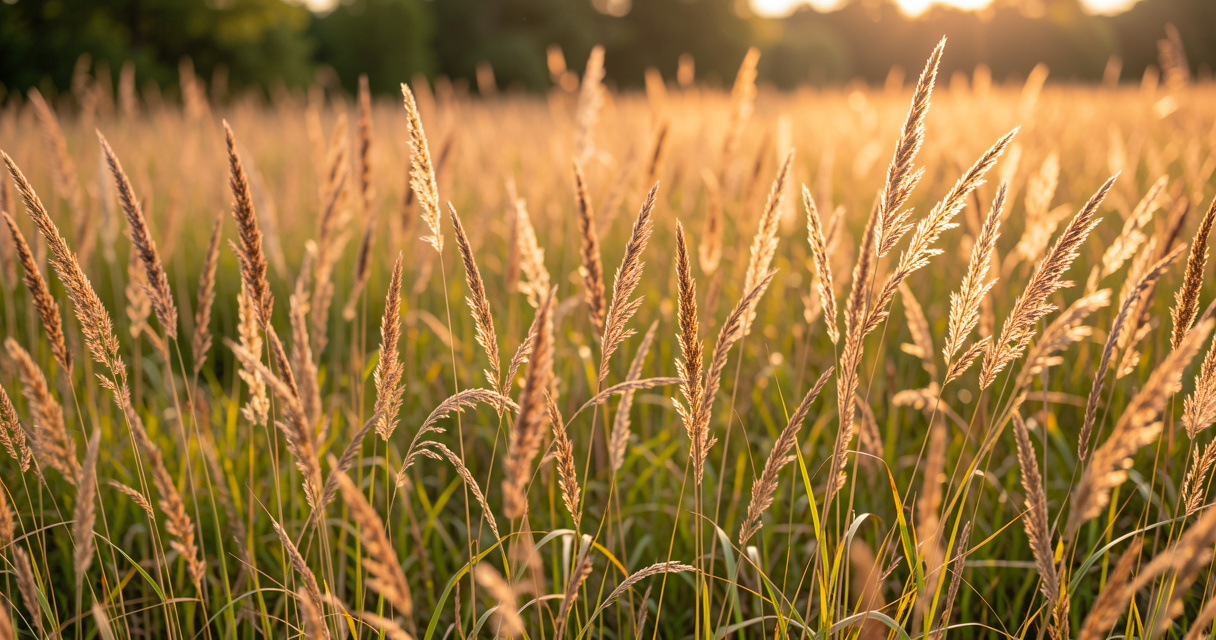
The three names describe a rainfall gradient more than a map. Tallgrass prairie occupies the deep, moisture-retentive soils of the central Midwest. Shortgrass prairie belongs to the drier west, where rainfall is too low to build a tall canopy. Mixed-grass prairie sits in the transition, holding species from both.
Tallgrass Prairie: Illinois’ Historic Dominant System
According to the Illinois Natural History Survey, tallgrass prairie vegetation can sometimes reach 10 feet or more in height. That is not a garden clump. That is a wall. The structure is built from big bluestem, yellow Indian grass, and switchgrass, threaded through with a forb layer of compass plant, prairie dock, leadplant, blazing star, and rattlesnake master.
Here is the part the prairie postcards leave out. That height was produced by disturbance. Bison and elk grazed it, fire swept it every few years, and drought knocked it back. Remove the grazers and the fire and the tall grasses keep the advantage, because height is how they compete for light. They shade the forbs out, litter accumulates around their crowns, and the planting drifts toward a pure stand. In a fenced garden with no bison and no burn crew, the tall grasses win by default.
Shortgrass and Mixed-Grass Lessons for Modern Plantings
Is Illinois tallgrass or mixed-grass prairie? Strictly speaking, tallgrass — Illinois sits within the tallgrass region, on the eastern edge of what ecologists call the prairie peninsula. But the shortgrass species still have a role here, and a larger one than most guides admit.
Shortgrass prairie is built from blue grama and buffalograss, with mixed-grass adding little bluestem and side oats grama. These species evolved under grazing pressure so intense that staying low was the survival strategy. They do not overtop their neighbours. In a garden, that single trait changes everything: a low grass leaves the light for the flowers.
What is the difference between tallgrass and shortgrass prairie? Height, rooting depth, and disturbance regime. Tallgrass is a light-competition system that depends on grazing and fire to stay diverse. Shortgrass is a grazing-adapted system where the grasses stay short and the diversity hides at ground level. Your garden is much closer to the second situation than the first, and your plant choices should reflect that.
| Prairie type | Dominant grasses | Typical Illinois setting | Garden implication |
|---|---|---|---|
| Tallgrass | Big bluestem, yellow Indian grass, switchgrass | Deep mesic black soil, former farmland, low ground | Needs space and management; can crowd out forbs |
| Shortgrass | Blue grama, buffalograss | Dry, thin, exposed soils; sandy or gravelly ground | Small, drought-proof, leaves room for flowers |
| Mixed-grass | Little bluestem, side oats grama, needlegrasses | Transition soils, shallow loess over rock, hill prairies | The most useful model for most gardens |
| Wet prairie | Switchgrass, prairie cordgrass, sedges | Drainage swales, old wetlands, clay flats | Only for sites that stay wet; fails on dry slopes |
With the systems clear, let me show you what actually works in practice — the six species worth knowing, and the honest caveats that come with each of them.
SECTION_IMAGE_1Top Native Prairie Grasses for Illinois Landscapes
Here is the shortlist, ordered by where each grass actually belongs.
- Big bluestem for large landscapes and wildlife cover.
- Yellow Indian grass for tall structure and fall color.
- Switchgrass for adaptable, robust plantings.
- Little bluestem for smaller gardens and compact clumps.
- Blue grama for dry, full-sun sites and short height.
- Side oats grama for pollinator-friendly mixes where tall grasses would crowd out wildflowers.
Tall Species With a Caveat
Big bluestem (Andropogon gerardii) is the official state grass of Illinois, and historically the most abundant and tallest of the prairie grasses. The seedheads fork into three, which is why everyone calls them turkey feet. In an average garden it settles somewhere between four and eight feet. In rich soil with a bit of moisture it will go higher, and then it will flop. Big bluestem Illinois gardeners plant for the fall colour get it — bronze, copper, then a good rust red — but they also get a plant that self-seeds into the surrounding border and leans over the path after rain.
Yellow Indian grass (Sorghastrum nutans) is the one I would choose if I could have only one tall grass. Four to six feet, upright, with golden seedheads that catch low September light in a way that makes people stop walking. It is more tolerant of a wet spring than big bluestem. It is also a strong competitor in a small planting, and that is the caveat.
Switchgrass (Panicum virgatum) is the most adaptable of the three. It handles wet ground, dry ground, clay, and sand, which is why it is planted everywhere from rain gardens to highway verges. It spreads by rhizomes, it self-seeds, and named cultivars vary wildly in height and habit. Switchgrass Illinois gardeners should treat as a structural plant, not a filler. Give it room or give it away.
Short Species for Smaller Plantings
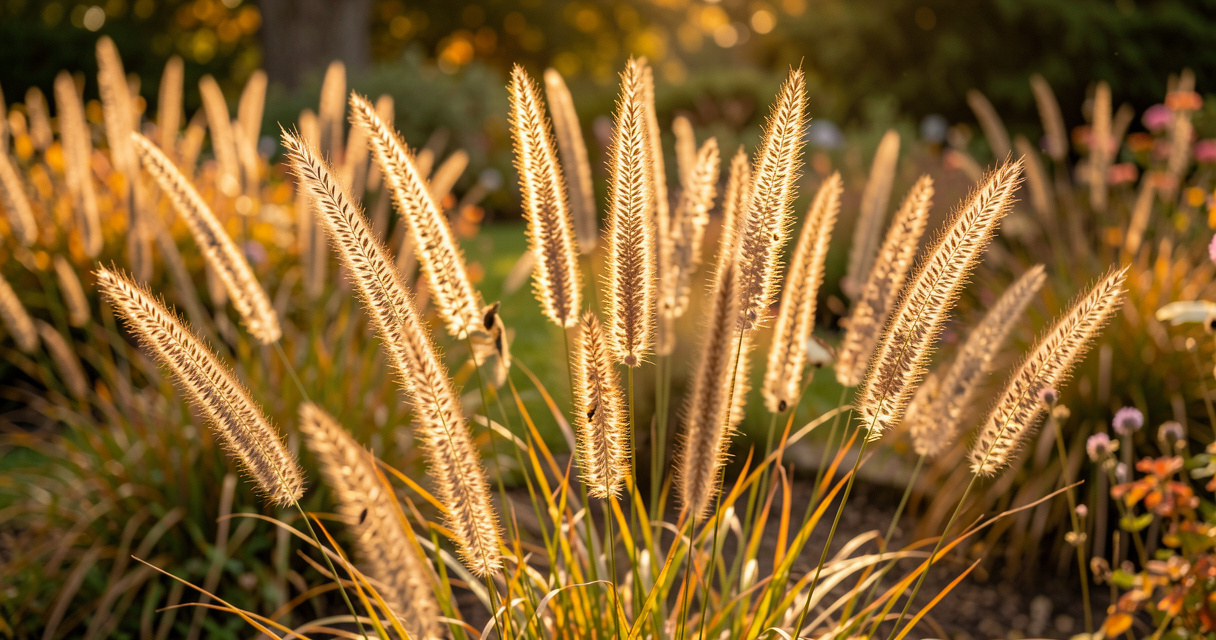
Little bluestem (Schizachyrium scoparium) is the plant I recommend most often. Two to three feet, strictly clump-forming, blue-green through summer and then a copper-orange that holds into December. It does not run, it does not self-seed aggressively, and it lets the asters and goldenrods stand next to it without being swallowed. If you have one border and one question, this is the answer.
Blue grama (Bouteloua gracilis) grows to about two feet and performs best on dry, full-sun sites, according to Illinois Extension (2023). The seedheads are eyebrow-shaped and sit horizontally, which is a strange and lovely thing in a garden. Blue grama Illinois plantings should treat as a dry-site specialist — occasionally found wild in the state, but happiest where drainage is sharp and nobody waters it. Put it in rich soil and it sulks.
Side oats grama (Bouteloua curtipendula) is the sleeper of the group and almost absent from the standard Illinois nursery lists. Two to three feet, adaptable across dry to average soils, with small oat-like spikelets that hang to one side of the stem — the plant tells you its name. It is native, it is clump-forming, and it is the best short grass for a pollinator mix where tall grasses would crowd out wildflowers.
Warm-Season Grasses and Fall Color
All six are warm-season grasses, which means they do not start growing until the soil has genuinely warmed — late May into June in northern Illinois. In April a prairie planting looks dead. It is not. It is waiting. Do not dig it up and do not fill the gap with pansies.
That late start is the price of the late show. Peak colour arrives in September and October, exactly when most of the border has given up. And the standing stems carry the garden through winter, catching frost and providing the cover that overwintering insects need. Cut them in spring, not autumn.
| Species | Height | Sun and moisture | Best use | Caveat |
|---|---|---|---|---|
| Big bluestem | 4–8 ft, taller in rich soil | Full sun; average to moist | Large landscapes, wildlife cover | Flops, self-seeds, shades out forbs |
| Yellow Indian grass | 4–6 ft | Full sun; dry to moist | Tall structure, autumn colour | Aggressive competitor in small beds |
| Switchgrass | 3–6 ft | Full sun; wet to dry | Adaptable, robust, rain gardens | Runs by rhizomes, self-seeds |
| Little bluestem | 2–3 ft | Full sun; dry to average | Small gardens, compact clumps | Wants sharp drainage in winter |
| Blue grama | Up to 2 ft | Full sun; dry | Dry sites, short height | Fails in rich or wet soil |
| Side oats grama | 2–3 ft | Full sun; dry to average | Pollinator mixes, small yards | Less showy in autumn colour |
A warning I give to every client
Tall grasses can form pure stands without grazing or active management. A planting of big bluestem and Indian grass in a fenced suburban garden is not a prairie — it is a grass bed with declining diversity. If you want a tall grass, budget for a spring cut, a division every few years, and a willingness to remove seedlings.
Knowing the species is only half the job. The other half is reading your own site honestly — which brings us to a decision framework that starts with sun and moisture rather than with a wish list.
How to Choose the Right Prairie Grass for Your Site
Six prairie subclasses and 23 prairie types is far too many to work through when you are standing in a garden centre. So do not work through them. Match your site conditions first, then choose from the handful of species that suit those conditions. Short prairie grasses win by default in most residential situations, but only after the site has been read properly.
Match Grass to Soil Moisture
Which prairie grass is best for wet soil in Illinois? Switchgrass, without much competition, with prairie cordgrass for genuinely wet hollows that hold water into June. For average garden soil, big bluestem and yellow Indian grass do well but bring the height problem with them. For dry ground — a south-facing slope, sandy fill, gravelly subsoil — little bluestem, side oats grama, and blue grama are the reliable trio.
Watch the site through a heavy rain before you plant. Not during a drizzle — during the storm that floods the street. Where the water goes tells you more than any soil test about which grass will survive.
Plan for Space and Competition
What prairie grass works in a small yard? Little bluestem, side oats grama, and blue grama. That is the whole list. A single big bluestem clump, in reasonable soil, occupies close to a square metre and leans a metre beyond it. In my 80 square metres in Haarlem I could accommodate one — and I would be pulling seedlings out of the gravel for the rest of my life.
Measure the space, then halve it. Every prairie planting I have ever seen in a private garden was installed at twice the density it wanted. Crowded grasses compete for light instead of coexisting, and the winner is always the tallest.
Choose Short Grasses to Protect Wildflowers
If wildflower diversity is your goal — and for pollinators it should be — the decision is close to automatic. Short grasses leave the light for the forbs. Tall grasses take it. Every design choice follows from that single fact, and no amount of clever planting can overrule it.
- Sun hours: count the hours of direct sun in June. Below five, do not plant prairie grasses.
- Soil moisture: dry, average, or wet, judged after a storm rather than after a drizzle.
- Drainage: does water stand anywhere for more than a day?
- Space: the real planting depth from path to edge, in metres.
- Maintenance tolerance: will you cut, divide, and weed, or should you plant something that needs none of it?
- Existing wildflowers: what is already growing there, and what would a tall grass shade out?
Once the site is settled, the next question is what the planting is for. A grass collection and a pollinator garden are two different briefs, and they do not resolve into the same plant list.
Designing a Pollinator-Friendly Prairie Grass Planting
Grasses and forbs do different jobs, and a planting that serves pollinators needs both. The grasses provide structure, nesting material, and winter cover. The forbs provide nearly all of the nectar and pollen. If you want prairie plants for pollinators Illinois gardeners can actually rely on, the ratio matters more than the species list: something close to one part short grass to three or four parts flowering forbs.
Combine Grasses With Early and Late Forbs
What prairie grasses attract pollinators in Illinois? None of them, directly — and that is the useful answer. Grasses are wind-pollinated and offer no nectar. What they offer is habitat. The pollinators come for the flowers, and the flowers need the grasses to keep the structure open.
Season-long resource means early and late. Early: golden alexanders, prairie smoke, penstemon, lupine. Late: New England aster, stiff goldenrod, showy goldenrod, blazing star, and the prairie gentians if you are lucky. Short grasses sit underneath both waves without competing for the light that the flowers need.
Should I plant prairie grasses with wildflowers? Yes, but not the way most people do it. Plant the short grasses as a matrix and the flowers in groups of three to seven, not scattered singly. A single blazing star in a grass matrix is invisible to a bee. A clump of seven is a destination.
Leave Winter Structure for Wildlife
Do not cut the grasses back in autumn. Standing stems hold overwintering insects — native bee larvae, moth pupae, ladybird beetles — through the coldest months. Cut in late March or early April, when you see the first new shoots pushing through the old stems. That timing is not sentimental. Cutting early destroys the overwintering population you spent the summer attracting.
One of my clients in a suburb of Chicago had a grass-heavy planting installed by a landscape contractor: big bluestem in rows, three Indian grass per metre, nothing else. Three years later it was a solid mass and the owner could not understand why she never saw bees. We took out two thirds of the tall grasses over two seasons, added little bluestem and side oats grama as a matrix, and planted asters, goldenrod, and blazing star in groups. By the second summer she had bumblebees nesting in the south-facing edge. Nothing about her soil changed. Only the height changed.
Design decisions only pay off if the planting establishes. And establishment is where most prairie plantings fail — not in the design, but in the first twelve months.
SECTION_IMAGE_2Planting, Establishing, and Maintaining Illinois Prairie Grasses
Seed vs. Plugs
Seed is cheaper per square metre and far harder to establish. Native warm-season grasses germinate slowly, stratify naturally, and compete badly against the weed seed already in your soil. Plugs cost far more and establish far faster, and for a garden under 200 square metres I would use plugs almost every time. For a meadow, seed is the only realistic route.
When should I plant prairie grass seed in Illinois? Late fall through winter — roughly November into February — for dormant seeding, so that winter cold does the stratification for you. Spring sowing works if the seed has been cold-moist stratified and you are prepared to irrigate and weed. Local extension guidance for your county and your species is worth checking before you commit, because the right window shifts north to south across the state.
First-Season Weed Management
How do I establish native prairie grass without weeds? You do not. You manage them, aggressively, for a year. Start by killing the existing vegetation before you plant — a full season of smothering or repeated shallow cultivation. After sowing, mow the new planting at six to eight inches whenever weeds get ahead of the grasses. The grasses are growing roots, not tops, in year one. The mower is there to stop the weeds seeding, not to tidy.
Do not fertilise. Prairie plants evolved on some of the poorest, most competitive soils in North America, and added nitrogen makes tall grasses floppy and weeds rampant. The plant will tell you if it needs anything, and mostly it does not.
Long-Term Maintenance
Once established, a prairie planting needs one intervention a year and one every few years. Annually: cut and remove in early spring. Every three to five years: divide the clumps that have gone hollow in the centre, and pull out tall grass seedlings before they become the new problem. In larger meadows, an occasional burn does the work that bison used to do — check local regulations, because burning in an Illinois suburb is not a casual decision.
- Step 1: kill existing vegetation a full season ahead.
- Step 2: choose seed (large areas) or plugs (gardens), and source local ecotype where possible.
- Step 3: sow dormant in late autumn or winter, or plant plugs in late spring.
- Step 4: mow at six to eight inches through the first season to control weeds.
- Step 5: no fertiliser, no irrigation once established beyond the first summer.
- Step 6: leave the standing structure through winter, cut in early spring.
Even with good establishment, certain mistakes recur so reliably across Illinois that they deserve their own section — and they are almost always design mistakes dressed up as plant choices.
Common Mistakes and Regional Considerations Across Illinois
Mistake 1: Planting Tall Grasses Everywhere
Why do big bluestem and Indian grass take over a garden? Because nothing is stopping them. They evolved to compete for light in a system where grazers and fire removed their competition every few years. In a garden, height is an unbeatable advantage and nothing removes it. The result is a monoculture that looks like a prairie from a distance and supports almost nothing up close. Illinois prairie grasses for small yards simply should not start with the tallest species available.
Mistake 2: Ignoring Local Ecotype and Site Conditions
Illinois has 14 natural divisions and six prairie subclasses. A plant that thrives on a dry hill prairie in Jo Daviess County may drown in a wet prairie remnant in Iroquois County, and both are Illinois. Local ecotype seed — collected within a few hundred miles of your site, from similar conditions — establishes better and is what restoration ecologists prefer. Ask the nursery where the seed came from. If nobody knows, that is your answer.
Are native prairie grass cultivars as good for wildlife? Sometimes, often not. Cultivars are selected for habit, colour, and seedhead size, not for nectar, pollen, or the leaf chemistry that insects evolved with. A cultivar that holds its colour longer may also hold its seed longer, which matters to the birds that eat it. Where wildlife value is the point, straight species and local ecotype are the safer choice.
Two more that come up constantly: overfertilising (which makes tall grasses flop and weeds thrive) and expecting prairie grasses to grow in shade. They will not. Most native prairie grasses need full sun and open, sunny sites; a few tolerate light shade and none of them performs in it.
Remember
Tall grasses can become monocultures without grazing or planned management. If you cannot commit to an annual cut and periodic removal of seedlings, plant short grasses instead. That is not a compromise. It is the correct decision for the site.
Frequently Asked Questions About Prairie Grasses in Illinois
What is the official state grass of Illinois?
Big bluestem (Andropogon gerardii) is the official state grass of Illinois. It was historically the most abundant and tallest prairie grass in the state, but it is aggressive in small plantings and should be matched carefully to the site.
What are the best prairie grasses for Illinois?
Match the species to the site. Use big bluestem, yellow Indian grass, and switchgrass for larger areas and wildlife cover; use little bluestem, blue grama, and side oats grama for smaller gardens and pollinator mixes.
Are short prairie grasses native to Illinois?
Yes. Side oats grama is native and well suited to Illinois plantings, and little bluestem is native across the state. Blue grama is occasionally found wild in Illinois and is recommended for dry, full-sun sites.
How tall do prairie grasses grow in Illinois?
Tallgrass prairie vegetation can sometimes reach 10 feet or more in height, according to the Illinois Natural History Survey. Blue grama grows only to about 2 feet. Match the height to the space you have and to the wildflowers you want to support.
When should I plant prairie grass seed in Illinois?
Late fall through winter is common, because natural cold does the stratification for you, and spring planting can work with stratified seed and good weed control. Confirm timing with local extension guidance for your species and county.
Can prairie grasses grow in shade?
Most native prairie grasses need full sun. A few tolerate light shade, but prairie species perform best in open, sunny sites with appropriate soil moisture. Deep shade is not a prairie condition.
Do prairie grasses attract pollinators?
Grasses provide structure and habitat, while flowering forbs provide most of the nectar and pollen. Combine short grasses with a diverse forb mix to genuinely support pollinators.
Final Thoughts: What the Prairie State Could Look Like
Three things are worth carrying out of this article.
Match height and species to sun, soil moisture, and garden size. The six grasses in the trade are not interchangeable, and the tallest are the least suitable for most residential sites.
Use short grasses to protect wildflower diversity. In small gardens and pollinator-focused plantings, little bluestem, side oats grama, and blue grama do more ecological work than any tall grass can.
Plant native species, manage the tall ones, and think about local ecotype. Illinois has 14 natural divisions and six prairie subclasses, and a plant that works in one will fail in another. Don’t overthink it, but do read your site before you read a catalogue.
In my experience, the gardens that succeed are the ones where the gardener accepted the site they actually had rather than the prairie they had seen in a photograph. The plant will tell you what it needs. The trick is choosing one that is asking for what you can give.
If Illinois is the Prairie State, why do so many of its landscapes still depend on a narrow palette of exotic groundcovers — when the plants that built the state are still here, still available, and still willing?

I’ve spent over fifteen years in botanical gardens and nurseries across the Netherlands and Belgium. Now I garden in Haarlem and write what I wish someone had told me sooner. No fluff — just what actually works.