
Reading time: 8 min
Key takeaways
- Taxus baccata is the most reliable yew for dense hedges, tolerating deep shade and poor soil — unlike its faster-growing cousin Taxus × media.
- Plant in autumn or spring with a 50 cm spacing for hedges; avoid waterlogged or compacted spots to prevent root rot.
- Prune twice a year — once in late spring after new growth, once in early autumn — and always wear gloves: all parts are toxic to dogs, cats, and humans.
Identifying yew: what most people get wrong
In my experience, the confusion starts the moment someone calls every dark-green conifer a "yew." What most people get wrong is mistaking Taxus baccata (European yew) for the faster-growing Taxus × media (Anglojap yew) — or worse, thinking a yew is a pine. Let me show you what actually works for identification.
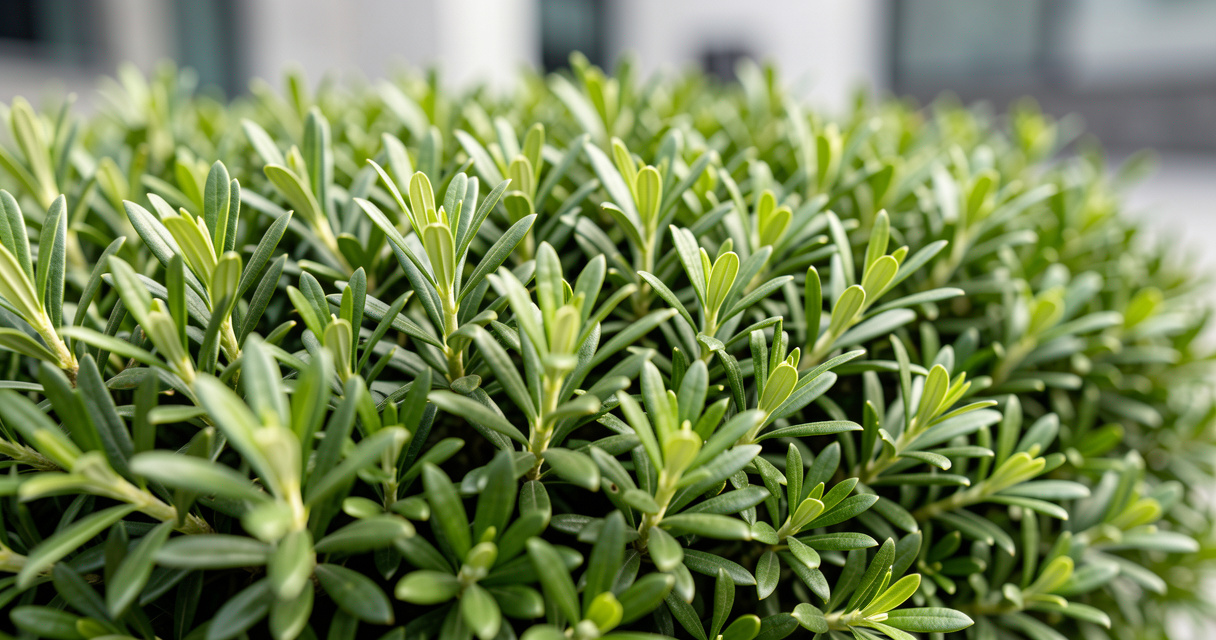
European yew has flat, soft, dark green needles arranged in two rows on each stem, with a pointed tip and a pale green underside. The bark flakes in reddish-brown strips. Its female plants produce a fleshy, cup-shaped bright red aril that contains a single dark seed — all parts except the aril are toxic. Taxus × media, bred in the 1930s, has slightly longer needles and a more upright, columnar form, but it still shares the same pruning needs.
If you see a "yew" with thick, scaled leaves that smell like Christmas, it’s probably a cypress. Don’t overthink it: yew needles are thin, flat, and never spikey. The plant will tell you — just look at the way the needles lie flat against the stem.
Planting yew: timing, spacing, and soil
Here’s what I’d do. I plant my yew hedges in late September or early October, when the soil is still warm and rain is reliable. Spring planting works too — March to early April — but you must water more during the first summer. My grandmother taught me to dig a trench, not individual holes, for a hedge: it sounds like more work, but it lets the roots spread evenly and avoids air pockets.
For a dense hedge, space plants 50 centimetres apart. Staggered double rows at 60 cm centres give fuller coverage in half the time, but that’s for when you’re impatient like me. Yew hates waterlogged roots, so on heavy clay, either raise the planting bed by 15–20 cm or amend the trench with sharp sand and organic matter. What most people get wrong is planting too deep — burry the root collar just below the soil surface, never deeper.
At Wageningen, we studied root development in container-grown yew vs bare-root specimens. Bare-root plants establish faster in hedges but need careful handling. If you buy container-grown, check that the roots are not pot-bound — if they are, tease them out gently before planting.
Pruning yew safely
Pruning is the moment where most gardeners panic. In my twelve years at Botanische Tuinen Utrecht, I saw people prune yew into a lollipop shape because they didn’t understand its regrowth pattern. Yew buds are distributed along old wood — not just at the tip — so you can cut back into bare stems, and new shoots will appear below the cut. This is not true for most conifers, which is why yew is forgiving.
Let me show you what actually works. For a hedge, I prune twice a season: first in late May or early June after the main flush of new growth, then a lighter trim in early September to tidy up before winter. Use sharp, by-pass secateurs for interior shaping and manual hedge shears for the sides — never an electric trimmer for the first cut on young hedges, because it tears the needles.
In my experience, city garden yews in Haarlem — like my 80-square-metre plot — respond best to a narrow, tapered profile: wider at the base, slightly narrower at the top. This lets light reach the lower branches and keeps the hedge green from top to bottom. If you want a topiary ball or cube, train it over two years: first year shape the outline, second year refine the interior.
Toxicity and safety: what you must know
Yew contains the alkaloid taxine, which can cause rapid heart failure in humans and animals if ingested. All parts — needles, bark, seeds, wood — are toxic, with only the fleshy aril being edible (but the seed inside is not). Don’t overthink it: wear gloves when pruning, wash your hands afterward, and keep prunings away from children and pets. In my grandmother’s village, horses used to die from eating yew clippings dumped over the fence — a lesson I never forgot.
If you have dogs that love to chew garden debris, sweep up every single needle after pruning. Even dry droppings remain toxic for months. In the Netherlands, the Vergiftigingen Informatie Centrum lists yew as a high-risk garden plant. That said, the plant is not dangerous to touch or prune — only to eat. The smell is mild, and the sap causes no skin irritation beyond a light reddening for sensitive people.
For topiary or hedging near a children’s play area, consider planting Taxus baccata ‘Semperaurea’ — a golden-yellow cultivar that is equally manageable but easier to spot if foliage drifts onto the lawn. I have three specimens along a patio, and I’ve never had an incident because I sweep regularly.
Watering, feeding, and troubleshooting
Yew is drought-tolerant once established, but in the first two years, I water deeply once a week from April to October if rain is scarce. In my 80-square-metre city plot, I use a soaker hose on a timer — 30 litres per plant per session. Overhead watering encourages fungal issues; the plant will tell you if it’s thirsty by browning in the interior needles.
Feed in early spring with a balanced, slow-release fertilizer (NPK 12-12-12) at the manufacturer’s rate for conifers. In autumn, a top-dressing of well-rotted compost works wonders, especially on light sandy soils like those in Haarlem. My grandmother used nothing but manure from her neighbour’s goat — the hedge was still green fifty years later.
The most common pest on yew is the vine weevil (Otiorhynchus sulcatus), which nibbles notches in the needles. In the nursery, I treated infestations with beneficial nematodes applied to the soil in September. Monitor for pale, sickly foliage — that’s often a sign of root damage from grubs. Scale insects and spider mites are rare in the north-European climate but can appear under drought stress.
Yew varieties for different garden styles
If you want a formal hedge, Taxus baccata is your first choice. It grows slowly, prefers the shade, and takes clipping without protest. For a narrow, upright hedge of 2–3 metres tall, ‘Fastigiata Robusta’ grows in a tight column — ideal for the end terrace or an entrance.
For a low edging or knot garden, ‘Repandens’ stays about 40 cm tall and spreads slowly. I’ve used it along the front of a mixed border in Leiden, and it neatly frames taller plants like foxgloves and ferns without bullying them. ‘Semperaurea’ with its golden foliage brings brightness to dark corners, but it needs at least three hours of indirect light to maintain the yellow colour.
British gardens often feature ‘Dovastoniana’ — a tall, broad form with weeping tips that looks magnificent as a specimen. In the Netherlands, I see it less often, but at the Pinetum Blijdestein near Haarlem, they have a 150-year-old ‘Dovastoniana’ that stretches 12 m wide — a living example of the species’ longevity.
Finally, consider Taxus × media ‘Hicksii’ if speed is important. It’s the fastest-growing yew I know — about 30 cm per year — and it holds a narrow cone shape. But in my experience, it greens up less densely lower down, so you’ll need to keep it wider at the base from the start.
FAQ — quick answers to common yew questions
Can I prune yew back to old wood?
Yes — yew is one of the few conifers that regrows from old wood. Cut back to a bud or a small branch, and new shoots will emerge. Avoid cutting into wood thicker than 5 cm as recovery will be slow.
Why is my yew turning brown?
It could be frost damage, too much sun in summer, waterlogging, or a vine weevil infestation. Check the soil moisture at depth, and look for root damage signs. The plant will tell you by browning from the inside outward if it’s shading itself.
How long does a yew hedge take to establish?
A newly planted bare-root hedge takes two to three years to thicken out. Container-grown specimens fill in slightly faster but need more attention to root spread. In my Haarlem garden, the hedge was presentable at 18 months but took four years to reach the density I wanted.
Is yew safe for a balcony or container?
Yes, with good drainage and winter protection. Choose ‘Repandens’ for a low container or ‘Fastigiata Robusta’ for a tall accent. In mild winters, move the pot away from direct north-east wind to avoid needle scorch.
Can I move a large yew?
Move yew only from late autumn to early spring while it’s dormant. Large hedges are better replaced — root disturbance will cause years of stress. For specimens under 1.5 m tall, you can succeed with a 60 cm‑rootball wrapped in hessian.
How do I tell female yew from male?
Female yews produce the red arils; male yews produce small, creamy cones that release pollen in March–April. The female is preferred for wildlife, but near paths the messy fallen fruit can be slippery. Avoid planting both sexes in a small garden unless you’re ready to sweep up berries.
Over the years, I’ve watched so many gardeners find confidence with just a few targeted pruning cuts. Yew is a plant that rewards patience. My grandmother’s giant yew — planted in 1945 — is still going strong, pruned once a year by whoever remembers, with no fertiliser and barely a thought. That’s the real secret: choose the right spot, plant it well, and then let it grow. The plant itself will teach you the rest.

I’ve spent over fifteen years in botanical gardens and nurseries across the Netherlands and Belgium. Now I garden in Haarlem and write what I wish someone had told me sooner. No fluff — just what actually works.