
Reading time: 18 min
Key takeaways
- Shade is a spectrum, not a single condition. Identify whether your bed gets light, partial, full, or deep shade before you buy a single plant — the same hellebore will thrive in one setting and sulk in the next.
- Perennials build the bones, annuals deliver the drama. Hosta, astilbe, hellebore, and toad lily return every year, while begonias and impatiens fill the gaps and give you instant color in one season.
- Moisture decides success more than light does. Dry shade under a mature maple and moist clay shade in a wet corner need completely different plant lists.
- Foliage carries the bed when nothing is blooming. Textured and colored leaves keep a shade garden interesting from March to October — flowers are the punctuation, not the sentence.
What if the shadiest corner of your yard could be the most colorful one? Most gardens have more shade than sun — a north-facing wall, a mature maple, a narrow side strip between two houses — and most plant labels assume the opposite. So gardeners buy sun-loving perennials, watch them stretch toward a light source that never arrives, and conclude that shade means no flowers at all.
That conclusion is wrong, and in my experience it costs people years of disappointing beds. The trick is not finding flowers that grow in shade in some abstract sense. It is diagnosing the specific kind of shade you actually have, then matching the plant to it. A shade garden that will bloom from March to October is not a fantasy — it is a planning exercise, and the plan starts with light.
I spent twelve years designing shade borders for botanical gardens and specialist nurseries across the Netherlands and Belgium, and I have been slowly rebuilding my own 80 square metre city garden in Haarlem into something that proves the point. Let me show you what actually works.
Which Flowers Grow in Shade? The Short Answer
The best flowers for shade include:
- Hosta — hardy foliage with purple or white summer flower spikes
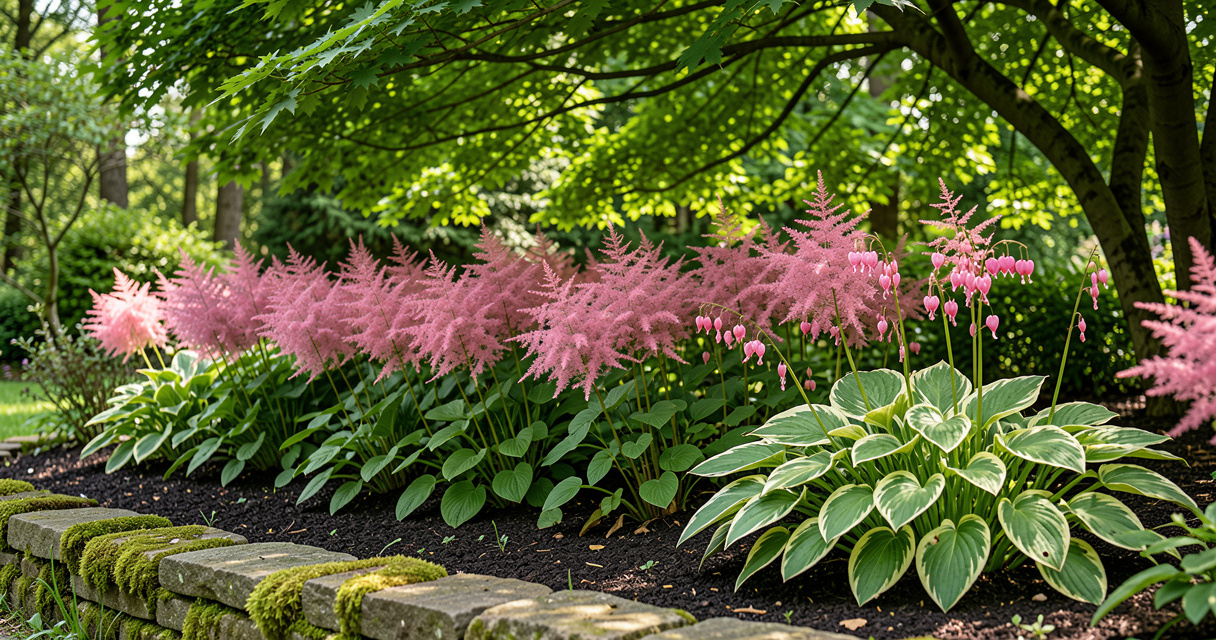
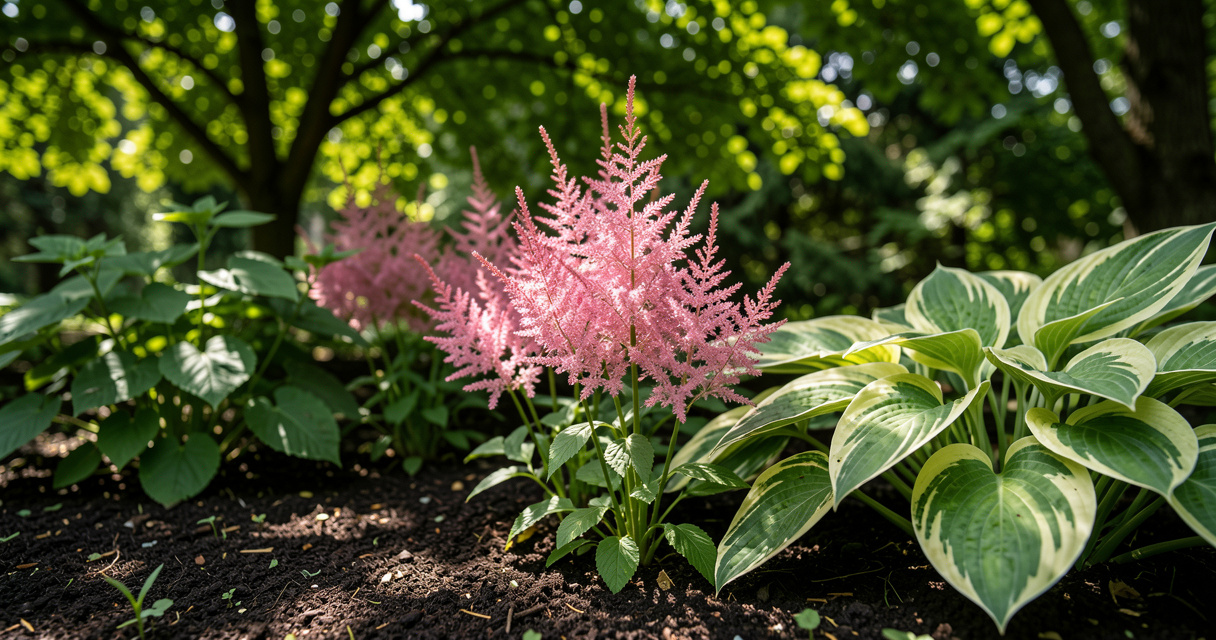
- Astilbe — feathery pink, red, or white plumes
- Hellebore (Lenten rose) — blooms in winter and early spring
- Bleeding heart — dangling heart-shaped spring flowers
- Impatiens — reliable annual color in full shade
- Wax begonia — flowers nonstop until frost
- Coleus and caladium — grown for bright, colorful foliage
- Toad lily — unusual late-summer and fall blooms
That list is the headline, but it only becomes useful once you know which of those plants belongs in your particular shade. What most people get wrong is treating “shade” as one thing. It is not. Bright indirect light filtered through a birch is a fundamentally different growing situation from the dense, dusty dark under a Norway maple, and the plant list for each one only partly overlaps.
Full-shade bloomers
These are the workhorses that flower with fewer than three hours of direct sun per day, as long as the light that reaches them is bright and indirect. Hosta sends up lavender or white trumpets in midsummer, often fragrant on the taller cultivars. Astilbe throws plumes of pink, red, or white that hold for weeks. Hellebore opens its nodding cups in the dead of winter, sometimes under snow. Bleeding heart (Lamprocapnos spectabilis) arches its heart-shaped flowers through late spring. Toad lily (Tricyrtis) closes the season with speckled orchid-like blooms in September and October. Then impatiens and wax begonia fill the annual slot with color from June until frost.
Partial-shade bloomers
Partial shade means three to five hours of direct sun, usually in the morning or late afternoon. That is a much easier environment, and this is where a wider palette unlocks. Coleus glows in every saturated color you can name and needs that touch of direct light to keep its patterns crisp. Caladium wants the same filtered brightness. Torenia (wishbone flower) is a small, tough, snapdragon-like bloomer that keeps going in humid shade where impatiens melt. Japanese anemone, Heuchera, and most hydrangeas also do their best work at this level — not in the dark.
Now let me define those shade levels properly, because every plant decision after this section depends on getting the diagnosis right.
What Counts as Shade? Four Shade Levels and What Thrives in Each
Horticulture uses four shade categories, and they are anchored on one measurable thing: how many hours of direct sun the bed receives. Everything else — soil moisture, plant choice, container or border, deer pressure — flows from that number. If you do not know how many hours of sun your bed gets, watch it for one clear day in May and write the number down.
Light and dappled shade
Three to five hours of direct sun, often broken up by leaf shadows moving with the breeze. This is the friendliest shade level and where most traditional woodland perennials actually grow best. Soil usually dries out between rains but stays crumbly rather than baked. Reliable flowering picks: hellebores, bleeding heart, Heuchera in a flowering cultivar like ‘Paris’, and most of the Polemonium family.
Partial shade
Roughly three to four hours of direct sun, typically in the morning or the last two hours of the afternoon. The distinction that matters is which sun: morning sun is gentle and dries dew, preventing fungal problems. Late afternoon sun is hot and can scorch leaves that stayed cool all day. In partial shade you can push the palette further — astilbe, hosta, impatiens, torenia, and Japanese anemone all flower well here.
Full shade
Fewer than three hours of direct sun, but still bright enough to read a newspaper without switching a light on. Full shade is not darkness. This is where hosta, toad lily, and wax begonias earn their keep, and where the first real limits appear. Hosta will bloom, though often with fewer and shorter spikes than in partial shade. Toad lily is one of the few perennials that genuinely flowers here in late summer.
Deep or dense shade
No direct sun, and the light is dim for most of the day — think a north-facing wall with a porch overhang or the interior floor of a mature conifer grove. Deep shade is honest territory: most plants will survive but few will flower. Treat it as a foliage garden. Ferns, lily of the valley, plain-leaved hostas, and Asarum are the realistic cast here. If a client insists on blooms in this corner, I send them to containers with caladium and begonias instead of fighting the soil.
| Shade level | Direct sun per day | Typical soil moisture | Flowering picks | Blooms in deep shade? |
|---|---|---|---|---|
| Light or dappled | 3–5 hours | Variable, dries between rains | Hellebore, bleeding heart, Heuchera, Polemonium | No |
| Partial | 3–4 hours | Moderately moist | Astilbe, hosta, impatiens, torenia | No |
| Full | Under 3 hours | Usually moist | Hosta, toad lily, wax begonia | Sometimes |
| Deep or dense | No direct sun | Often dry from root competition | Fern, lily of the valley, plain hosta (foliage) | Rarely |
Definition: full shade is not darkness
“Full shade” in horticulture means under three hours of direct sun but still bright indirect light — the kind of light where you would be comfortable reading without a lamp. A corner that requires indoor lighting at midday is deep shade, and no flowering plant list should pretend otherwise. My grandmother taught me that the plants will tell you which kind of shade you have, if you listen with your eyes.
Once you know your shade level, the next variable is what you want to plant — perennials for permanence, or annuals for speed. Both have a place, and they belong to different strategies.
Best Perennial Flowers for Shade (They Come Back Every Year)
Shade perennials are the long-term investment. They cost more up front than annuals and look sparse the first season, but by year two or three they carry the bed with almost no intervention. Here is my structured shortlist — the plants I actually specify for clients, with the data I want before I put them in a design.
| Plant | USDA zone | Bloom time | Height x spread | Shade level | Deer resistance |
|---|---|---|---|---|---|
| Hosta | 3–9 | Midsummer | 12–36 in x 24–48 in | Full shade | Low |
| Astilbe | 4–8 | Early summer | 18–30 in x 18–24 in | Partial to full | Medium |
| Hellebore (Lenten rose) | 4–9 | Winter to early spring | 12–24 in x 18–24 in | Partial to full | High |
| Bleeding heart (Lamprocapnos spectabilis) | 3–9 | Late spring | 24–36 in x 24–30 in | Partial to full | Medium |
| Heuchera (coral bells) | 4–9 | Late spring to summer | 8–18 in x 12–18 in | Partial to full | Medium |
| Toad lily (Tricyrtis) | 4–8 | Late summer to fall | 24–36 in x 12–18 in | Partial to full | High |
| Mertensia virginica (Virginia bluebells) | 3–8 | Early to mid-spring | 12–24 in x 12–24 in | Partial to full | High |
| Polemonium reptans (Jacob’s ladder) | 3–8 | Mid-spring to summer | 12–24 in x 24–36 in | Partial to full | High |
Deer resistance is a guidance column, not measured data — browsing pressure varies hugely by region, season, and how hungry the local herd happens to be. Treat “high” as a strong head start and “low” as shorthand for “this hosta will be a deer salad bar.”
Spring bloomers: bleeding heart, hellebore, Virginia bluebells
Spring is the season when shade gardens outshine their sunny cousins. Hellebore starts the year as early as January in my Haarlem garden, unfolding its nodding cups in creamy white, dusty pink, or deep maroon while the rest of the border is still asleep. It looks best planted in drifts where the flowers can be appreciated from above — a hellebore facing sideways at eye level is a wasted hellebore.
Bleeding heart takes over in late April and holds through May, arching its stems horizontally so the heart-shaped flowers dangle like a row of small lanterns. According to Gardenia.net’s shade perennial reference, Mertensia virginica is hardy in Zones 3–8, prefers partial sun to shade, blooms in early to mid-spring, and settles at 1–2 ft (30–60 cm) tall and wide. In my experience Virginia bluebells are the single most reliable early native bloomer for a partially shaded bed — the buds open pink and turn a translucent blue within a day of emerging, and bees find them before almost anything else is flowering.
Jacob’s ladder (Polemonium reptans) is the sleeper of this group. The same reference lists it as hardy in Zones 3–8, with partial sun to shade exposure, blooming from mid-spring through summer, reaching 1–2 ft (30–60 cm) tall and spreading 2–3 ft (60–90 cm). The blue-purple clusters are small but nonstop, and the plant will gently self-seed into a naturalized drift if you leave the seedheads to ripen.
Summer bloomers: astilbe, hosta, coral bells
Summer is where astilbe takes the stage. The plumes rise above fern-like foliage in fluffy cones of pink, red, or white, and unlike most shade plants they hold their color for three to four weeks. Astilbe is a moisture lover, so pair it with hosta and ferns rather than dry-shade plants. The dwarf forms (‘Sprite’, ‘Deutschland’) sit at the front of the border; the taller ones (‘Bridal Veil’, ‘Fanal’) stand at the back.
Hosta is technically a foliage plant, but many cultivars flower generously — ‘Royal Standard’ and ‘Fragrant Bouquet’ throw white, evening-fragrant trumpets in July that hummingbirds and hawk moths visit. The real story with hosta is the leaves: 30-inch blue-grey ‘Blue Angel’ beside a lime-edged ‘Patriot’ beside a slug-resistant, thick-leaved ‘June’ creates a colour story that outlasts every flower in the bed. Slugs are the price, and I will cover that honestly later.
Heuchera (coral bells) is the connective tissue of a shade border. The foliage stays evergreen through most winters here, and the small, airy flower wands rise 15–20 inches from late spring onward, giving bees a low-effort meal. ‘Caramel’ and ‘Peach Flambe’ bring warm amber into a bed that too often defaults to green and blue.
Late-season bloomers: toad lily and Japanese anemone
This is the section most shade lists skip, and it is the reason so many shade borders peak in June and then fall silent. Toad lily (Tricyrtis) flowers in September and October, when almost nothing else in a shaded bed is doing anything. The blooms are exotic — white or pale purple with darker speckles, orchid-like in shape — and each stem carries a dozen or more over several weeks. It wants moist soil and dappled shade, and it resents being moved, so choose its spot carefully.
Japanese anemone (Anemone hupehensis and A. x hybrida) is the other late showstopper. It spreads by runners — aggressively in moist soil, gently in dry — so give it room or a deep root barrier. The single white or pink flowers held on wiry stems moving in the slightest breeze are worth the space they occupy.
The spring ephemeral trap
Virginia bluebells, bleeding heart, and many woodland natives are spring ephemerals: they emerge, bloom, set seed, and go dormant by midsummer, leaving bare ground behind. Plant annuals — wax begonias, torenia, coleus — over the empty patch, or interplant late perennials such as toad lily and Japanese anemone that will grow into the space as the ephemerals fade. Do not panic when the foliage yellows in June; that is the plant doing its job, not dying.
Perennials give you structure. Annuals give you speed — and for renters, container gardeners, and anyone filling that ephemeral gap, they may be the better first purchase.
Best Annual Flowers for Shade (Instant Color in One Season)
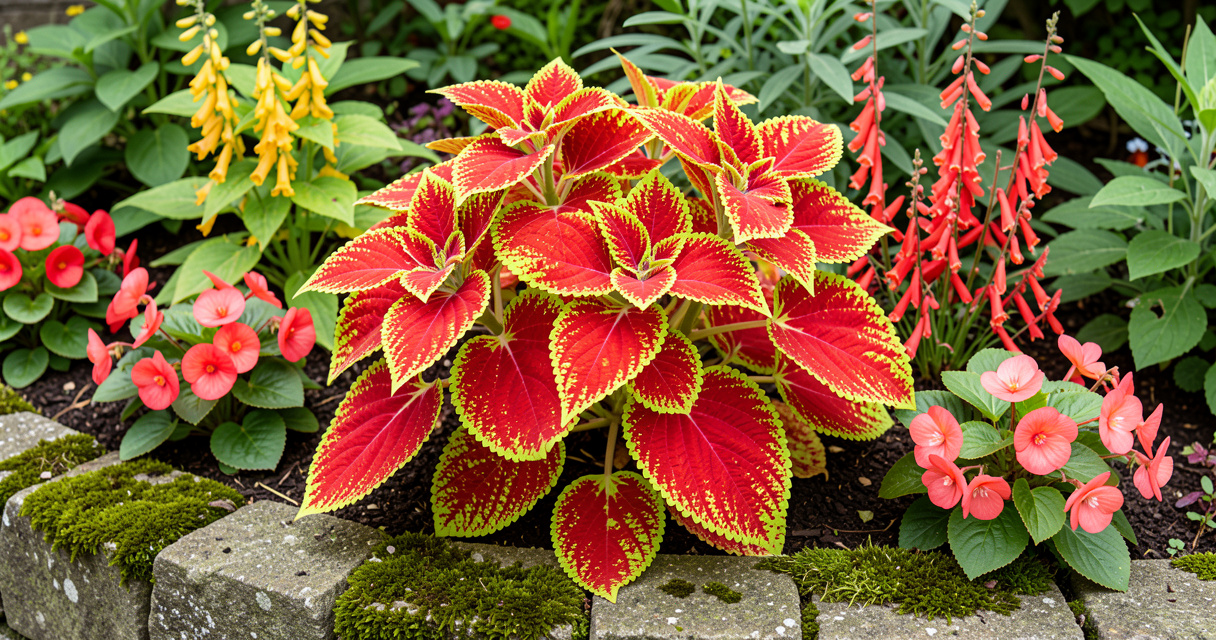
I reach for annual flowers for shade whenever colour needs to happen now: filling the void above a dormant ephemeral, dressing a rental patio that cannot accept permanent plantings, or plugging a gap while slow perennials bulk up. Annuals cost more per plant but yield a full season of effect, so buy fewer and buy better. How many plants fill a square foot? Six to nine for impatiens and wax begonias at 6–8 inch spacing, three for coleus and caladium at 10–14 inches.
Flowering annuals for shade
Wax begonia is the most forgiving shade annual I know. It flowers nonstop from June to first frost in full shade, needs no deadheading, and shrugs off drought better than impatiens. Impatiens is the classic — nowhere richer in flower density — but it wants consistent moisture and will collapse overnight if a container dries out. Tuberous begonia delivers bigger, camellia-like blooms for hanging baskets. Torenia (wishbone flower) is a smaller, tougher plant that handles humid shade where impatiens struggle with downy mildew. Browallia and ageratum round out the palette with blue and lavender tones that are hard to source in perennials.
Foliage-first annuals that light up dark corners
Where flowers fail, foliage performs. Coleus has been utterly reinvented in the last fifteen years — the modern types hold their colour in full shade and do not stretch the way the old varieties did. ‘Kong Rose’ with lime veining, ‘Wicked Hot’ in deep burgundy, and ‘Colorblaze’ series in bronze are my consistent performers. Caladium is the cool cousin: heart-shaped leaves in white, pink, or red on long petioles, ideal for shaded containers where you see the foliage from below.
| Annual | Type | Light needs | Height | Container friendly |
|---|---|---|---|---|
| Wax begonia | Flower | Full shade to partial | 6–12 in | Yes |
| Impatiens | Flower | Full to partial shade | 8–24 in | Yes |
| Tuberous begonia | Flower | Partial shade | 12–18 in | Yes |
| Torenia (wishbone flower) | Flower | Partial shade | 8–12 in | Yes |
| Browallia (bush violet) | Flower | Partial shade | 12–24 in | Yes |
| Ageratum | Flower | Partial shade | 6–24 in | Yes |
| Coleus | Foliage | Partial to full shade | 12–36 in | Yes |
| Caladium | Foliage | Partial to full shade | 12–24 in | Yes |
Spacing, pinching, and moisture
Pinch out the growing tip of coleus and impatiens once when they reach 6 inches. You sacrifice a week of height and gain a branched, fuller plant that flowers or colours across a wider surface. Water shade containers every second or third day in summer — shade slows evaporation but containers dry fast, and consistent moisture matters more than volume. Once a week, water deeply until it runs from the drainage hole. Don’t overthink it: give them even moisture, a weekly pinch, and they will perform.
Light and plant type get most of the attention, but soil moisture is the variable that actually decides whether these plants survive their first winter.
Dry Shade vs. Moist Shade: Matching Flowers to Your Soil
Two beds can both get four hours of dappled sun and still want completely different plant lists, because one drains like a sieve and the other holds water like a sponge. According to Breck’s shade perennial guide, shade plants tend to be more moisture tolerant than sun-loving plants, and many are native to woodlands and other naturally moist locations. That is generally true — but it means that when you have dry shade, you are fighting the plant’s instincts, and the smart move is to plant drought-adapted species instead of trying to fix the soil permanently.
Plants for dry shade
Autumn fern (Dryopteris erythrosora) is the star — it handles dry shade better than almost any other fern, and the new fronds emerge copper-pink. Carex pensylvanica makes a soft, semi-evergreen ground cover that tolerates root competition. Dwarf hosta varieties such as ‘Blue Mouse Ears’ cope with dry soil longer than the big-leaved types. Saxifraga stolonifera (strawberry begonia) spreads by runners across dry shade with marbled leaves and airy white flowers. Lamium and ground-cover Phlox (P. stolonifera) close the soil surface and suppress weeds.
Plants for moist or heavy clay shade
This is the easy end of the spectrum. Astilbe, hosta, ferns, lily of the valley, and most woodland perennials evolved in damp forest soil and will grow luxuriantly in heavy clay that drains slowly. Ligularia and Rodgersia are the bold foliage options here. Avoid dry-adapted alpines and Mediterranean herbs — rosemary and lavender will rot in clay shade within a single wet winter.
Improving shade soil before you plant
Two seasons of prep pay off faster than any fertilizer. Spread two inches of compost over the bed in autumn and let the worms work it down — no digging required in an established bed with roots underneath. Mulch with shredded leaves or bark fines to a depth of three inches, pulling it back from the crown of every plant so nothing sits wet against the stems. Water deeply once a week for the first growing season and once every ten days in the second. After that, the plant will tell you what it needs.
| Condition | Signs in the soil | Best flowering picks | What to avoid |
|---|---|---|---|
| Dry shade | Bone-dry 2 in (5 cm) down, crumbly texture, visible root mat | Autumn fern, Carex pensylvanica, dwarf hosta, Saxifraga stolonifera, Lamium, ground-cover Phlox | Astilbe, Ligularia, moisture lovers |
| Moist or clay shade | Dark, cool, holds shape when squeezed into a ball | Astilbe, hosta, ferns, lily of the valley, woodland perennials | Drought-adapted alpines, Mediterranean herbs |
Why shade under trees is dry shade
Tree canopies act as an umbrella, intercepting 30–60% of rainfall before it reaches the soil. Tree roots then compete for whatever water remains. A building overhang or a wall on the west side does the same thing. So most shade beds under mature trees are dry shade by default, even if the surrounding garden is moist. Plan the plant list accordingly and you will not be disappointed.
Speaking of trees, under-canopy planting deserves its own section, because it fails for reasons unrelated to light.
Flowers That Grow in Shade Under Trees
Why tree roots make shade planting hard
Two problems conspire under a mature tree. The first is root competition — the tree has already claimed the water and nutrients in that soil, and any perennial you plant must fight for the scraps. The second is that the light itself changes seasonally: the bed gets sun in April while the tree is bare, then plunges into shade from June onward. That spring window belongs to ephemerals and bulbs. Summer and autumn colour has to come from shade-adapted perennials and annuals that can cope with the darker half of the year.
A planting method that protects the tree
- Choose small plugs or 9 cm (3.5 in) pots rather than large specimens — they slip between major roots without cutting.
- Dig individual planting holes with a trowel, feeling for roots as you go. If you hit a root thicker than your thumb, move the hole.
- Never add a raised soil mound over the root flare. Backfill only to the level the plant was growing at in its pot.
- Water deeply twice a week for the first growing season, and once a week through the second. Ten seconds with a hose will not do it — give each plant four to five litres.
- Mulch with two inches of compost, keeping a 2-inch gap around every stem and trunk. No mulch volcanoes.
Best low-water picks for tree shade
Stick with the dry-shade list, but add woodland species that evolved under canopies. Toad lily and dicentra both handle root competition as long as you water them through establishment. Hellebores are the most forgiving under trees — their deep, fleshy roots tolerate dryness better than most. Let ferns and lily of the valley naturalize as ground cover in the corners where you cannot reach with a trowel anyway, and tuck the flowering species into the gaps you can access.
Protect the root flare
Never raise the soil line over the base of the trunk. Even 2 inches of extra soil compacts into a barrier that slowly kills the tree over five to ten years. Equally, do not cut major roots — a cut root larger than your wrist can destabilize the tree and opens a wound that will not heal. Small sacrifices in planting size and speed are the price of keeping the tree.
Individual plant choices solve individual spots. A shade garden, though, needs design logic that ties all of them together into something that reads as intentional from March to October.
Designing a Shade Garden That Blooms From Spring to Fall
Shade garden design is not about finding one magical plant. It is about building a system in which something is always doing the work of being beautiful. That system has three layers.
Build the foliage backbone first
Foliage is what carries the bed when nothing is blooming — which, in a shade garden, is most of the time. Start with leaf texture and colour: coarse hosta next to fine fern next to mid-texture heuchera creates visual rhythm without a single flower. Aim for at least one evergreen or semi-evergreen element (helle bore, heuchera, autumn fern) so the bed has structure through winter. Get this layer right and you can forgive almost any gap in the flowering calendar.
Layer by height and bloom time
Tall astilbe and toad lily at the back — 30 to 36 inches. Mid-height hosta and hellebore in the middle layer, 18 to 24 inches. Heuchera, Lamium, and ground covers at the front, 8 to 12 inches. Within that frame, distribute bloom times across the season: hellebore in winter, bleeding heart and bluebells in spring, astilbe and hosta in summer, toad lily and Japanese anemone in autumn. Now the bed has something flowering — or at least something looking interesting — for nine months of the year.
Fill the midsummer gap
June and July are the danger zone in a shade bed, because the spring ephemerals have gone dormant and the autumn stars have not yet started. This is the exact slot where annuals are worth the money. A row of wax begonias or a few coleus plugged into the gap transforms the bed’s midsummer performance for the cost of a single nursery visit.
| Month | What is flowering | Foliage carrying the bed | Gap-filler to add |
|---|---|---|---|
| March | Hellebore | Evergreen heuchera, unfurling fern fronds | — |
| April | Virginia bluebells, early bleeding heart | Fresh hosta shoots | Pansies if hard frosts have passed |
| May | Bleeding heart peak, Polemonium | Hosta unfolding, heuchera | First coleus once nights stay warm |
| June | Astilbe early, hosta flower spikes | Hosta, heuchera | Wax begonias |
| July | Astilbe peak, wax begonias | Coleus, caladium, hosta | Impatiens |
| August | Impatiens, begonias | Coleus, caladium | Torenia |
| September | Toad lily starting, Japanese anemone | Coleus, ageing hosta | Late astilbe varieties |
| October | Toad lily, Japanese anemone | Hosta turning gold | — (let seedheads stand) |
Let me give you a real example, because the theory is only useful when it meets a specific garden. A gardener I worked with remotely, in Zone 6, had a dry north-facing foundation bed against the front of her house — 4 metres long, 1.2 metres deep, sun only from 8 to 10:30 am. She planted it in year one with sun-loving perennials (lavender, coreopsis, catmint), and by August everything was leggy and miserable. That is the mistake almost everyone makes first time around.
In year two we replanted it with a three-layer scheme: dwarf hosta ‘Blue Mouse Ears’ and autumn fern at the front, Heuchera ‘Caramel’ in the middle, toad lily and Polemonium reptans behind, and a plug of wax begonias where the bluebells had gone dormant the previous spring. By the following July, the bed was so full you could not see the soil. It bloomed from late March (hellebores) through October (toad lily), and the only interventions were a compost top-dress each spring and a weekly deep water in the first two summers. The plant will tell you what it needs — you just have to be honest about the light before you buy.
Even a well-designed shade garden produces its fair share of problems. Most of them have simple diagnoses, and most of the fixes are cheaper than you would expect.
Shade Garden Problems and Fixes: Leggy Growth, No Blooms, Pests
Why shade plants get leggy
Stretched, floppy growth — long internodes, small pale leaves, stems that lean toward the nearest window — almost always means one of two things: not enough light for that particular plant, or too much nitrogen in the soil. Nitrogen pushes soft vegetative growth, and in shade that growth cannot be supported. The fix is blunt but effective: stop feeding, pinch growing tips back by a third, and move the worst offenders to a brighter spot. If a sun plant is in full shade, no amount of pinching will fix the underlying problem.
Why shade plants stop blooming
Lush leaves with no flowers is the classic shade complaint, and it has three usual causes. Overfeeding ranks first — reduce fertilizer and the plant will usually flower the following season. Shade that is deeper than the plant tolerates ranks second, and there is no clever workaround: relocate the plant. The third cause is age: crowded clumps of astilbe, heuchera, and hosta bloom less and less as they matt together. Divide every three or four years in early spring and the flowering will reset.
Pests and disease in damp shade
Shade gardens are slower to dry than sunny beds, and slow-drying foliage invites trouble. Powdery mildew — the white dusting on phlox and monarda — comes from poor air circulation, not from wet weather alone. Thin the clump, water at the base, and remove the worst leaves. Slugs and snails are the price of a damp, mulched shade bed, especially around hosta. Barriers of coarse grit, evening beer traps, and encouragement of ground beetles and frogs will keep them in check without pellets. Deer browsing is a regional problem, but the highest-resistance picks are hellebore, toad lily, Mertensia, and Polemonium reptans.
- Symptom: stretched, floppy stems — Cause: insufficient light or excess nitrogen — Fix now: stop feeding, pinch back by a third — Prevent: reposition to a brighter bed
- Symptom: all leaves, no flowers — Cause: overfeeding or too deep shade — Fix now: halve the fertilizer, look for a brighter spot — Prevent: feed at half the rate recommended for sun borders
- Symptom: white powdery coating on leaves — Cause: poor air circulation in damp shade — Fix now: thin the clump, water at the base only — Prevent: space plants to full mature spread
- Symptom: shredded or missing leaves overnight — Cause: slugs, snails, or deer — Fix now: grit barrier, evening removal, beer traps — Prevent: plant high-resistance species such as hellebore and toad lily
Feed shade perennials at half strength
Here’s what I’d do with any shade border: feed once in early spring with a slow-release organic fertilizer at roughly half the rate the label recommends for a sun border, and rely on compost top-dressing for the rest of the year. Shade plants need less because they do less. Overfeeding them produces leaves at the expense of flowers — exactly the opposite of what you want.
Frequently Asked Questions
What flowers grow in full shade?
Full shade — under three hours of direct sun but still bright indirect light — supports hosta, astilbe, hellebore, bleeding heart, toad lily, impatiens, wax begonia, and coleus. Deep, dense shade supports far fewer blooms and is best treated as a foliage garden with ferns, lily of the valley, and plain-leaved hostas.
What is the easiest flower to grow in shade for beginners?
Wax begonias and impatiens flower reliably in both containers and beds with almost no intervention. Hosta is the most forgiving perennial for long-term planting, returning every year and asking only for consistent moisture in its first two summers. Watering consistency is the only real requirement.
Do hydrangeas grow in shade?
Most hydrangeas prefer morning sun with afternoon shade, and panicle types such as ‘Limelight’ need more sun to bloom well. In full shade they usually survive but produce few or no flowers. Position them where they receive bright light or filtered sun and they will reward you.
What flowers bloom in shade in late summer?
Toad lily is the standout late-season shade bloomer, joined by Japanese anemone and continued color from begonias and coleus. Many spring shade bloomers have gone dormant by this point, which is precisely why late-season picks matter so much in a shaded border.
Can I grow flowers in a north-facing garden?
Yes. North-facing beds receive bright indirect light rather than deep darkness, so partial-shade perennials and shade annuals grow well there. Hosta, astilbe, Heuchera, and begonias make a strong starting palette, and hellebores will give you flowers in the middle of winter.
Do shade plants need fertilizer?
They need less than sun plants, and overfeeding produces leaves at the expense of flowers. Apply a slow-release feed at roughly half the label rate in early spring and use a compost top-dress instead of repeated liquid feeding through the season.
What flowers grow in shade in Zones 5, 6, and 7?
Hardiness zones describe winter cold, not light, and many shade perennials are listed as hardy across Zones 3–8, including Mertensia virginica and Polemonium reptans. Most gardeners in temperate zones can grow the full shade palette described in this article.
The Shade You Already Have Is the Garden You Actually Get to Plant
Here is the whole argument in four lines. Shade is not one condition — identify whether your bed is light, partial, full, or deep shade before you buy anything. Perennials build the structure (hosta, astilbe, hellebore, toad lily) while annuals deliver instant color and fill the seasonal gaps that spring ephemerals leave behind. Soil moisture and tree-root competition decide survival more than light alone, so match plants to dry or moist shade rather than fighting the soil. And foliage carries the bed when nothing is blooming — which, in shade, is most of the time.
The real shift is not learning a longer plant list. It is accepting that you are designing for the conditions you have instead of the ones you wish you had. That is the difference between a shade garden that disappoints for years and one that gets a little better every season. So — which neglected corner of your garden, the one you walk past without looking, will you plant first this season?

I’ve spent over fifteen years in botanical gardens and nurseries across the Netherlands and Belgium. Now I garden in Haarlem and write what I wish someone had told me sooner. No fluff — just what actually works.